
How to Cold Contact: A B2B Playbook for 2026
Your team is probably doing at least one of these right now. Buying bigger lists. Sending more sequences. Asking reps to increase call blocks. Watching opens, clicks, and activity counts while booked meetings stay flat.
That pattern burns budget fast.
Modern B2B outreach is less forgiving than it used to be. Buyers are saturated, inboxes are crowded, and weak targeting gets punished twice. First with no response. Then with damaged deliverability, lower connect rates, and sales reps who stop believing the channel works. If you want to know how to cold contact in 2026, start with the right objective: book qualified meetings with accounts that can buy, not just generate surface-level engagement.
That changes everything. It changes how you build lists, how you write copy, which channels you use, how long you follow up, and whether you should run outreach in-house at all.
Why “More Dials, More Emails” Is a Losing Strategy
A rep starts the week with a bigger list, a higher dial target, and another email sequence. Activity goes up. Meetings do not.
That result is common because volume magnifies whatever is already in the system. If the list is weak, you reach more bad-fit accounts. If the copy is generic, you send more reasons to ignore you. If the sending setup is sloppy, you create more deliverability risk. More output only helps after the fundamentals are in place.
This is the part many teams miss. Cold outreach is not a pure volume game anymore. It is a conversion system with technical constraints. Every extra touch has a cost. Some costs are obvious, like rep time and data spend. Others show up later, like lower inbox placement, poorer connect rates, and a team that stops trusting outbound because the process keeps producing low-quality conversations.
The practical question is not whether your team should do more. The question is whether each touch has a realistic chance to produce a qualified meeting.
That standard changes how you judge performance. Open rates can look fine while meetings stay flat. Reply rates can rise because the message attracts curiosity from people who will never buy. Call activity can increase while connect quality drops because reps are working through the wrong accounts. A performance-minded team tracks booked meetings, show rates, opportunity creation, and pipeline from outreach. The rest only matters if it improves those numbers.
Channel choice gets misread for the same reason. Email and calling are not opponents. They work best as coordinated touches inside the same system, with trade-offs around speed, cost, deliverability, and contact coverage. If you are deciding where each channel fits, this comparison of cold calling vs cold emailing is a useful reference.
The hard truth is simple. Bad outreach scales failure faster.
I have seen companies burn through a valuable market segment in one quarter because they pushed volume before they fixed targeting, data quality, domain setup, and message-market fit. The short-term dashboard looked busy. The actual economics were poor. Reps spent time on accounts that would not convert, leadership paid for tools and data that did not produce pipeline, and future campaigns got harder because the market had already seen irrelevant outreach from the same brand.
The teams that consistently book meetings treat outbound as a precision channel first and a scale channel second. They use volume after they know who converts, which message earns attention, which channel mix gets responses, and which setup protects deliverability. That is how cold contact produces pipeline instead of noise.
Building Your Ideal Prospect Blueprint
Most cold outreach failures start before the first email or call. The message gets blamed, but the primary issue is usually list strategy. If you contact accounts with weak fit, wrong timing, or bad contact data, even strong copy won’t save the campaign.
The first job is building a clear prospect blueprint. Not a vague persona. A usable targeting model your team can source, segment, and test.

Start with the account before the contact
A lot of teams start by hunting job titles. That’s backward. Start with the kind of company that is most likely to buy, then identify the people inside it.
Build your ideal customer profile around a few practical filters:
-
Firmographics. Industry, company size, region, business model, and maturity stage.
-
Technographics. The tools they already use, especially if your product replaces, complements, or integrates with them.
-
Commercial fit. Proven buying ability, active go-to-market motion, and a problem your offer can solve now.
-
Trigger events. Funding, leadership changes, expansion into new markets, new hires, or product launches.
If you’re formalizing this from scratch, a detailed guide to building a B2B ideal customer profile helps turn those filters into a repeatable model.
The goal is simple. Reduce waste before the campaign starts.
Use data quality as a performance lever
A lot of outreach teams treat contact data like admin work. It isn’t. It’s a conversion lever.
A proven methodology for outperforming the industry average response rate of 5.1-8.5% starts with in-depth market research and verified databases. Teams with high-quality contact data achieve open rates up to 24% and can double their response rates with advanced personalization, according to TryKondo’s analysis of cold networking success rates.
That has two direct implications:
-
List building is not a one-time scrape.
-
Verification is worth the friction.
Use reputable B2B data providers, then verify again before launch. In practice, that means combining sources, checking role relevance manually on priority accounts, and removing stale or ambiguous records before they hit sequencing tools.
Good outreach teams don’t ask, “How many contacts do we have?” They ask, “How many contacts are accurate, relevant, and worth a touch?”
Segment by buying context, not just title
“VP of Sales” is not a segment. A sales leader at a bootstrapped startup has different priorities than one at a funded company building outbound for the first time. The title may match, but the message won’t.
Break your list into groups that change the conversation:
| Segment type | What to look for | Why it matters |
|---|---|---|
| Growth stage | Early traction, expansion, mature scale | Budget, urgency, and buying process differ |
| Operational environment | Existing tools, team structure, outbound maturity | Shapes your angle and objections |
| Trigger-based segment | Recent funding, hiring, leadership changes | Gives you a timely reason to reach out |
| Geography | Region and market | Affects compliance, messaging style, and channel preference |
That segmentation gives your copywriter and SDR something useful to work with. Instead of “we help SaaS companies,” the team can say, “we help funded SaaS teams that have sales capacity but inconsistent pipeline generation.”
Later in the process, a video walkthrough often helps teams pressure-test segmentation assumptions before launch:
Build a list you can defend
Before you send anything, review the list as if you had to justify every contact to your head of sales.
Ask:
-
Would this company plausibly buy in the near term?
-
Is this the right person for the problem we solve?
-
Do we have a real reason to contact them now?
-
Can we personalize without inventing relevance?
If the answer is no, remove them.
That’s the practical side of how to cold contact well. You don’t earn meetings by contacting more strangers. You earn them by contacting fewer, better-matched prospects with enough context to sound informed.
Choosing Your Cold Contacting Channels
A rep sends 400 emails, gets a handful of replies, and books nothing worth taking to sales. The problem usually is not effort. It is channel choice.
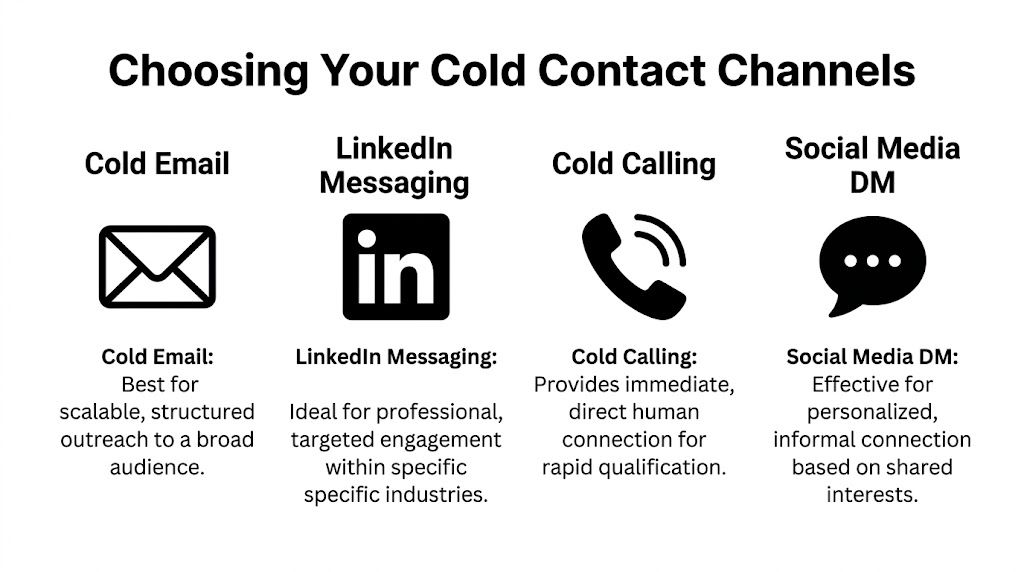
Channel selection decides whether outreach turns into qualified conversations or just activity. If your buyers screen unknown numbers, a call-first motion burns rep hours. If they live in email but your setup is weak, good messaging still lands in spam. If trust matters before a meeting, LinkedIn can improve response quality, but it also adds manual work and slows volume. Strong outbound programs choose channels based on buying behavior, rep capacity, and meeting economics.
Cold email fits scale, testing, and process control
Email remains the backbone for many B2B outbound programs because it is measurable and repeatable. You can test different value propositions across segments, track reply patterns, and build a process the team can run every week.
That does not make it easy.
Cold email only works well when the infrastructure is sound. Domain setup, inbox rotation, list quality, and segmentation all affect whether good copy even gets seen. Teams that judge email only by open rates usually miss the essential question. Are the replies turning into meetings with accounts your sales team wants?
Use email when you need:
-
Coverage across a defined market
-
Fast feedback on positioning
-
A channel that supports structured experimentation
-
A documented workflow other reps can follow
If your team needs help tightening the copy side of that process, this guide on how to write a cold mail that gets replies is a useful companion.
Cold calling fits speed, qualification, and higher intent signals
Calling gives you something email cannot. Immediate clarity.
A live conversation exposes whether the contact owns the problem, whether timing is real, and whether the account is even worth pursuing. That is why experienced outbound teams still keep calling in the mix, especially for higher-value deals. The trade-off is obvious. Calling requires better data, better reps, and more discipline around timing and follow-up.
It also has less room for weak execution. A poor opener, a bad list, or random dialing windows kill performance fast.
Use calling when:
-
Deal value justifies rep time
-
Qualification matters more than raw reply volume
-
Your reps can handle objections live
-
You need fast signal on fit and urgency
LinkedIn works when credibility affects response quality
LinkedIn is rarely the highest-volume channel. It is often the channel that makes the other two work better.
A prospect who ignores your email may still check your profile after seeing your name twice. A contact who will not answer a cold call may accept a connection request if the profile and context make sense. This matters in markets where trust, title, and professional identity influence who gets a response. It also matters when founders or senior operators are part of the outreach, because buyers often respond differently to visible expertise than to a generic SDR profile.
For teams building that motion, these strategies to generate leads on LinkedIn can help sharpen profile positioning and outreach flow.
LinkedIn works best when:
-
The ICP is active there
-
Social proof improves trust
-
You are supporting email and calls, not replacing them
-
The outreach is light, specific, and tied to a real reason for contact
LinkedIn performs poorly when reps send instant pitches after connecting or copy the same message they already sent by email.
Social DMs are niche channels, not a default outbound system
Social DMs can produce meetings in the right motion. Founder-led offers, creator partnerships, niche communities, and some agency services can all benefit from direct outreach on platforms where the buyer already spends time.
For standard B2B prospecting, though, this is usually a secondary channel. The tone is less formal, expectations are different, and the line between relevant and intrusive is thin. If you cannot explain why that platform makes sense for that buyer, skip it.
Build a channel mix around meeting quality
The strongest programs do not ask one channel to carry the whole pipeline. They assign jobs to each channel.
A practical mix often looks like this:
| Channel | Best use case | Main risk | What it is best at |
|---|---|---|---|
| Cold email | Scaled prospecting across defined segments | Deliverability issues and low relevance | Testing messaging and generating broad coverage |
| Cold calling | Fast qualification and live objection handling | Low connect rates if timing and data are weak | Confirming fit and urgency quickly |
| LinkedIn messaging | Trust-building around identity and context | Generic outreach that feels copied | Warming accounts before or between other touches |
| Social media DM | Niche or founder-led outreach | Poor platform fit and intrusive tone | Opening doors in communities where buyers already engage |
That mix is why performance-focused teams measure more than opens and replies. The scoreboard is booked meetings, show rate, qualification rate, and pipeline created. If email generates replies but calling uncovers no pain, the message is attracting the wrong people. If LinkedIn increases acceptance but no one books, the profile may be credible while the offer is still weak.
This is also where the build-versus-buy decision starts to matter. Multi-channel outbound gets expensive once you factor in infrastructure, list sourcing, copy testing, call blocks, LinkedIn management, and the management time needed to keep all of it tight. If your internal team cannot support that consistently, a pay-per-meeting model can make the economics easier to justify because you are buying qualified conversations instead of funding trial-and-error activity.
Choose channels the same way you would choose hires or ad spend. Based on expected return, operational burden, and how reliably each one produces sales-ready meetings.
Crafting Outreach Messages That Actually Get Replies
A rep sends 200 emails, gets a handful of opens, two polite replies, and no meetings. That usually is not a volume problem. It is a message problem.
Cold outreach works when the buyer can answer three questions in seconds. Why are you reaching out to me, why now, and why should I care enough to respond? If the message misses any of those, opens do not matter. Replies do not matter either if they come from people who were never a fit to begin with.
Write from relevance to action
The strongest cold messages are built for one job. Start a qualified conversation. They usually include four parts:
-
A real reason for reaching out now
-
A problem the prospect is likely dealing with
-
A clear explanation of how you help
-
A small next step
Teams weaken this by leading with their company pitch, stacking credentials, or asking for too much too early.
Bad version:
Hi Sarah, we help B2B companies scale pipeline with structured outbound systems. I’d love to show you how we can support your growth goals. Open to a quick chat next week?
That message says almost nothing. It could go to any VP, at any company, in any quarter.
Stronger version:
Hi Sarah, noticed your team is hiring outbound reps while entering a new segment. That usually creates pressure to build pipeline before the new team is fully ramped. We help teams improve list quality, messaging, and meeting booking so reps spend more time selling. Worth a quick conversation if outbound consistency is a priority this quarter?
The difference is not clever copy. It is context. The second version gives the buyer a reason to believe the outreach is relevant to an actual business problem.
If you want a tighter breakdown of structure, this guide on how to write a cold mail is a useful reference.
Personalization needs to change the message
Surface-level personalization does not carry much weight anymore. Adding a first name, company name, or a line about a recent post rarely moves performance unless it changes the angle of the outreach.
Useful personalization comes from signals that affect priorities:
-
Company events like expansion, new hires, funding, pricing changes, or a product launch
-
Role pressure tied to pipeline coverage, hiring plans, retention, or territory growth
-
Visible gaps in messaging, follow-up, response handling, or market focus
-
Industry language that shows you understand how that buyer evaluates risk and ROI
Here is the test I use. If you can delete the personalized line and the email still makes the same argument, that line was decoration, not relevance.
There is a trade-off here. Deep personalization takes time and limits volume. That is why high-performing outbound programs do not personalize every account the same way. They reserve heavier research for high-value targets and use sharper role-based messaging for the rest. The goal is not to sound custom. The goal is to book meetings with the right accounts efficiently.
Keep the CTA small
A cold message should ask for a low-commitment next step. Asking for a demo, a full audit, or 30 minutes on the first touch creates friction that is hard to justify from a stranger.
Better CTAs include:
-
Open to a brief conversation?
-
Worth comparing notes?
-
Should I send a quick idea?
-
Relevant enough to discuss?
These asks work because they match the temperature of the relationship. You are trying to start a sales conversation, not force the buyer into one.
Copy and sequence need to work together
A good first message rarely carries the whole result. The copy has to leave room for follow-ups that add something useful, whether that is a different pain point, a sharper example, or a narrower ask. That is one reason solid outbound teams write messages as part of a sequence, not as isolated emails. This overview of drip campaign best practices is useful if you are building that structure from scratch.
The technical side still decides whether your copy gets seen
Strong copy does not fix weak setup. If your sending domain is poorly configured, your inboxes are cold, or your list quality is loose, good messaging gets buried before a buyer can judge it.
At a minimum, outbound teams need authenticated domains, warmed inboxes, clean data, and regular monitoring of inbox placement. I have seen companies rewrite copy five times when the actual issue was that their infrastructure was suppressing deliverability. That is one of the clearest differences between DIY outreach and a performance-based partner. The partner is not only writing copy. They are managing the conditions that let the copy produce qualified meetings.
A practical message checklist looks like this:
-
Lead with buyer context
-
Name one clear problem
-
Explain the offer in plain language
-
Ask for a small next step
-
Send from infrastructure you trust
-
Keep the outreach compliant with applicable rules
Compliance still matters, but the practical standard is simple. Contact relevant business prospects, use accurate information, keep claims honest, and make opt-out and sender identification clear where required.
Strong outreach rarely sounds flashy. It sounds well aimed.
Designing a Relentless Follow-Up Cadence
The first message rarely does the job. Not because your copy was bad, but because inboxes are crowded, calls get missed, and timing is uneven. A lot of prospects who could become good meetings don’t respond on touch one.
The mistake is how teams react. They either stop too early or they follow up with useless bumps that add no new reason to engage.
A strong cadence is persistent, varied, and cumulative. Each touch should either sharpen relevance, change channel, or introduce a slightly different angle.
Stop sending empty follow-ups
“Just checking in” is what reps send when they ran out of ideas.
It doesn’t help the buyer make a decision. It doesn’t add context. It doesn’t deepen the case for a meeting. It just reminds the prospect that you’re still waiting.
A better follow-up sequence introduces movement. One email references a trigger event. The next highlights a specific pain point for that role. A call tests urgency. A LinkedIn touch adds recognition. A later email narrows the ask or offers a simpler next step.
According to Gem’s cold outreach guidance, a five-stage sequence can yield twice as many replies as one-off outreach, and 6-8 touchpoint omnichannel sequences using email and LinkedIn produce a 25% uplift in qualified meetings for SaaS companies.
That’s why shallow three-touch sequences often underperform. They give up before the prospect has enough reasons to respond.
A practical omnichannel cadence
This is the kind of pattern that works better than repeated same-message emailing:
-
Touch one. Initial email with clear context and tight CTA.
-
Touch two. Follow-up email with a new angle, not a bump.
-
Touch three. LinkedIn profile view or connection request with light context.
-
Touch four. Call attempt focused on quick qualification.
-
Touch five. Email that reframes the problem or narrows the ask.
-
Touch six and beyond. Additional touches only if you still have relevance to add.
For teams building these flows, this resource on drip campaign best practices is useful because cadence only works when timing, message variation, and automation are aligned.
And if your team needs examples for email follow-ups specifically, these sales follow-up email templates are a practical starting point.
Most prospects aren’t rejecting you on the first touch. They’re ignoring a message that hasn’t yet earned priority.
Know when to persist and when to exit
Persistence isn’t endless repetition. It has to stay tied to relevance.
Keep following up when:
-
the account fits your ICP tightly
-
the timing signal is still valid
-
you can add a fresh angle
-
a call or social touch might work better than another email
Back off when:
-
the role is clearly wrong
-
the account isn’t commercially viable
-
the sequence has become repetitive
-
the contact indicates no interest or no fit
The discipline here matters. Some teams mistake aggressiveness for rigor. Good outbound is rigorous because it tracks context, adjusts by signal, and stops wasting touches where there is no path.
Automation should assist judgment, not replace it
Sequencing tools are useful. They keep execution consistent and prevent reps from dropping leads too early. But automation can also multiply bad habits.
Use it for task timing, touch orchestration, and testing. Don’t use it as an excuse to send seven versions of the same message with a different opening line.
A relentless follow-up cadence doesn’t feel robotic from the buyer’s side. It feels like a person who knows why they’re reaching out and has more than one reason to be taken seriously.
From Data to Deals When to Outsource Your Outreach
A sales team can send 5,000 emails, log 200 calls, and still end the month with an empty calendar. That usually means the outreach program is being measured like a marketing activity instead of a meeting-generation system.
If outbound is supposed to create pipeline, judge it by pipeline.
Watch meeting quality, not just message activity
The useful metrics sit close to revenue and sales capacity.
At minimum, track:
-
Positive reply rate. Replies that show buying interest, not polite brush-offs.
-
Meeting booked rate. How often outreach turns into scheduled conversations.
-
Meeting-held rate. Whether booked calls happen.
-
Qualification rate. Whether those meetings match your ICP, deal size, and buying criteria.
-
Opportunity rate. Whether sales can move the meeting into a real pipeline stage.
That last point gets missed often. A campaign can generate replies and even booked calls while still wasting rep time. If the meetings are junior contacts, poor-fit accounts, or prospects with no active pain, the program is producing activity, not pipeline.
Outsource when execution complexity starts stealing selling time
Running outbound in-house looks cheaper on a spreadsheet than it feels in practice.
Someone has to source data, clean it, verify emails, manage domains and inboxes, test copy, monitor deliverability, build sequences, route replies, and close the loop with sales after meetings happen. If that work sits with reps, they prospect instead of selling. If it sits with marketing, message-market fit often drifts because the team is too far from live objections. If it sits with a founder, it usually breaks the moment priorities shift.
That is the trade-off.
Outsource when your team can close deals but cannot maintain outbound quality every week. Common signals include:
-
Reps spend too much time building lists and too little time running calls
-
List quality drops as soon as volume increases
-
Reply quality is inconsistent across campaigns
-
Deliverability problems make performance hard to judge
-
Leadership wants meetings booked, not another internal system to manage
At that point, outsourcing is less about convenience and more about economics. You are paying to get execution discipline, channel knowledge, and a faster path to a repeatable meeting engine.
A good example is a pay-per-meeting cold outreach agency model. It changes the buying decision. Instead of hiring for tooling, infrastructure, list operations, copy testing, and campaign management upfront, a company can tie more of the spend to held meetings that fit agreed criteria.
Add referrals after results, not just cold outreach at the top
Outbound should not carry the full burden of pipeline creation.
Teams that deliver strong outcomes for clients often ignore the lowest-friction source of qualified conversations: referrals. Once you have produced a result, asking for an introduction is not a side tactic. It is a channel. The economics are usually better than cold outreach because trust is already present and the context transfer is faster.
This matters for outsourcing decisions too. If your internal team is better at relationship expansion than top-of-funnel execution, keep referrals and account growth in-house, and get outside help for cold outbound infrastructure. That split is often more efficient than forcing one team to do both well.
The lowest-cost qualified meeting often comes from work you’ve already delivered successfully.
The Operational Question of DIY vs. Outsource
The decision comes down to control, speed, and cost of distraction.
Keep it in-house if you have strong product-market fit, clear ICP definition, someone who can own outbound operations, and enough volume to justify building the system properly. That can work well, especially when the feedback loop between outreach and sales is tight.
Outsource if your team needs qualified meetings sooner, lacks outbound infrastructure, or keeps losing momentum after the first few campaigns. In those cases, DIY usually creates hidden costs. Reps lose selling hours. leadership buys tools before process exists. Copy gets written without enough buyer signal. Results flatten, and the channel gets blamed for execution problems.
Cold contact still books meetings. The difference is whether the system behind it is built to produce conversations that sales actually wants.