
Cold Outreach Automation: Boost Results with cold outreach automation
Cold outreach automation isn’t just about using software to blast out emails. It’s about building an intelligent system to book qualified meetings on autopilot. We’re moving far beyond the old ‘spray and pray’ methods and into a world of smart, scalable personalization.
The Modern Blueprint for Predictable B2B Growth
Forget the high-level theory. This is our hands-on blueprint for building a cold outreach machine that actually fuels your sales pipeline, day in and day out. Old-school outreach fails because it treats people like numbers on a spreadsheet. A modern, automated approach allows you to scale predictably by getting the right message to the right person at the right time.
This guide gives you the core components we use to build these systems. We’ll help you shift from tedious manual work to a process that drives real, measurable results.
A well-oiled automation engine really comes down to a few key pillars. We’ve summarized them in the table below.
Pillars of Successful Cold Outreach Automation
| Pillar | Objective | Key Action |
|---|---|---|
| Targeting Precision | Engage only your most qualified prospects. | Develop a granular Ideal Customer Profile (ICP). |
| Technical Foundation | Maximize email deliverability and avoid spam. | Configure dedicated domains with proper authentication. |
| Personalized Sequencing | Mimic human conversation, but at scale. | Craft multi-touch sequences with custom variables. |
| Data-Driven Optimization | Continuously improve campaign performance. | Track metrics like positive replies and meetings booked. |
Getting these pillars right is the foundation for everything else. It’s the difference between a campaign that flops and one that consistently delivers.
This diagram breaks down the process into its three fundamental stages: targeting, the technical setup, and the actual sequence automation.
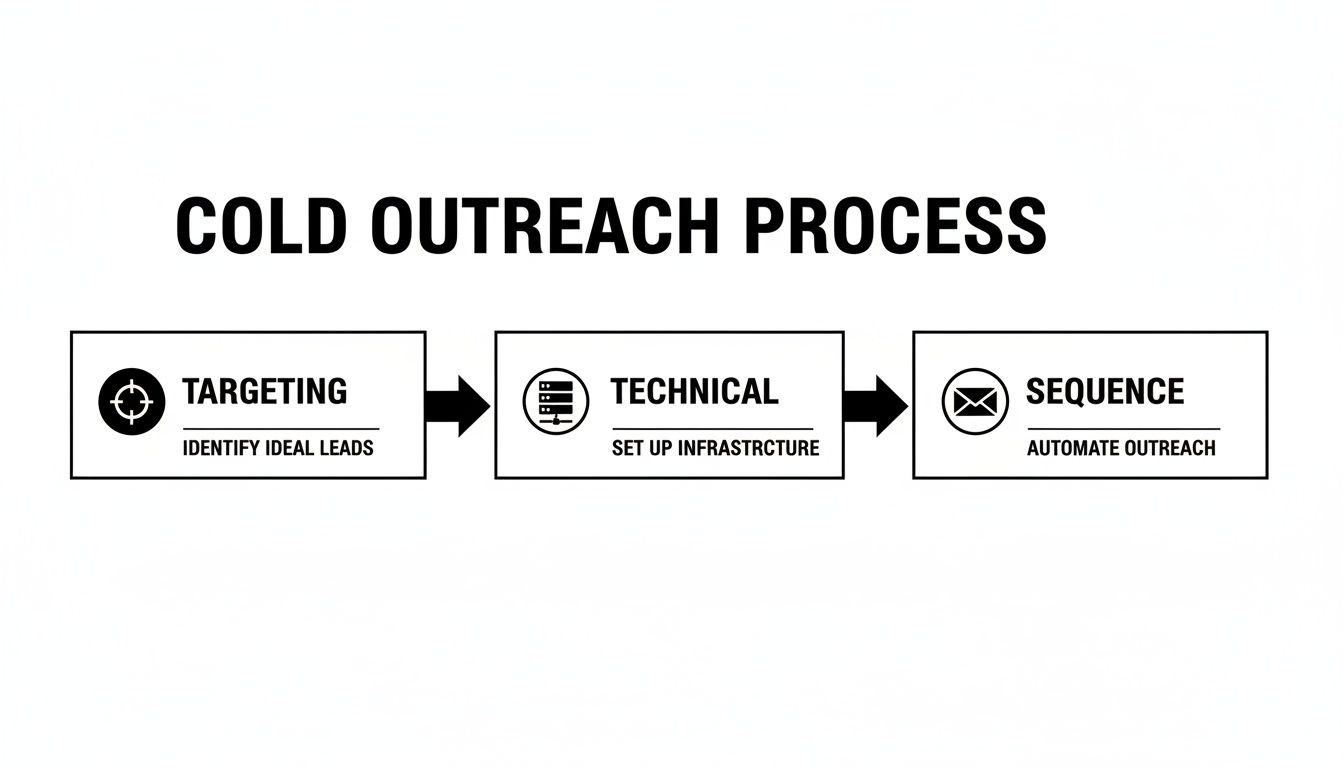
As you can see, success isn’t about one magic bullet. It’s a connected workflow where each step builds on the last. Building a solid system like this is an essential part of any modern B2B lead generation strategy. You can see how this fits into the bigger picture in our ultimate modern guide to B2B lead generation.
The critical difference between raw volume and smart automation is intent. One blasts messages hoping for a response; the other architects conversations designed to earn one.
Building Your Technical Foundation for Maximum Deliverability
Before you even think about scaling up your cold outreach, you have to get the technical foundation right. This is where most people trip up.
Let me be blunt: sending campaigns from your main corporate domain is a disaster waiting to happen. It’s the fastest way to get your domain blacklisted, which can cripple your entire company’s ability to send and receive emails. One bad move here can haunt your sender reputation for months.
The only professional way to do this is by creating separate, dedicated domains just for your outreach. These are usually slight variations of your main domain. For example, if your company is , you might buy or . This simple step isolates all your cold emailing activity, protecting your core business from any deliverability hiccups.
Getting Your Authentication Protocols in Order
Once you have your new domains, the next job is setting up email authentication. Think of these as a digital passport for your emails. They prove to inbox providers like Google and Microsoft that your messages are legitimate and not from a spoofer trying to impersonate you. Without them, you’re basically guaranteeing a one-way ticket to the spam folder.
You absolutely need to have these three protocols configured:
-
SPF (Sender Policy Framework): This is a simple record that lists all the servers authorized to send email on behalf of your domain.
-
DKIM (DomainKeys Identified Mail): This adds a digital signature to every email, which the receiving server checks to make sure the message wasn’t tampered with.
-
DMARC (Domain-based Message Authentication, Reporting & Conformance): This protocol is the enforcer. It tells inbox providers what to do with emails that fail the SPF or DKIM checks - like sending them to quarantine or rejecting them completely.
Getting these right is non-negotiable for anyone serious about cold email. We’ve laid out the entire process step-by-step in our guide on setting up your cold email infrastructure.
The Art of the Domain and Email Warm-Up
With your domains authenticated, you still can’t just start blasting hundreds of emails a day. New domains have zero sending history, which immediately looks suspicious to spam filters. You have to build a positive reputation over time, and that process is called “warming up.”
Tools like Instantly or Smartlead are built for this. They automate the warm-up by sending a gradually increasing number of emails to a network of high-reputation inboxes. More importantly, they generate positive engagement - like opens, replies, and marking your emails as important - which are all green flags for providers like Google and Microsoft.
This process usually takes a few weeks, but it’s the bedrock of good deliverability.
Don’t skip the warm-up. A properly warmed-up domain is the difference between a 2% bounce rate and a 40% bounce rate. It’s the single most important activity for long-term campaign success.
Nailing these technical details has never been more critical. The B2B space is noisy, and even the best operators are seeing challenges. While recent data shows B2B cold email open rates have dropped, a well-executed strategy still wins. For example, top agencies using automation are hitting over 10% reply rates because they obsessively monitor their SPF/DKIM/DMARC records to keep bounce rates under 2%. You can dig into more of the latest cold email metrics and trends on WarmForge.ai.
Mastering Prospect Targeting and List Building
Let’s be blunt: your cold outreach automation is only as good as the list you feed it. You can write the most brilliant copy in the world, but if you’re sending it to the wrong people, you’re just wasting your time and money.
Success starts by getting laser-focused on your Ideal Customer Profile (ICP). This goes way beyond basic info like company size or industry. Who are these people, really? What are their exact job titles? What specific problems keep them up at night?
Nailing down a detailed ICP is the foundation for finding prospects who actually need what you’re selling. If you want to go deeper, we’ve put together a complete guide on creating a B2B Ideal Customer Profile that gets real results.
Identifying Actionable Buying Signals
The best prospects are the ones already primed to buy. Your job is to spot the “trigger events” - those specific moments that signal a company is facing a problem you can solve or just got the budget to do something about it. These are your golden tickets to sending a timely, relevant message.
Keep an eye out for signals like:
-
New Funding Rounds: A fresh pile of cash often means new projects are getting greenlit and spending is about to ramp up.
-
Key Executive Hires: A new VP of Sales or CTO isn’t hired to keep things the same. They’re brought in to make changes and buy new tools.
-
Technology Adoption: See a company just switched to a new CRM? They might be looking for services that plug right into their new stack.
-
Rapid Hiring: A sudden spike in job postings, especially for one department, is a huge flag for growth - and the growing pains that come with it.
Identifying a trigger event is like finding the perfect moment to knock on the door. You’re not interrupting their day; you’re arriving with a solution right when they need one.
This is where you can get a serious edge. Using tools for AI for sales prospecting can automate this entire process, scanning public data and intent signals to surface these triggers for you. It saves your team from countless hours of mind-numbing manual research.
Building and Verifying Your Prospect List
Okay, you know who you’re targeting. Now it’s time to build the list. Data platforms like Apollo.io, ZoomInfo, or LinkedIn Sales Navigator are your best friends here. They let you filter massive databases using your ICP criteria and those trigger events to create incredibly targeted lists.
But building the list is only half the job. You absolutely, positively must verify the email addresses before you send a single email.
Sending to an unverified list can spike your bounce rate to 20% or more. That’s a fast track to destroying your domain’s reputation and getting all your future emails sent straight to spam.
Use a verification tool like NeverBounce or ZeroBounce to clean your list. The goal is to keep your bounce rate under a strict 2-3% threshold. This one step is non-negotiable; it protects your deliverability and makes sure your hard work actually lands in the inbox.
Crafting High-Converting Automated Email Sequences
Alright, you’ve done the technical grunt work and built your lists. Now comes the fun part - turning all that preparation into actual conversations with potential customers.
Here’s the thing about great cold outreach automation: it doesn’t feel automated. At all. It should feel personal, relevant, and perfectly timed. We’re aiming to mimic a persistent, helpful human, not a relentless spam-bot.
Your entire campaign hinges on that very first email. Every single element, from the subject line to the sign-off, has to earn you the next few seconds of your prospect’s attention.
The Anatomy of a High-Reply Email
Think of your first email as a quick, respectful tap on the shoulder in a crowded room. It needs to be sharp, immediately valuable, and dead simple to respond to. Forget the long, rambling pitches. Clarity and curiosity are your best friends.
Let’s break down what that looks like:
-
A Compelling Subject Line: Keep it short and natural. Avoid anything that screams “SALES EMAIL!” Simple, direct lines like “Quick question about {{companyName}}” or referencing a mutual connection often cut through the noise.
-
A Personalized Opening Line: This is your proof of life. Show them you’re not just blasting a template. Reference a recent LinkedIn post they made, a company announcement, or a challenge you know their role faces. This is non-negotiable.
-
A Clear Value Proposition: In one or two sentences, connect their problem to your solution. Don’t just list features; talk outcomes. For example, “I saw you’re hiring more SDRs, and I help sales leaders like you cut ramp time in half.”
-
A Low-Friction Call-to-Action (CTA): Asking for a 30-minute demo in the first email is like asking for marriage on the first date. Aim for a simple, interest-based question instead. “Mind if I send over a short case study on how we did this for a similar company?” is far more likely to get a “yes” than “Are you free to chat next week?”
The job of the first email isn’t to close a deal; it’s to start a conversation. Your copy should be built around earning a simple ‘yes’ or ‘tell me more’ response.
Designing Your Automated Follow-Up Sequence
The real power of cold outreach automation is in the follow-up. Most people don’t reply to the first email. In fact, while a single cold email might only get a 3.43% reply rate, a staggering 42% of all replies come from the follow-ups.
A well-designed sequence can deliver a 30% lift in replies just by keeping you top-of-mind without being annoying. You can dig into the latest numbers and cold email benchmarks from Mailshake to see how powerful this is.
A 4-7 step sequence is usually the sweet spot. Space them out strategically - maybe a Monday-Wednesday-Friday cadence for the first week - to feel like a natural conversation.
Each follow-up needs to offer something new, not just be a “bumping this to the top of your inbox” message. Try a few different angles:
-
Step 2 (2 days later): Share a short, relevant case study or a useful article.
-
Step 3 (3 days later): Rephrase your value proposition. Focus on a different benefit.
-
Step 4 (5 days later): Use a pattern-interrupt. A short, informal check-in can work wonders.
-
Step 5 (7 days later): The “break-up” email. Politely close the loop and let them know you won’t be in touch again about this.
If you’re looking for more ideas, our guide on winning replies with a proven cold email template has some great structures you can adapt. Using spintax and a few custom variables in your automation tool lets you generate thousands of unique variations, making sure your emails never look like a lazy copy-and-paste job.
Measuring What Matters to Optimize Performance
It’s easy to get bogged down in data, especially in cold outreach. But if you want to improve, you have to measure - and you have to measure the right things. Too many people get hung up on vanity metrics that look good on a chart but don’t actually put money in the bank.
Real success isn’t about getting the highest open rates. It’s about systematically improving the numbers that lead directly to sales conversations. This is how you move a campaign from an average 1% positive reply rate into the top-tier 2-3% range, where the real pipeline growth happens.
The KPIs That Actually Matter
Forget obsessing over opens and clicks. Sure, they can give you a quick pulse check on your deliverability, but they won’t tell you if your message is landing. Your focus should be squarely on the metrics that signal genuine buying intent.
These are the only KPIs you really need on your dashboard:
-
Reply Rate: This is your first real sign of life. It tells you how many people were intrigued enough by your email to actually hit “reply.”
-
Positive Reply Rate: Not all replies are good replies. This metric is your north star - it filters out the “no thank yous” and focuses only on people who express interest.
-
Meetings Booked: The ultimate prize. This number tracks how many of those positive conversations you turned into a concrete meeting on the calendar.
A high open rate with a low reply rate usually means your subject line is working, but your email body is falling flat. On the other hand, a killer positive reply rate - even with average opens - tells you that your message is perfect for your audience.
To really dial this in, you need to know exactly which campaigns are driving results. Understanding UTM variables in Google Analytics is a game-changer for attributing meetings back to specific sequences and messages.
Creating Your Optimization Loop
Top performers don’t guess; they test. Continuous improvement comes from a simple, repeatable process that turns your data into smarter decisions. Think of it as your playbook for refining your outreach machine over time.
First, you analyze the data. Dive into your core KPIs and find the weak spots. Is your overall reply rate tanking? Or are you getting plenty of positive replies, but none are turning into meetings?
Once you spot a problem, you form a hypothesis. This is just an educated guess. For example: “I bet if I change my CTA from asking for a demo to asking for their take on a new industry trend, my positive reply rate will go up.”
Next, you A/B test your change. Don’t change everything at once. Isolate that one variable - in this case, the CTA - and test it. Create a “Control” sequence (the original) and a “Variant” sequence (the new one) and send them to similar prospect segments.
Finally, you scale what works. After you have enough data, check the results. If your new CTA crushed it and brought in more positive replies, roll it out across your other campaigns. Simple as that.
This disciplined approach is what builds a scalable lead-gen engine. If you want to dig deeper into what to track, you can explore these 8 essential KPIs for lead generation metrics.
Common Questions About Cold Outreach Automation
Even with a rock-solid plan, questions always pop up. When you’re diving into cold outreach automation, getting the details right is what separates a successful campaign from a one-way ticket to the spam folder.
Let’s tackle some of the most common questions we hear every day.
Is Cold Email Still Effective in 2026
Short answer: Yes, absolutely. But it’s not the same game it was a few years ago.
The era of “spray and pray” with generic email blasts is long gone. Today, winning with cold email means sending a perfectly personalized message to the right person, right when they’re wrestling with a problem you can solve. Automation is what makes this possible at scale.
It’s no longer a numbers game about volume. It’s about quality. When you pair a solid technical setup with clean lists and copy that actually provides value, cold email still delivers one of the highest ROIs out there. It’s why the best in the business consistently see reply rates well above 5-10%.
How Many Emails Should I Send Per Day Per Domain
This is one of the most important questions you can ask. Get this wrong, and you’ll tank your sender reputation for the long haul.
For a fully warmed-up domain, the sweet spot is no more than 30-50 emails per day from a single email account. That includes all your follow-ups.
If you’re starting with a brand-new domain, you have to be patient. Start small, sending just 5-10 emails a day, and slowly ramp up that volume over several weeks. This mimics natural human behavior and is exactly what inbox providers like Google and Microsoft want to see.
Trying to blast out hundreds of emails from one account is a massive red flag for spam filters. If you want to scale, you add more domains and email accounts - you don’t push a single one to its breaking point.
What Is the Difference Between Personalization and Customization
People use these terms interchangeably, but they’re worlds apart in terms of effort and impact. Knowing the difference is what gets you replies.
-
Customization is the basic stuff. It’s using merge tags like or to fill in the blanks on a template. It’s better than nothing, but it doesn’t show you’ve done any real work.
-
Personalization is where the magic happens. It means you’ve done your homework and are referencing something specific and unique about the prospect. For example: “Saw your LinkedIn post about scaling your engineering team and thought of you…”
Smart automation uses customization for efficiency, but it’s that touch of true personalization that actually earns the conversation. This is where AI tools are becoming incredibly helpful, finding those unique nuggets of information for you without you spending hours on manual research.
Should I Manage Automation In-House or Outsource It
This really comes down to your team’s resources, expertise, and focus.
Running a sophisticated cold outreach program isn’t a side project; it’s a full-time job. It demands a dedicated expert who can handle everything from the technical setup and data sourcing to list verification, copywriting, and constant A/B testing.
For most businesses, outsourcing to a specialist agency is simply the faster and more efficient way to get results. A performance-based model, where you only pay for qualified meetings, is especially effective. It means the agency’s success is tied directly to yours, so they’re completely motivated to manage every last detail to book meetings on your calendar. This lets your team focus on what they do best - closing deals.
Ready to scale your pipeline without the risk of retainers or setup fees? At Fypion Marketing, we build and manage your entire cold outreach engine, and you only pay for the qualified meetings we book. Learn how our performance-based model can deliver predictable growth for your business.