
Digital Marketing Agency for Startups: The Founder's Guide

You’ve likely hit the point where the product is solid, a few early customers are in, and growth no longer feels automatic. Referrals slow down. Founder-led outreach stops scaling. Paid tests produce noise, not a system. That’s usually when the search for a digital marketing agency for startups begins.
Most founders make that hire too loosely. They look for channel coverage, polished decks, or startup branding. The better filter is simpler. Find out whether the agency gets paid for effort or gets paid for outcomes. If you only remember one idea from this guide, remember that one.
Why Hiring a Marketing Agency is Your Next Big Move
A startup doesn’t hire an agency just to “do marketing.” It hires an outside team to create an advantage that the founding team can’t create alone anymore. That usually means sharper positioning, a repeatable acquisition motion, and cleaner feedback on what’s working.
The timing makes sense. The market for agencies keeps expanding because more companies are handing this work to specialists. The global digital marketing agency market is projected to grow from USD 7.23 billion in 2025 to USD 27.57 billion by 2035, at a CAGR of 14.32%, with over 70% of businesses using social media and 56% of small businesses outsourcing digital marketing according to Business Research Insights. Founders aren’t imagining the complexity. It’s real, and more businesses are deciding not to solve it alone.
That doesn’t mean any agency will help. A weak agency adds meetings, reports, and channel activity. A strong one gives you a growth model you can measure.
If you need a practical primer before hiring anyone, this a guide to digital marketing for startups is useful because it frames the core channels and priorities without assuming you already have a mature marketing team.
What changes when you hire the right partner
The right agency shortens the learning loop. Instead of debating whether your weak results came from poor targeting, weak messaging, broken tracking, or bad execution, you get a team that can isolate the issue and act on it.
That matters most in startups because time is more expensive than almost anything else. A quarter spent on the wrong channel is more damaging than a campaign that underperforms.
Practical rule: Hire an agency when you need faster, better decisions. Not when you just want more activity.
What founders usually get wrong
Many founders assume the first agency hire should be broad. Full funnel. Every channel. Lots of deliverables. That sounds safe, but it often spreads a small budget across too many experiments at once.
Early on, depth usually beats breadth. You don’t need an agency that can do everything. You need one that can help you find one reliable path to revenue, then expand from there.
Laying the Foundation Before You Search
A founder hires an agency, signs a six-month contract, and gets polished reports by week three. By month three, pipeline still looks flat, CAC is unclear, and every problem somehow requires more budget. That usually starts before the agency search. The company never defined what had to happen for the engagement to pay for itself.

Good agency selection starts with internal clarity. If you cannot state the revenue goal, the buying audience, the acceptable acquisition cost, and the time window for results, you are not ready to compare proposals. You are just inviting different firms to sell you their preferred process.
Confirm that marketing is the bottleneck
Marketing multiplies what already works. It does not fix a weak offer, poor retention, or a sales process that collapses after the demo.
Start with a hard question. Do you need more demand, or do you need a better product, offer, or sales motion? Founders often blur those together. Agencies benefit when they stay blurred because activity is easy to bill for.
Look for proof that the market is pulling, even at a small scale. Repeat purchases, unsolicited referrals, short sales cycles in one segment, strong response to one message, or prospects who already understand the pain are better signals than top-of-funnel traffic. If those signs are missing, spending more on acquisition usually buys expensive feedback you could have learned through direct customer work.
A founder should be able to answer:
-
Who buys first: Which segment moves fastest and needs the least explanation?
-
What pain is active: What problem are buyers already trying to solve?
-
Why now: What event makes this urgent this quarter?
-
What proof exists: Are customers renewing, referring, replying, or expanding?
If those answers are vague, fix that first.
Turn business goals into operating metrics
Agencies like soft goals because soft goals are hard to judge. Founders need decision metrics instead. The point is not better reporting. The point is knowing when to keep funding the agency, when to change the plan, and when to stop.
Use a one-page brief before you contact anyone:
-
Revenue target: What pipeline or booked revenue should marketing influence?
-
Primary KPI: Choose one leading metric that connects to revenue.
-
Cost ceiling: At what CAC, cost per opportunity, or payback period does the math break?
-
Sales context: How long is the cycle, and where do deals stall?
-
Test window: How long do you give a new partner to show traction?
This is also where incentive alignment starts. If your internal brief is vague, the agency can hide behind deliverables. If your brief is clear, you can push for a structure tied to outcomes, not just hours or output. For startups, that matters. A performance-based model usually creates better financial discipline than a flat retainer because both sides know what success must look like.
Define your ICP before anyone touches campaigns
An agency can sharpen your targeting. It should not invent your market while charging you every month.
Your starting ICP should cover industry, company size, buyer role, buying trigger, budget reality, and the use case that gets deals moving. If you sell to five different audiences with five different pains, expect weak messaging and slow learning. Early-stage companies get better results by narrowing the target until one segment converts predictably.
If your team needs help documenting that clearly, this guide on how to create buyer personas for better outreach is a useful starting point.
Clear targeting also improves agency evaluation. You can tell whether a proposed strategy fits your buyer, your sales cycle, and your economics, or whether the agency is recycling a playbook from another client.
Set a budget from runway and payback logic
Budgeting for an agency is a finance decision first. It is a marketing decision second.
Start with the downside. How much can the company spend on testing without creating a runway problem if results take longer than expected? Then work back to the upside. If one new customer is worth a certain gross margin over a defined period, what acquisition cost still leaves room for error?
A simple B2B marketing plan can help connect budget, goals, channels, and expected outcomes before you ask agencies for proposals.
Founders often compare agency fees without comparing exposure. A cheap retainer with no accountability can cost more than a higher-fee partner that agrees to performance milestones, shared risk, or compensation tied to qualified pipeline. For a startup, that alignment is usually the smarter benchmark. You want an agency that is confident enough to be measured against business results, not one that gets paid the same whether growth happens or not.
Choosing Your Agency Partner Archetype
Not every startup needs the same kind of agency. Founders often shop as if they’re choosing from a ranked list of “best agencies,” but the better approach is to choose the archetype that fits your stage.
Specialist or generalist
Generalist agencies sell convenience. One team, many services, broad coverage. That can work when you already know your market, your conversion path is stable, and you need coordination across multiple channels.
Specialist agencies are usually the better choice earlier. They focus on one growth problem and solve it repeatedly. For a B2B SaaS startup, that might mean outbound lead generation, paid search for high-intent terms, or content tied to buyer-stage demand.
This trade-off is often ignored in startup roundups. As noted by Thrive Agency’s startup agency overview, guides often push full-funnel agencies while overlooking the mismatch risk. Niche agencies like Kalungi for B2B SaaS or Bay Leaf Digital for SaaS subscription models exist because specialization matters when a startup hasn’t fully established product-market fit.
A simple way to choose
| Agency type | Best fit | Main advantage | Main risk |
|---|---|---|---|
| Specialist | Early-stage startups trying to prove one channel | Deep expertise and faster learning | Can leave gaps outside their lane |
| Generalist | Startups with proven traction across several channels | Coordination across functions | Shallow execution and diluted focus |
A founder should ask one hard question here. Are you trying to discover a scalable channel, or are you trying to manage several channels that already work? That answer usually points to the right archetype.
B2B and B2C are different games
A B2B startup selling into sales leaders, operations teams, or technical buyers needs an agency that understands long cycles, multi-touch influence, and offer clarity. A B2C startup needs speed, creative testing, and stronger volume dynamics.
Don’t hire a broad “startup agency” and assume they can switch mindsets. Ask how they approach sales-led funnels, multi-stakeholder deals, and CRM feedback loops. If their examples center on ecommerce creative or consumer social growth, they may not fit a B2B motion at all.
A curated list of top performance marketing agencies can help you see how different agency models position themselves, but the category matters less than fit. A startup doesn’t need the most impressive agency. It needs the one built for its current problem.
Choose for the constraint you have today, not for the company you hope to be in two years.
How to Vet Agencies and Spot Critical Red Flags
Your first few agency calls usually sound productive. The team is polished, the slides are clean, and every answer suggests they have done this before. Then 90 days pass, spend rises, reporting gets busy, and you still cannot tell whether the work is creating qualified pipeline or just activity.
That outcome is common because founders often evaluate agencies like vendors instead of operating partners. The goal of vetting is simple. Find out how the agency makes decisions under uncertainty, how it treats your budget when tests fail, and whether its incentives match your growth target.

Start with incentive alignment
Commercial structure reveals more than a strategy deck.
If an agency gets paid the same whether you generate revenue or not, ask for stronger proof on process, reporting, and budget control. Startups do not have room to fund long learning cycles with weak accountability. A retainer can still work, especially for setup-heavy work or multi-channel support, but it creates obvious risk if the agency is rewarded for hours and output rather than qualified demand, pipeline, or revenue movement.
This is why I treat performance-based models as the benchmark. They force a harder conversation early. What counts as a result? How is quality defined? Which parts of the funnel are in the agency’s control, and which stay with sales or product? An agency that is willing to tie compensation to outcomes usually has clearer thinking about measurement and ownership.
Ask questions that expose operating habits
Polished agencies have polished answers. Founders need operational answers.
Use questions that force detail, trade-offs, and judgment:
-
Failure handling: Tell me about a campaign that missed target. What did you check first, and what did you change next?
-
ICP discipline: How do you separate a targeting problem from a positioning problem?
-
Offer testing: What do you test before increasing budget?
-
Attribution honesty: Which conversions would you refuse to claim?
-
Pace of iteration: How often do you review creative, targeting, landing page performance, and follow-up quality?
-
Escalation path: If results stall for 30 days, who changes the plan and how fast?
-
Exit criteria: Under what conditions would you recommend pausing the engagement?
Strong agencies answer with examples, thresholds, and specific choices they made. Weak agencies hide inside phrases like “best practices,” “full-funnel support,” or “brand awareness” without explaining what happens if early assumptions are wrong.
What case studies should prove
A case study should help you predict future execution, not admire past results.
Look for five things:
-
A clear starting point: What problem existed before the agency stepped in?
-
Reasoning behind the channel choice: Why was that channel the right fit for that company, offer, and sales cycle?
-
Measurement setup: How did the team track lead quality, opportunity creation, or revenue influence?
-
Iteration after launch: What changed after the first test underperformed or plateaued?
-
Business relevance: Did the work improve qualified pipeline, sales efficiency, or customer acquisition economics?
If the story jumps from “we launched” to “results increased,” skip it. Startups need evidence of diagnosis and adjustment. That matters more than a single big number.
Red flags that should stop the process
Some warning signs are easy to excuse in the moment and expensive later.
-
Guaranteed outcomes: Agencies can control process, speed, and testing discipline. They cannot control buyer behavior or close rates.
-
No visibility into the work: If they resist account access, raw data access, or campaign-level transparency, you lose control of the system you are paying for.
-
Reporting that centers on volume instead of value: Traffic, impressions, and clicks matter only if they connect to qualified leads, pipeline, or revenue.
-
One-size-fits-all startup messaging: Your stage, sales cycle, and ACV should change the plan. If their recommendation sounds identical for every startup, it probably is.
-
No point of view on lead quality: Agencies that celebrate booked meetings without discussing qualification, show rate, close rate, or sales feedback will waste budget fast.
-
Senior team sells, junior team disappears into execution: Ask who owns strategy, who touches campaigns weekly, and who joins performance reviews.
-
Long contracts with vague deliverables: If the agency wants commitment before it defines success, reporting cadence, and optimization scope, the risk sits with you.
For founders hiring around pipeline creation, reviewing how a specialized lead generation agency for startup growth frames scope and accountability can sharpen your comparison standard.
A good discovery process leaves you with fewer promises and more proof.
Comparing Agency Engagement and Pricing Models
Pricing models tell you how an agency behaves when pressure rises. Founders often treat pricing as a procurement issue. It’s really an incentive issue.
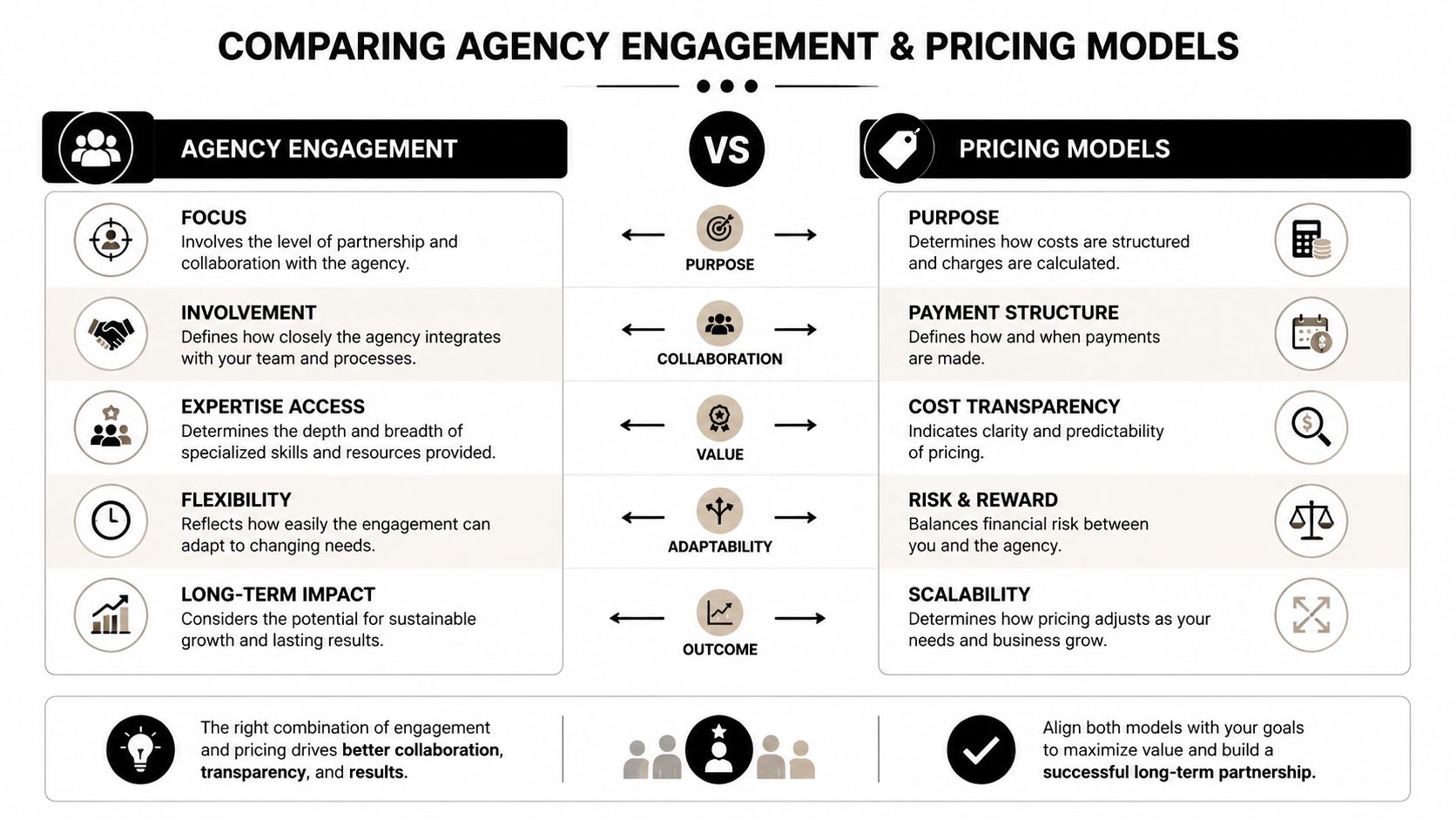
One of the biggest problems in the market is that agencies talk about affordability and flexibility without giving founders clear break-even logic. As noted by The Marketing Agency, most agencies advertise flexible pricing without clear ROI thresholds, creating a cost-transparency crisis for startups. That lack of predictable structure is a major decision barrier, especially when comparing traditional retainers to outcome-based models.
Agency Pricing Model Comparison
| Model | Best For | Primary Risk | Incentive Alignment |
|---|---|---|---|
| Fixed retainer | Startups needing broad ongoing support | You can pay for motion instead of results | Low |
| Project-based | Defined deliverables like audits, landing pages, or setup work | Ends before a growth system is proven | Medium |
| Performance-based | Startups that need accountability tied to outcomes | Requires clean definitions of qualified results | High |
Why retainers often underperform for startups
A retainer can work when the company already knows what it needs and has internal operators who can hold the agency tightly accountable. Most startups don’t have that setup. They’re still learning which message, segment, and channel move pipeline.
That makes a retainer dangerous. The agency gets paid to stay busy. You need them to stay commercially useful.
Common retainer failure modes include:
-
Activity inflation: More meetings, more assets, more tasks. Not more revenue signal.
-
Scope fog: The agency can always argue that results take longer.
-
Budget drift: Extra tests, extra channels, extra deliverables slowly expand the spend.
-
Weak urgency: The downside of underperformance falls mostly on you.
Why performance-based models fit startup reality
For most startups, performance-based pricing is the gold standard because it forces alignment. If the agency only wins when you get qualified outcomes, both sides care about targeting, quality control, and conversion efficiency from day one.
That model isn’t magic. It still requires tight definitions. What counts as a qualified lead? What counts as a booked meeting? What happens with no-shows, junk leads, or off-ICP responses? But those are healthy conversations. They create operational clarity before money starts flowing.
If you want to understand the logic behind outcome-based structures, this breakdown of pay-for-performance marketing and agency alignment with real revenue is worth reading.
Founders should push every agency toward outcome accountability, even when the contract isn’t purely performance-based.
The practical buying stance
If an agency won’t discuss ROI thresholds, success definitions, or exit conditions, keep looking. Startups don’t need “flexibility” in the abstract. They need a model that protects cash and rewards measurable execution.
Onboarding Your New Agency for a Fast Start
Signing the contract doesn’t create alignment. Onboarding does. A startup can waste the first month of an agency engagement just collecting access, clarifying goals, and revisiting assumptions that should’ve been settled before kickoff.

What your kickoff brief should include
Don’t send the agency a loose deck and expect them to “figure it out.” Give them a working brief that forces precision.
A strong startup brief includes:
-
Company snapshot: Product, market, current stage, and what has already been tested
-
ICP summary: Best-fit segments, buyers, pain points, and known objections
-
Offer and funnel: What happens between first touch and closed deal
-
Current assets: Website, landing pages, CRM, analytics, past campaigns, and sales collateral
-
Success definition: Primary KPI, secondary KPI, guardrails, and review window
-
Constraints: Compliance, brand limits, geographic focus, pricing realities, internal approval flow
This document should be short enough to use, but sharp enough to remove ambiguity.
The first two weeks should look operational
A good onboarding process feels structured very quickly. You should know who owns what, how communication works, and what gets reviewed when.
Use this checklist:
-
Grant access early: Analytics, ad platforms, CRM, website, scheduling tools, and reporting tools.
-
Name decision-makers: One internal owner. One agency lead. No confusion.
-
Set meeting cadence: Weekly working session. Monthly strategic review.
-
Approve definitions: Lead quality, meeting quality, attribution rules, disqualification reasons.
-
Lock the dashboard: Everyone should read from the same metrics.
-
Document escalation paths: Who decides when performance slips or assumptions change?
A clean dashboard matters here. If your team needs a simple reference for what should be tracked, this guide to lead generation KPIs and essential metrics is useful for deciding what belongs in the weekly review.
What a serious 90-day plan should contain
An agency’s first-quarter plan shouldn’t be a wish list. It should be a sequence. The best ones have a clear logic: diagnose, launch, refine, scale cautiously.
A practical 90-day structure often looks like this:
| Timeframe | What should happen | What you should look for |
|---|---|---|
| Days 1 to 30 | Research, account setup, message refinement, tracking validation | Clear assumptions and a launch-ready system |
| Days 31 to 60 | Live testing, early performance reviews, offer and targeting adjustments | Evidence that the team can react to data |
| Days 61 to 90 | Tighter optimization, quality control, scale decisions | A confident keep, change, or cut decision |
Quick wins aren’t always flashy
Founders often expect an early agency win to mean a surge in leads. Sometimes the actual early win is better diagnosis. Clean tracking. A sharper segment. Better reply quality. Fewer wasted sales calls. Those changes matter because they improve every later test.
The right agency should still aim to produce visible movement in the first quarter. But visible movement doesn’t always mean volume. It can mean confidence in where to push harder and where to stop spending.
Early momentum is good. Decision-quality is better.
A digital marketing agency for startups should leave you with more control, not less. If the onboarding process increases confusion, hides the data, or delays accountability, that’s not a scaling partner. That’s outsourced uncertainty.
If you’re a B2B company with proven product-market fit and you want an agency model built around outcomes, Fypion Marketing is worth a look. Their pay-per-meeting approach is designed for founders who want qualified pipeline without upfront retainers, setup fees, or vague “activity” reporting.