
Top Performance Marketing Agencies: Best 7 for 2026

You’re probably in one of two situations right now. Either your team has hit a growth plateau and you need a partner who can produce pipeline, not just reports, or you’re replacing an agency that talked about traffic and engagement while sales asked a simpler question: what revenue did this create?
Selecting a premier performance marketing agency is more than a vendor search; it is a critical revenue decision. The distinction between a leading firm and an underperformer rarely stems from channel expertise alone. Instead, it depends on their ability to align media, messaging, tracking, and conversion efforts with the business outcomes you care about.
This guide gets to the shortlist fast. It covers seven agencies worth serious consideration in 2026, with a practical lens on fit, trade-offs, and buying model. Some are built for enterprise media scale. Some are better for B2B pipeline generation. Some make the most sense if you already have a healthy ad budget. Others are more attractive if you want tighter alignment between fees and outcomes.
If you’re also tightening outbound alongside paid acquisition, these RevoScale outbound automation strategies are worth reviewing. In most growth programs, agencies perform best when acquisition channels support each other instead of competing for credit.
1. Fypion Marketing
Your paid campaigns are producing clicks, your SDR team is chasing weak leads, and leadership wants one answer: how many qualified meetings hit the calendar this month? That is the context where Fypion Marketing tends to make sense.
Fypion focuses on a narrower outcome than most agencies in this list. It is built around booked, qualified meetings through cold email, primarily for B2B companies in SaaS, tech, and related categories. That specialization matters. Buyers are not hiring Fypion for brand reach, retail media, or a broad channel mix. They are hiring it to create sales conversations with defined target accounts.
Why Fypion earns consideration
The main distinction is the pricing structure. Fypion centers engagements on qualified meetings rather than a standard monthly retainer. That changes the agency evaluation process because the first question is not channel coverage. It is whether your team can define qualification clearly enough for a pay-for-performance model to work.
That model is usually a strong fit when three conditions are already true:
-
Your ICP is clear: industry, title, company size, and buying triggers are already defined
-
Your offer is proven: sales calls convert at a reasonable rate once the right buyer shows up
-
Your sales process is operational: follow-up speed, qualification, and closing discipline are already in place
If those pieces are missing, the model can still generate meetings, but it will also expose weak messaging, poor handoff, or a fuzzy offer very quickly.
What the engagement actually covers
Fypion is more than a copywriting shop or list vendor. The service includes research, targeting, messaging, technical email setup, list building, inbox management, and ongoing optimization. That operational scope is important because cold outbound usually fails at the system level, not just the subject line. Weak domain setup, poor list quality, and bad targeting can suppress results before the campaign has a fair test.
For teams weighing outsourced execution against building the function internally, this guide to outsourced marketing services helps frame the trade-offs.
Evaluation checklist
Use this checklist before you put Fypion, or any meeting-based agency, on the shortlist:
-
Qualification standard: Can both sides define exactly what counts as a qualified meeting?
-
Sales readiness: Can your team respond quickly and convert interest into pipeline?
-
Targeting maturity: Do you know which segments and job titles are worth pursuing?
-
Outbound tolerance: Is your market responsive to cold email, or heavily saturated?
-
Attribution discipline: Will you judge success on meetings, pipeline quality, or closed revenue?
If those answers are vague, a retainer model with more testing room may be safer. If those answers are clear, performance pricing can create better fee alignment.
Retainer vs. pay-for-performance
Fypion is useful as a comparison point in the broader agency buying decision.
Pay-for-performance works best when:
-
the offer is established
-
lead qualification is agreed before launch
-
the company wants tighter alignment between fees and outcomes
A retainer usually works better when:
-
the team is still testing ICP, messaging, or channels
-
campaign success depends on creative, landing pages, paid media, and analytics working together
-
the business needs strategic experimentation, not just meeting volume
That distinction matters throughout this list. Agencies are not interchangeable just because they all operate under the performance marketing label. If you want a more detailed breakdown of where lead-focused partners fit, this explanation of a lead generation agency is a useful reference.
Strengths and trade-offs
Where Fypion is strong
-
Incentive alignment: Fees are tied to booked, qualified meetings instead of general activity
-
Operational control: Research, infrastructure, targeting, and optimization sit with one provider
-
Useful for B2B sales teams: The output maps directly to pipeline creation rather than top-of-funnel reporting
Where buyers should be careful
-
Less room for discovery work: Companies still figuring out product-market fit or positioning may struggle
-
Narrower use case: This is not the right choice for omnichannel media management or broad awareness goals
-
Qualification disputes can derail results: If standards are loose, both sides can end up measuring different outcomes
Fypion also presents stronger social proof than many niche outbound firms. The company cites a high client rating and publishes example outcomes tied to lead growth, positive replies, and appointment generation.
Best fit
Fypion is a good option for B2B teams that want qualified meetings without committing to a standard agency retainer, and that already know who they want to reach. The practical test is simple. If your bottleneck is meeting volume, not demand strategy, and you can define quality upfront, this model deserves a serious look.
2. Tinuiti
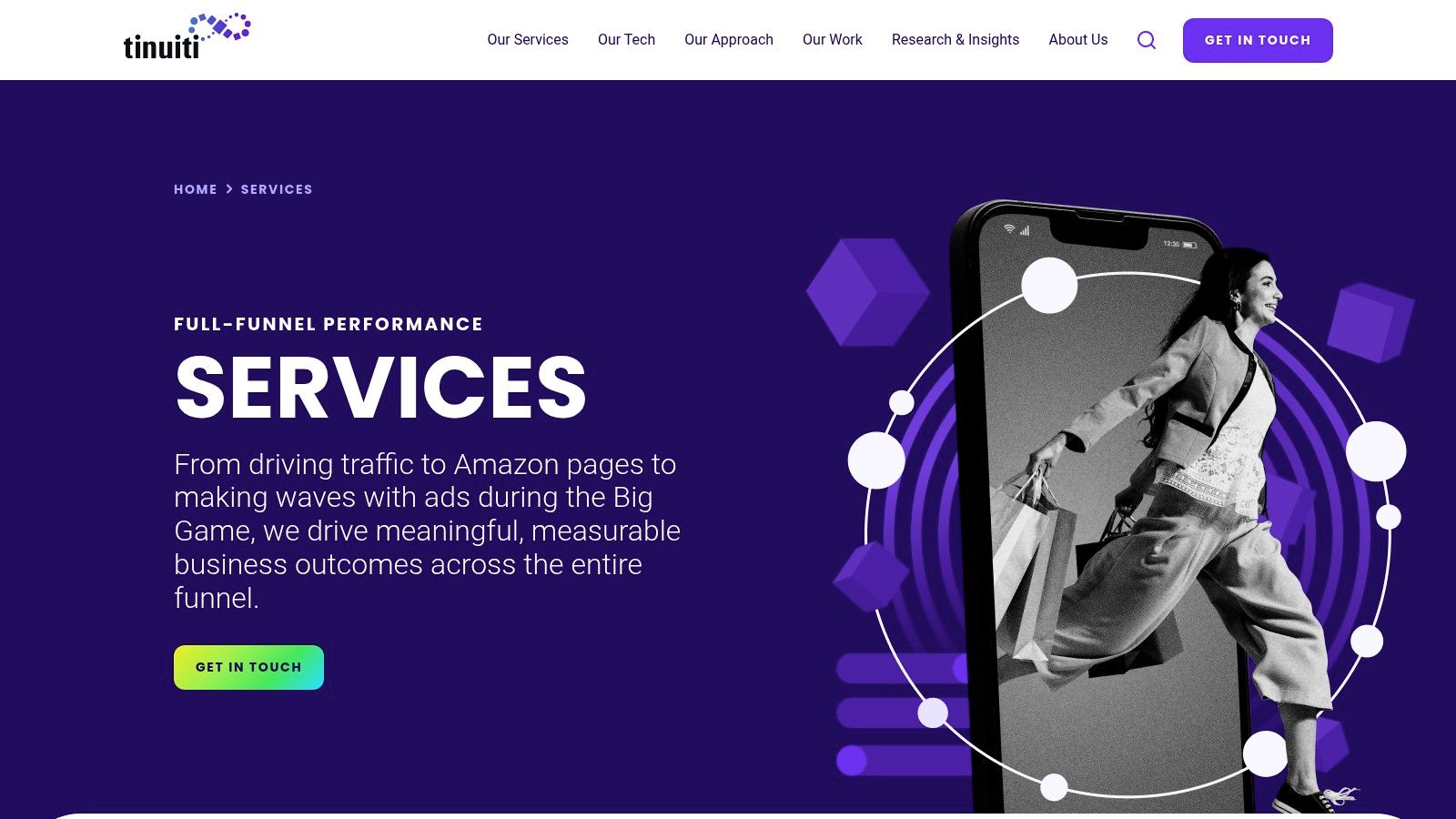
A brand is spending across Google, Meta, Amazon, retail media, email, and CTV. Performance is decent in each channel, but reporting is fragmented, attribution is contested, and no one owns the full customer journey. That is the buying scenario where Tinuiti tends to make sense.
Tinuiti stands out as a scaled full-funnel partner with real depth across paid media, commerce, lifecycle, creative, and conversion work. The practical value is coordination. Teams that are already past the “fix one channel” stage often need tighter planning, cleaner measurement, and one operator that can manage channel trade-offs instead of optimizing each platform in isolation.
Where Tinuiti is strongest
Tinuiti is a better fit for brands with channel complexity, not just media spend. Its edge shows up when performance depends on how search, social, retail media, CRM, and creative work together.
Key strengths include:
-
Cross-channel coordination: Useful when budget allocation decisions affect multiple channels at once
-
Commerce depth: Stronger fit for brands selling through marketplaces, retail networks, and direct channels simultaneously
-
Measurement discipline: Better suited to organizations that need reporting frameworks leadership can use for decisions
-
Broader in-house capability: Helps reduce handoff problems between media, creative, and lifecycle teams
That matters because the wrong agency model can create a hidden tax. One specialist may improve paid search while another runs paid social, but neither is accountable for blended CAC, incrementality, or channel overlap. Tinuiti is built for companies trying to solve that operating problem.
Pricing model and buying trade-offs
Tinuiti is generally a retainer-style agency decision, not a pay-for-performance one. That changes how buyers should evaluate it.
Use this framework:
-
Choose a retainer model if you need strategic planning, cross-channel governance, testing infrastructure, and consistent execution across a large program
-
Choose pay-for-performance if your main concern is outcome-based efficiency and the deliverable can be defined cleanly upfront
-
Be careful with retainers when internal teams are still unclear on goals, attribution rules, or channel ownership
-
Be careful with performance pricing when success depends on many upstream factors the agency cannot fully control
For teams comparing these models, this guide to pay-for-performance marketing and revenue alignment is useful context before signing a broad retainer.
Best fit
Tinuiti is a strong option for mid-market and enterprise brands that need one partner to run an integrated acquisition and commerce program.
Best for
-
Brands with meaningful spend across several channels
-
E-commerce and retail-driven businesses with marketplace complexity
-
Teams that need tighter forecasting, reporting, and budget coordination
Less ideal for
-
Small companies that need one channel fixed before expanding
-
Buyers looking for low-cost execution support
-
Organizations that want fees tied directly to a narrow performance outcome
Bottom line: Tinuiti is usually the right hire when the core problem is orchestration, measurement, and scale.
Direct site: Tinuiti services
3. Wpromote
Wpromote is a strong option for brands that want an agency with enterprise-grade analytics muscle but don’t want to default to a legacy holding-company feel. Its reputation is built on omnichannel execution backed by data and predictive modeling.
That combination is useful when your leadership team doesn’t just want campaign management. They want a planning model they can defend internally.
What Wpromote does well
Wpromote’s positioning centers on integrated analytics, forecasting, and cross-channel decision-making. In practice, that makes it better suited to brands that already have meaningful spend and enough data volume for predictive modeling to be useful.
This isn’t usually the right hire when you need scrappy channel-specific experimentation on a tight budget. It’s better when you’re trying to coordinate paid media, SEO, lifecycle work, creative, and analytics into one operating rhythm.
One of the harder buying questions with agencies is whether the fee model supports actual business outcomes. This explainer on pay-for-performance marketing and revenue alignment is useful context before you evaluate a traditional analytics-heavy agency.
Best and worst-fit scenarios
Wpromote tends to fit companies that need executive-level reporting and channel coordination. It tends to underfit founder-led teams that need speed and direct senior attention more than process depth.
-
Strong fit: Brands with multiple active channels and a need for unified performance visibility
-
Weaker fit: Very early-stage companies that don’t yet have enough signal to benefit from advanced modeling
-
Main advantage: Cross-channel intelligence, not just media buying
-
Main concern: Pricing isn’t public, so qualification happens through scoping
Wpromote is one of the top performance marketing agencies to shortlist when the challenge is complexity. If the challenge is “we need more leads next month,” it may be more platform than you need.
Direct site: Wpromote
4. NP Digital
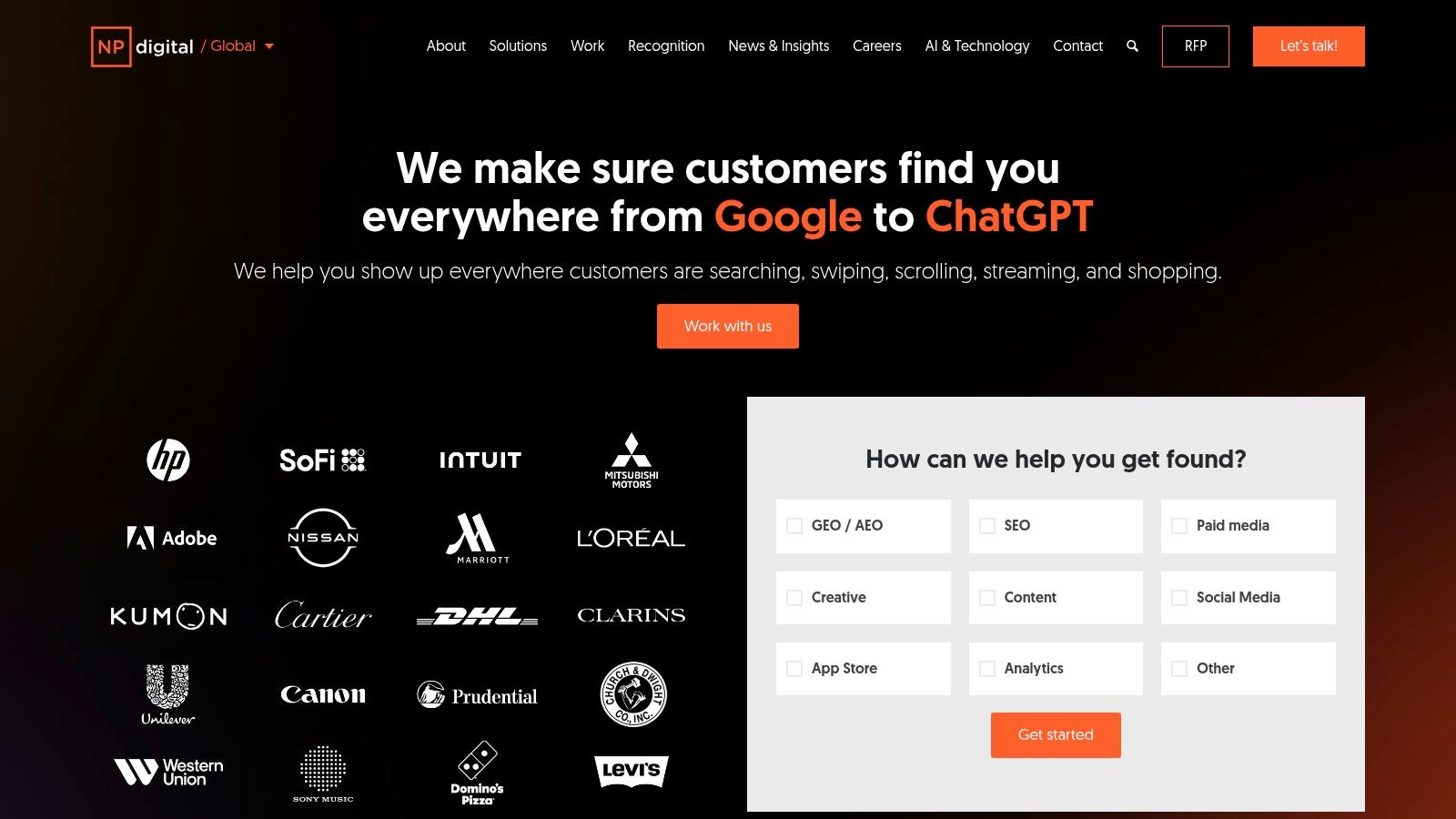
NP Digital is attractive for companies that don’t want to split search, paid media, marketplace work, and performance content across multiple vendors. Its practical advantage is range. You can use one partner for demand capture, demand creation, and emerging AI-search adaptation.
That’s particularly relevant now because a lot of agencies still separate SEO strategy from paid strategy in ways buyers don’t.
Why teams choose NP Digital
NP Digital brings together paid search, paid social, programmatic, marketplaces, SEO, CRO, creative, and analytics. If your growth motion depends on both capturing existing demand and building new demand, that integrated structure can reduce handoff problems.
Its SEO and AI-search positioning also gives it a clearer role in modern search than agencies that still talk like it’s only about rankings and keywords. For companies selling in multiple markets, the global footprint can help.
For outbound-heavy teams, NP Digital isn’t a replacement for direct prospecting. It’s complementary. If your team is also building direct outreach, these cold outreach principles in how to cold contact prospects effectively are the right companion play.
The real trade-off
The biggest trade-off is touch model. Large global agencies can bring breadth, but startups sometimes feel like they’re getting a process, not a partner.
-
Why buy: Strong blend of paid media and search visibility work
-
Why hesitate: Pricing is opaque, and some buyers will want more boutique involvement
-
Best use case: Companies that need one agency to support both near-term acquisition and longer-horizon discoverability
If your revenue depends on both immediate capture and long-tail search visibility, splitting those functions across separate agencies often creates attribution fights and slow execution.
Direct site: NP Digital
5. Power Digital
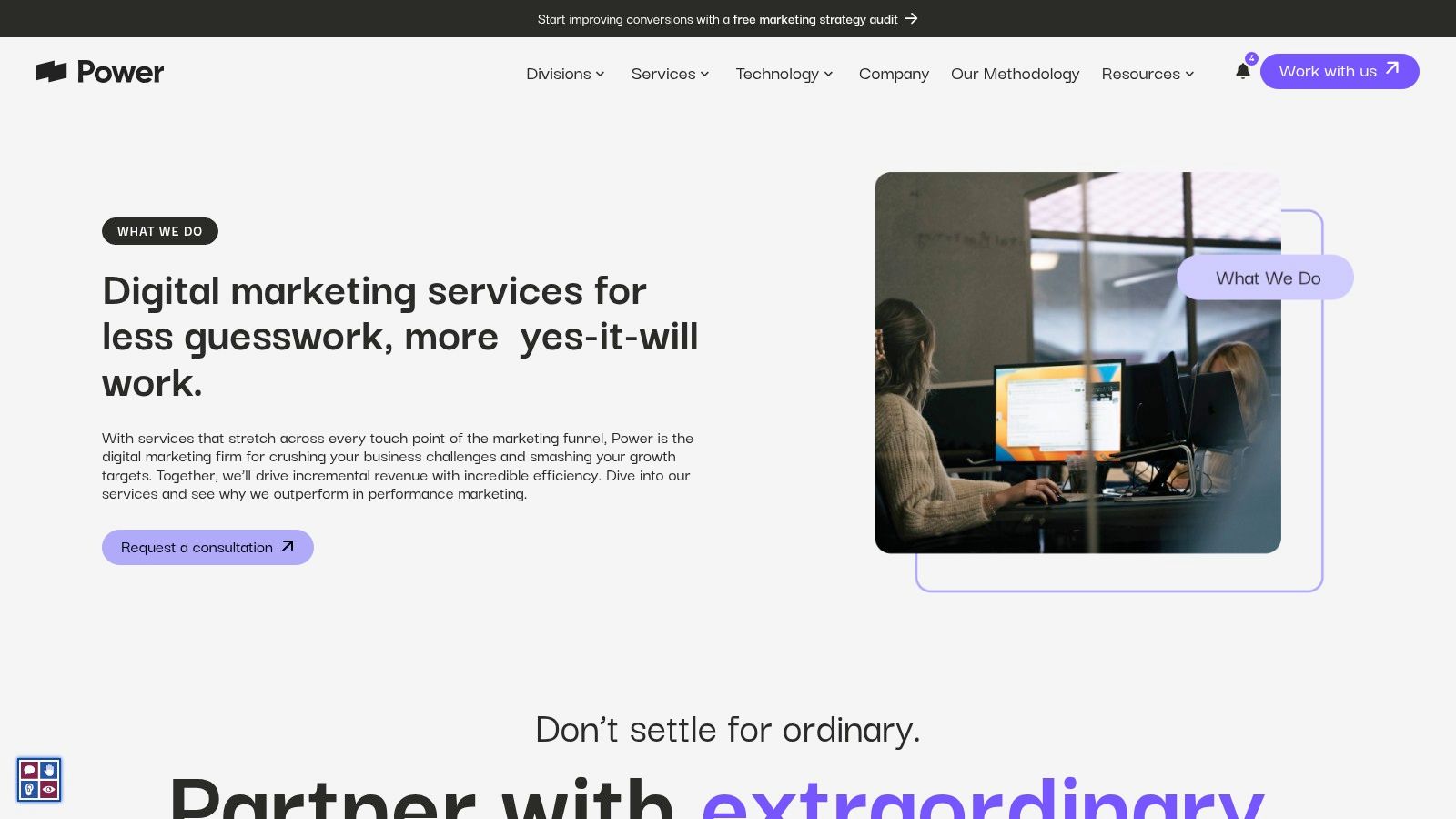
Power Digital appeals to companies that want more than campaign management. Its pitch is measurement, forecasting, and growth planning tied to revenue, with a proprietary platform layer that tries to make attribution and decision-making less fragmented.
That’s a compelling story when a business is expanding into more channels and doesn’t want reporting stitched together manually.
Where Power Digital stands out
The main differentiator is its nova platform, which connects forecasting, customer cohorts, creative affinity, and revenue-oriented insights. In practical terms, that matters most for brands juggling paid media, lifecycle, influencer, PR, CRO, and creative at the same time.
This is one of the agencies on the list that can support growth across both classic performance channels and upper-funnel expansion plays like creators and CTV. That broader lens can be useful, but only if your business is mature enough to need it.
If your internal buying discussion keeps circling around cost efficiency and outcome-based fees, it helps to compare agency pricing against outcome benchmarks like price-per-lead economics.
When to shortlist it
Power Digital is a serious option for brands that are scaling and need a partner with strategic range. It’s less compelling for companies that just want one paid channel run tightly and efficiently.
-
Good fit: Growth-stage and established brands adding channel complexity
-
Poor fit: Lean startups with narrow budgets and a single core acquisition need
-
Strength: Measurement posture and proprietary data layer
-
Watch-out: Discovery-heavy sales process and no public pricing
One more practical point. Agencies with proprietary platforms are useful only if they improve decisions. Fancy dashboards that your team doesn’t use are just expensive decoration.
Direct site: Power Digital services
6. HawkSEM
HawkSEM is one of the more pragmatic options on this list. It’s focused on ROI, centered on search and performance channels, and less likely to overwhelm a buyer with broad brand language that doesn’t help procurement.
For many companies, that’s a strength. You don’t always need a sprawling full-service partner. Sometimes you need disciplined search, paid social, CRO, and reporting.
Why HawkSEM makes sense
Its ConversionIQ platform is the key selling point. It centralizes reporting and insights across channels, which is useful for companies that want cleaner performance visibility without buying into a much larger agency ecosystem.
HawkSEM also tends to be more direct about pricing structures than many peers. Even when exact fees depend on scope and ad spend, that willingness to explain agency economics matters. Buyers usually regret vague pricing later.
Practical fit
HawkSEM fits companies that want a focused performance operator for PPC, SEO, paid social, CRO, content, and Amazon ads. It’s especially workable for B2B lead generation and e-commerce teams that need efficiency and clarity.
-
Best for: Companies that value transparency in reporting and channel economics
-
Less suited for: Brands that need deep brand strategy or heavy creative production from the same partner
-
Main upside: Clearer reporting and a focused performance stack
-
Main downside: Final pricing still depends on the scope you negotiate
Buy HawkSEM for operational sharpness. Don’t buy it expecting a large creative agency wrapped inside a search team.
Direct site: HawkSEM
7. Directive
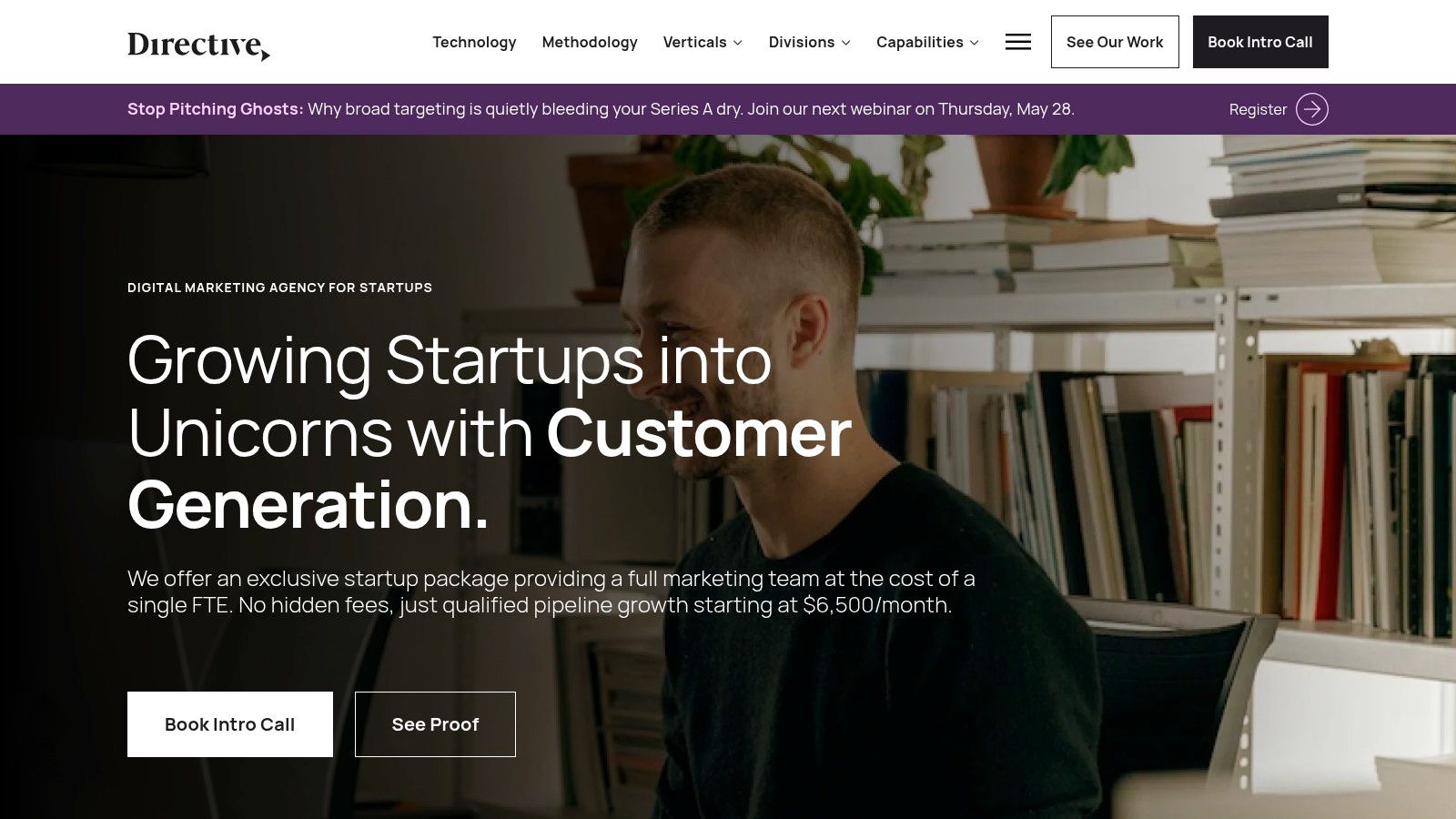
A common buying scenario looks like this: the company has product-market fit, a real sales team, and pressure to prove marketing’s contribution to pipeline. At that point, a generalist agency often creates reporting noise. Directive is built for the opposite use case. It focuses on B2B, SaaS, enterprise tech, and revenue teams that need marketing tied to CRM outcomes.
That specialization is the main reason to consider it.
Why Directive stands out
Directive is easier to assess than many agencies because it signals who it wants to work with and how it frames growth. The public startup offer helps set expectations on budget and scope, even if the final program expands well beyond an entry package.
More important than the package itself is the operating model. Directive tends to fit teams that care about:
-
Pipeline quality over lead volume
-
Paid media tied to revenue stages, not just top-of-funnel metrics
-
RevOps alignment across campaigns, attribution, and sales handoff
-
B2B execution for longer, more complex buying cycles
That matters in an agency review process. Buyers should not ask only, “Is this agency good?” They should ask, “Is this agency built for the way we measure growth?”
Practical fit
Directive is a strong option for funded startups and established B2B SaaS companies that need a specialist partner. It makes less sense for brands that depend on consumer creative, influencer-heavy acquisition, or retail marketplace execution.
Use this checklist before you shortlist them:
-
Good fit if: your KPIs are pipeline, SQL quality, CAC efficiency, and revenue contribution
-
Good fit if: your internal team already has product positioning and needs stronger execution across paid, CRO, and RevOps-connected reporting
-
Proceed carefully if: you want one agency to own brand strategy, large-scale creative production, and performance media under one roof
-
Proceed carefully if: you need a low-cost testing partner and expect senior strategic support across many channels from day one
Pricing model takeaway
Directive is the kind of agency that usually fits a retainer model better than a pure pay-for-performance model. That is not a weakness. It reflects the work.
For complex B2B demand generation, outcomes depend on sales cycles, attribution setup, CRM hygiene, landing pages, and audience quality. A retainer can be the better structure when the agency is influencing multiple parts of the funnel and the result will not show up as an immediate booked meeting. If a company wants direct response accountability with a short feedback loop, agencies built around performance-based pricing may be easier to evaluate.
-
Best for: B2B SaaS and tech companies that need revenue-oriented performance marketing
-
Less suited for: DTC brands or marketplace-first sellers
-
Main upside: Clear category focus and stronger fit for CRM-accountable growth teams
-
Main downside: Starter-level pricing and scope can change quickly once channel mix and reporting needs expand**
Top 7 Performance Marketing Agencies Comparison
| Service | 🔄 Implementation complexity | ⚡ Resource requirements | 📊 Expected outcomes | 💡 Ideal use cases | ⭐ Key advantages |
|---|---|---|---|---|---|
| Fypion Marketing | Moderate, agency handles full cold‑email stack; initial 3‑month ramp | Low client effort; pay‑per‑meeting model (no default upfront fees) | Booked, qualified B2B meetings and measurable pipeline lift within weeks | B2B/SaaS/tech with product‑market fit seeking performance‑aligned lead gen | Performance‑aligned pricing; full service cold‑email + iterative deliverability optimization |
| Tinuiti | High, enterprise multichannel orchestration and measurement | High media spend and budget; dedicated channel specialists | Scaled full‑funnel growth with advanced attribution | Mid‑market to enterprise consumer and B2B brands needing channel breadth | Elite platform partnerships; robust measurement (Rapid MMM); marketplace expertise |
| Wpromote | High, omnichannel integration with predictive analytics | Significant budget and analytics/tech investment | Predictive, cross‑channel growth and improved ROAS | Brands seeking analytics/AI‑driven scaling across channels | Strong analytics/predictive modeling; enterprise credibility and case history |
| NP Digital | High, full‑stack global execution including SEO/AI optimization | High budgets; global team coordination for multi‑market work | Improved search visibility, AI/LLM optimization and paid performance | Enterprises needing SEO depth, AI search optimization and multi‑market support | Deep SEO/AI expertise + full‑stack paid and organic capabilities |
| Power Digital | High, integrates proprietary nova data/AI platform with channels | Mid‑to‑large budgets; data/tech enabled teams | Measurable revenue attribution and LTV‑focused growth | Brands prioritizing data‑driven growth and creator/CTV expansion | Proprietary data/AI (nova); unified dashboards and forecasting |
| HawkSEM | Moderate, focused SEM/CRO with centralized reporting (ConversionIQ) | Moderate budgets; fees scale with ad spend | Clear ROI reporting and optimized paid performance | B2B lead gen and e‑commerce teams needing transparent SEM | ConversionIQ reporting; transparent pricing education and channel focus |
| Directive | Moderate, B2B/SaaS playbooks and a defined 90‑day Startup Package | Moderate, explicit startup pricing ($6.5k/mo) or scalable scopes | Rapid pipeline impact tied to pipeline/revenue within defined scope | Funded SaaS startups and B2B companies seeking quick pipeline lift | SaaS/RevOps specialization; published startup package reduces procurement friction |
How to Choose Your Agency and The Right Model
You narrow the list to three agencies. Every pitch sounds polished. Every case study looks strong. Then the hard part starts. Which team can handle your actual constraint, and which pricing model fits the way your company grows?
That decision usually matters more than the ranking itself. A poor fit shows up fast in wasted ad spend, slow execution, weak reporting, and arguments about what success was supposed to mean.
Your Agency Evaluation Checklist
Use discovery calls to test how an agency thinks, scopes work, and handles accountability. Score each area as strong, mixed, or weak. If answers stay vague, treat that as a warning.
-
Growth constraint fit: Ask what problem they believe they are solving. Pipeline creation, CAC control, geographic expansion, retention support, and channel diversification require different operating models.
-
Business outcome proof: Look for examples tied to revenue, qualified pipeline, booked meetings, purchase volume, or efficiency gains. Channel metrics alone are not enough.
-
Day-to-day team quality: Confirm who runs the account after the sale. Senior strategists in the pitch do not help if execution gets passed to a junior team with limited oversight.
-
Measurement discipline: Ask how they handle attribution, CRM syncing, conversion tracking, and reporting gaps. If they cannot explain measurement plainly, reporting will become a problem later.
-
Reporting usefulness: Good reporting helps a leadership team make decisions. Weak reporting lists clicks, impressions, and activity with no clear recommendation.
-
Execution depth: Test whether they can handle the operational work your program needs, such as creative testing, landing page feedback, feed management, lifecycle automation, or outbound deliverability.
-
Onboarding plan: Ask for the first 30 to 60 days in concrete terms. You want milestones, owners, dependencies, and what they need from your team.
-
Scope clarity: Push on what is included, what triggers added fees, and what sits outside scope. Many agency relationships go off course at this stage.
-
Reference quality: Strong references describe outcomes, speed, communication style, and how the agency handled setbacks. Generic praise has little value.
-
Working style: Pressure reveals fit. If communication already feels unclear or defensive during the sales process, expect more of that after signature.
A good agency call feels more like a diagnostic session than a pitch.
Retainer vs. Pay-for-Performance Which Is Right for You
This is the pricing decision that trips up a lot of teams. The cheaper-looking option is not always the lower-risk option.
Retainer models work well when the agency is responsible for a broad set of ongoing tasks across paid media, creative input, analytics, testing, and cross-channel coordination. This model is easier to budget, but it can hide weak accountability if scope is fuzzy or reporting stays high level.
Pay-for-performance models tie fees to a defined outcome. That can improve alignment, but only when the result is measurable, accepted by both sides, and not distorted by weak qualification standards. Fypion Marketing’s pay-per-meeting model is one example of this structure. It fits companies that care primarily about qualified sales conversations and can define qualification rules before launch.
Choose a retainer when:
-
You need broad execution: Multiple channels, frequent testing, reporting, and coordination across internal teams
-
Your results depend on shared inputs: Site conversion rate, sales follow-up speed, offer strength, and data quality all affect performance
-
You need fixed monthly planning: Finance teams often prefer stable forecasting over variable fees
-
You expect strategy as well as execution: Retainers usually fit ongoing planning better than narrow output-based pricing
Choose pay-for-performance when:
-
You want tighter incentive alignment: Fees should track meetings, leads, or another defined outcome
-
The success metric is clean: Qualification rules, attribution logic, and handoff expectations are already agreed
-
Your offer is validated: Performance pricing exposes weak positioning and poor product-market fit quickly
-
You are buying a specific result: This model works best for focused programs, not broad multi-channel management
A few trade-offs are worth stating plainly:
-
Retainers can support better long-term planning, but they require sharper oversight from the client
-
Performance pricing can reduce wasted spend on idle agency work, but fees may rise fast if the program works
-
Retainers usually fit complex channel mixes
-
Performance models usually fit narrower, highly measurable outcomes
-
Neither model fixes weak internal execution, especially slow sales follow-up, poor landing pages, or broken tracking
If your leadership team also needs senior marketing direction beyond channel execution, this guide on how to drive startup growth with a CMO is a useful complement to the agency decision.
A practical final screen helps. Shortlist two or three agencies. Run the checklist. Compare how each team defines success, handles reporting, scopes work, and prices risk. Then choose the partner whose incentives match your revenue model and internal operating reality.
If qualified pipeline is the core goal, Fypion Marketing is the clearest pay-for-performance option in this list, as noted earlier. If your needs are broader than meeting generation, a retainer-based agency will usually be the better fit.