
Pay for Performance Marketing: Align Agencies with Real Revenue

Tired of throwing money at marketing retainers with no guarantee of results? It often feels like a gamble, right? You sign a hefty check, cross your fingers, and hope it brings in leads and sales.
Pay-for-performance marketing flips that entire model on its head.
What Is Pay For Performance Marketing
Imagine hiring a salesperson who only gets a commission after they close a deal. That’s the core idea here. It’s a marketing strategy where you only pay for specific, measurable results.
Instead of paying for effort, exposure, or hours billed, you’re paying for actual outcomes. This approach creates a powerful partnership where your marketing agency is only successful when you are. Their compensation is directly tied to delivering what your business needs most, whether that’s a qualified lead, a booked sales meeting, or a closed sale.
This simple shift aligns everyone’s goals. The marketing partner is financially motivated to deliver high-quality results, and to do it efficiently.
Shifting The Financial Risk
The biggest win with this model is the transfer of financial risk. In a traditional setup, you (the client) shoulder all the cost and risk of a campaign that might fall flat. With pay-for-performance, the agency puts its money where its mouth is.
If their campaigns don’t produce the agreed-upon results, they don’t get paid. Simple as that.
This built-in accountability is why so many B2B companies are ditching old-school retainers. Leaders are tired of pouring money into activities that don’t translate into real pipeline growth. They want a crystal-clear line connecting every marketing dollar to the revenue it generates.
A true pay for performance model ensures that your marketing partner has “skin in the game.” Their success isn’t measured by the hours they bill, but by the concrete value they create for your sales team.
How It Works In Practice
Let’s make this real. Take a B2B lead generation agency like Fypion Marketing. Under a performance model, a client doesn’t pay for the campaign setup, the copywriting, or the time spent sending emails.
Instead, they only pay a fixed price for each qualified sales meeting that lands on their calendar.
This structure forces the agency to be incredibly sharp and strategic. They have to master:
-
Precise Targeting: Laser-focusing on your exact ideal customer profile.
-
Compelling Messaging: Writing outreach that actually resonates and gets a response.
-
Continuous Optimization: Constantly analyzing data and tweaking campaigns to squeeze out the best possible results.
To really get the most out of this model, you need a solid grasp of the metrics that define success. For a great resource on this, check out this guide on Mastering Marketing Performance Metrics.
Ultimately, this approach turns marketing from a cost center into a predictable, scalable revenue engine. To see how this applies specifically to lead generation, you can dive deeper into our guide to performance-based lead generation.
Exploring Different Performance Marketing Models
Let’s get one thing straight: not all pay-for-performance marketing is the same. The term is really a big umbrella covering a bunch of different ways to pay for results. It’s like hiring a builder - you could agree to pay them after they lay the foundation, when the framing is up, or only when the whole house is finished and passes inspection.
Each model ties the payment to a specific moment in the customer’s journey. Getting this right is critical. You need to pick a structure that actually lines up with your business goals and sales cycle, defining what a “result” truly means to you. This choice directly shapes the kind of outcomes you’ll get.
A Breakdown Of Common Performance Marketing Models
To make sense of the different options, it helps to see them side-by-side. Each model has its own pros and cons, and what works wonders for an e-commerce brand might be a total flop for a B2B software company.
Here’s a simple comparison of the most popular performance marketing models out there.
| Model Type | How You Pay | Best For | Key Benefit | Potential Risk |
|---|---|---|---|---|
| Cost Per Lead (CPL) | For each contact who shows interest (e.g., form fill). | Businesses with strong sales teams that can nurture leads. | Quickly fills the top of your sales funnel with potential customers. | Lead quality can be all over the place; many won’t be ready to buy. |
| Cost Per Acquisition (CPA) | Only when a lead makes a purchase and becomes a customer. | E-commerce, B2C, or businesses with short, clear sales cycles. | You only pay for actual revenue. It’s virtually risk-free marketing spend. | Tough for long B2B sales cycles; attribution gets complicated. |
| Pay Per Qualified Meeting | For each scheduled meeting with a pre-vetted, qualified prospect. | B2B companies with high-value products and complex sales cycles. | Your sales team only talks to relevant, interested decision-makers. | Higher upfront cost per meeting compared to a raw lead. |
Choosing the right model is all about aligning incentives. You want your marketing partner focused on the outcome that matters most to your bottom line, not just a vanity metric.
Cost Per Lead (CPL)
The Cost Per Lead (CPL) model is probably the most common starting point. The deal is simple: you pay a flat fee for every lead your partner sends your way. A “lead” is usually just someone who gave you their contact info by filling out a form or downloading an ebook.
It’s a straightforward way to pump volume into the top of your sales funnel. The big catch? Lead quality. A lead is just a contact, not a guaranteed sale. There’s no way to know if they’re a real decision-maker or just someone kicking tires.
This is why CPL really only works if you have a killer lead nurturing process already in place. If your sales team is ready to jump on these contacts, qualify them, and follow up relentlessly, CPL can be a goldmine. If you want to dive deeper into this model, check out our comprehensive guide to pay-per-lead B2B marketing.
Cost Per Acquisition (CPA)
If you move further down the funnel, you get to the Cost Per Acquisition (CPA) model. Here, you’re tying the payment directly to a sale. It’s often called Cost Per Sale (CPS), and it means you only pay your marketing partner after one of their leads becomes a paying customer. This is about as results-driven as it gets.
The upside is huge - you’re literally paying for revenue. This model shifts almost all the marketing risk from you to the agency, since your ad spend is directly tied to closed deals. It’s incredibly popular in e-commerce and for any business where the path from lead to purchase is fast and simple.
But for B2B companies with long, complicated sales cycles, CPA can be a nightmare. It might take six months to close a deal, making it tough to track where the lead came from and forcing the agency to wait ages to get paid. That can kill their motivation pretty quickly.
This diagram shows exactly how the financial risk gets passed from the client to the agency as you move toward a performance model.
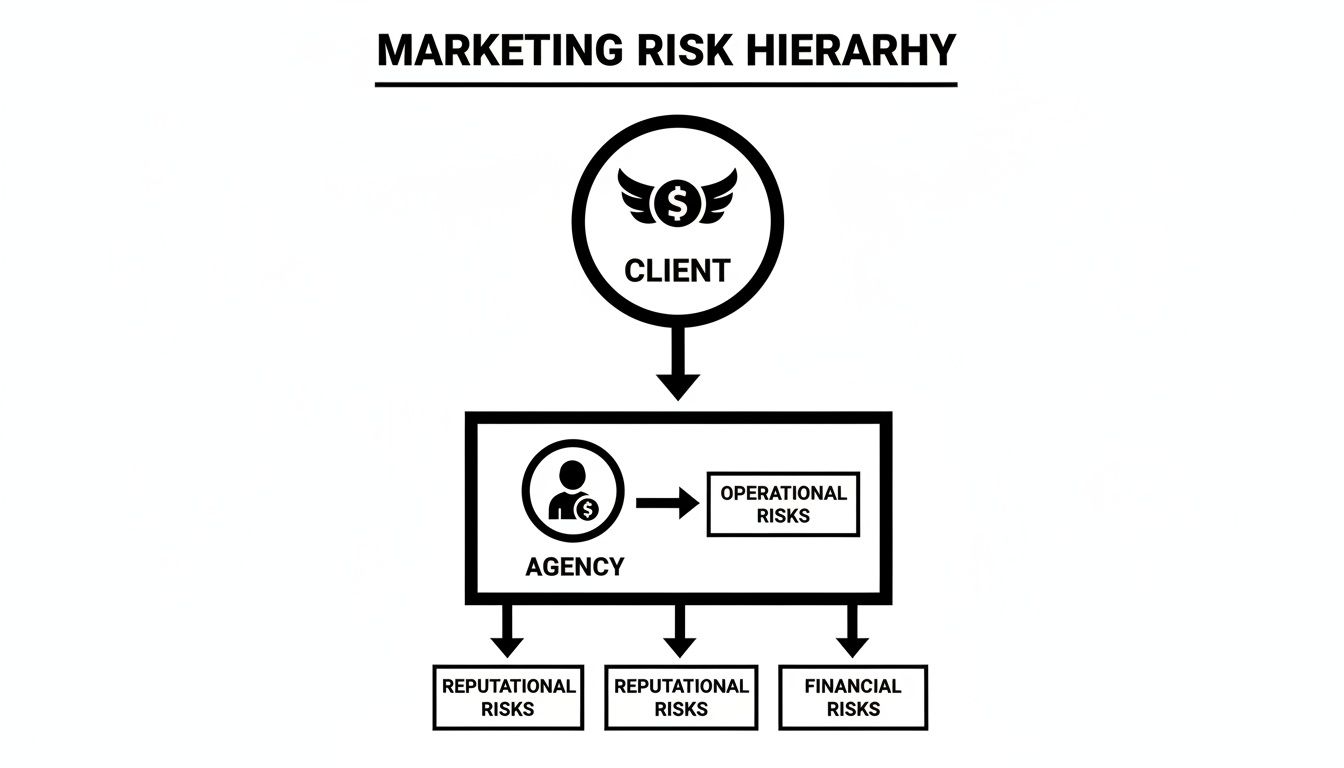
As you can see, the more you base payment on final results, the more skin the agency has in the game.
Pay Per Qualified Meeting
There’s a sweet spot between CPL and CPA, and that’s the Pay Per Qualified Meeting model. It’s especially powerful in the B2B world. Instead of paying for a raw name and email (CPL) or waiting for a closed deal (CPA), you pay for a confirmed appointment with a prospect who fits a tight set of pre-agreed criteria.
The whole point of this model is to make sure your sales team’s calendar is filled with conversations that matter - and only conversations that matter. No more wasted time on tire-kickers.
This is exactly what we specialize in at Fypion Marketing. Before we even start, we work with you to hammer out a detailed Service Level Agreement (SLA). This document spells out the exact definition of a “qualified” meeting, covering things like:
-
Company Size: Are we targeting startups or enterprise-level companies?
-
Industry: Which specific sectors are a perfect fit for you?
-
Job Title: Who is the decision-maker we need to talk to? A VP? A C-level exec?
-
Demonstrated Need: Does the prospect have a real problem that you can solve right now?
This laser-focused approach is a game-changer for B2B companies selling high-ticket items. It turns marketing from a lead generation machine into a direct pipeline of sales-ready opportunities.
Why B2B Leaders Are Trading Retainers for Performance Models
The move to pay for performance marketing isn’t just another buzzword making the rounds - it’s a real, fundamental shift in how smart B2B leaders are chasing growth. Companies are tired of paying for effort and are now laser-focused on investing in tangible business outcomes. It’s a strategic pivot grounded in one simple idea: accountability.
The old model of handing over a hefty monthly retainer often feels like a shot in the dark. You’re funding activities and just hoping they lead to sales, but the line connecting your spend to actual revenue is blurry at best. A performance model completely erases that ambiguity, forging a direct, unbreakable link between your marketing investment and your sales pipeline.
When an agency’s paycheck is tied directly to the results they generate - like booked, qualified meetings - their goals snap into perfect alignment with yours. They stop being just another vendor and become a true partner, financially invested in seeing you win.
Perfect Alignment Creates True Partnerships
Think about two teams trying to row a boat across a finish line. In a traditional retainer model, one team gets paid to row as hard as they can, whether the boat is moving forward, backward, or in circles. But in a performance model, both teams only get the prize when they cross that finish line together.
This shared goal forces a whole different level of strategy and execution from your marketing partner. They have to think like an extension of your own sales team, constantly asking the tough questions:
-
Who is the exact decision-maker we need to get in front of?
-
What’s the one message that will cut through the noise and grab their attention?
-
How can we tweak and refine our process, week after week, to deliver even better meetings?
This dynamic builds a relationship on mutual growth, not just contractual obligations. Success becomes a shared victory, and that’s when incredible things happen. We’ve seen companies achieve as much as 220% month-over-month lead growth simply by partnering with agencies whose success was directly tied to their own.
Predictable ROI and Capital Efficiency
For any B2B leader, especially in finance or sales, predictability is pure gold. Pay for performance models take marketing from being an unpredictable expense line and turn it into a reliable, scalable growth engine. You know exactly what each qualified meeting costs, which makes forecasting and budgeting a breeze.
This isn’t about spending less; it’s about investing smarter. Every single dollar is accountable, ensuring your marketing budget is working as hard as possible to generate revenue. This kind of clarity makes it incredibly easy to justify more investment when you can point to a direct, provable return.
You can see this shift happening across the industry. Marketing budgets are flowing away from fuzzy metrics and toward channels that deliver measurable returns. The data doesn’t lie: 54% of buyers are planning to increase their performance ad spend, while only 22% plan to do the same for traditional brand advertising.
With 84% of CMOs now citing ROI as their top priority for budgeting, the focus is ruthlessly on outcomes, not just impressions. This requires a solid technical foundation and killer creative - exactly what a good performance agency brings to the table.
Driving Accountability and Superior Results
At the end of the day, a performance-based model holds your marketing partner to the highest possible standard. There’s simply no room for vanity metrics or fluffy reports on “brand awareness.” The only number that matters is the one you both agreed to.
This level of accountability forces agencies to operate at the absolute top of their game. They need deep expertise in data, targeting, and conversion to even survive, let alone thrive. For you, the result is a marketing function that is lean, brutally effective, and directly contributes to your bottom line. It frees up your sales team to do what they do best - close deals - by keeping their calendars filled with genuinely promising conversations. This relentless focus on efficiency is a key part of learning how to reduce customer acquisition cost with proven strategies.
Launching Your First Performance Marketing Campaign

Alright, let’s move from theory to action. This is where pay-for-performance marketing really starts to shine. Kicking off a campaign isn’t as simple as flipping a switch; it’s a careful process that turns your business goals into a predictable stream of qualified meetings.
Think of it like building a high-performance engine. You wouldn’t just toss a bunch of parts together and hope for the best, right? You need a detailed blueprint, the right components, and a system for fine-tuning it. This initial setup is what makes the difference between a campaign that just creates noise and one that actually delivers results.
Setting The Stage For Success
The first step is all about getting on the same page. Before a single ad is placed or an email goes out, you and your performance partner need to be in perfect sync. This strategic groundwork is what separates a successful campaign from a costly mistake.
It starts with a deep dive into your business to create a laser-focused Ideal Customer Profile (ICP). We’re talking way beyond basic demographics. You need to dig into the psychographics, the real pain points, and the buying triggers of your absolute best customers. A vague ICP is the number one killer of performance campaigns.
Next up is the Service Level Agreement (SLA). This thing is basically the constitution for your campaign, and it has to be rock-solid.
The SLA is the most critical document in any pay for performance marketing engagement. It eliminates all ambiguity by defining, in meticulous detail, what a “qualified meeting” or a “win” looks like, ensuring you only pay for outcomes that directly contribute to your sales pipeline.
A good SLA leaves zero room for interpretation. It should clearly spell out criteria like company size, industry, the prospect’s exact job title, and even specific challenges they need to be facing.
The Core Campaign Framework
With a solid strategy and a tight SLA, it’s time to shift to execution. This phase is all about building the assets and the technical backbone needed to get in front of your target audience. It’s a deliberate process designed to pack a punch and deliver quality appointments.
A proven framework for this usually involves a few key steps:
-
Crafting Compelling Messaging: This means writing personalized outreach that speaks directly to your ICP’s pain points. Generic messages are a one-way ticket to the trash folder; great copy starts conversations.
-
Building Targeted Contact Lists: You can have the best message in the world, but it’s useless if it goes to the wrong people. Your partner should be building a clean, accurate list of contacts who are a perfect match for your ICP and SLA.
-
Implementing Technical Infrastructure: For channels like cold email, this is huge. It means properly setting up domains and inboxes to make sure your messages actually land where they’re supposed to and don’t get trapped by spam filters.
This methodical approach makes sure every piece of the puzzle is in place and optimized before you hit “go.”
Continuous Optimization and Data Expertise
A great performance campaign is never “set it and forget it.” The final, ongoing step is a relentless cycle of testing, learning, and tweaking. Your agency should be constantly watching the numbers and making data-driven adjustments to improve response rates and the quality of the meetings.
This is where having a partner with serious data expertise gives you a massive edge. For B2B lead gen, email outreach is still a powerhouse. While things like website/SEO and paid social are the top ROI channels for 26% of marketers, email’s average click-through rate still holds strong at 2.5%, proving it’s as reliable as ever. This is why 78% of marketing leaders are now paying top dollar for pros who can turn raw data into a winning strategy. You can see more on the latest marketing trends and stats over at HubSpot.
Choosing The Right Performance Marketing Partner

The success of your pay for performance marketing efforts boils down to a single, make-or-break decision: the partner you choose. A great pricing model is just the starting line. The real win is finding an agency that acts like an extension of your team, not just another name on your vendor list.
This isn’t your typical hiring process. You’re building a strategic alliance where your partner’s revenue is directly tied to the quality of the opportunities they generate for you. This completely changes the game, making your selection process absolutely critical to get right.
Beyond The Compelling Price Tag
A genuine performance marketing partner won’t just welcome scrutiny - they’ll expect it. They know trust is everything in this kind of relationship. When you’re talking to potential agencies, you need to look for concrete proof that they can actually deliver.
Forget the sales pitch for a minute and ask for real, verifiable evidence of their work. This should include:
-
Detailed Case Studies: Don’t just settle for vague success stories. Look for examples with clients who look like you - same industry, similar size, and target audience. The best case studies are packed with specific numbers and context.
-
Strong Client Testimonials: Ask if you can speak directly with one or two of their clients. A confident agency will have a lineup of happy customers ready to vouch for them.
-
Full Process Transparency: They should be able to walk you through their entire workflow, from research and targeting to messaging and reporting. If their process feels like a “black box,” that’s a huge red flag.
Doing this homework ensures you’re teaming up with an agency that has a proven track record, not just one using a performance model to get in the door.
Vetting Technical and Strategic Capabilities
The best performance partners are wired like top-tier salespeople who thrive on commission - they’re incentivized by the results they generate. This mindset shows in their technical know-how and strategic thinking. You need to dig into the “how” behind their promises.
Think about modern sales compensation. The best salespeople operate on high-stakes, high-reward structures. For instance, recent data shows the median on-target earnings (OTE) for sales pros is around $275,000, with base salaries near $175,000. That’s almost a 50/50 split between fixed pay and performance-based incentives. This proves that top performers are rewarded for outcomes, the exact principle behind pay-for-performance marketing.
This just reinforces the point: the best partners, like the best salespeople, are set up to win only when you win.
Your relationship with a performance marketing partner should feel like a strategic partnership geared toward mutual growth, not a simple vendor transaction. Their success and yours should be one and the same.
Critical Questions To Ask Potential Partners
To make sure you find a partner who can walk the walk, come to the table with specific, probing questions. You need to get to the heart of their competence and understand their exact methodology for generating qualified meetings.
Here are a few essential questions to get the conversation started:
-
Lead Qualification: “Can you walk me through your exact criteria for a ‘qualified’ meeting? How do you build and refine the Service Level Agreement (SLA) with your clients?”
-
Campaign Technology: “What does your tech stack for outreach look like? How do you ensure high deliverability and stay out of spam filters?”
-
Data Analysis: “What specific metrics do you track to measure campaign health, and how often do you report on them? Can we see a sample report?”
-
Optimization Process: “What’s your process for A/B testing and campaign optimization? How quickly do you adapt based on the initial performance data?”
Their answers will tell you everything you need to know about their level of sophistication and whether they have a real system for generating predictable results. A top-tier agency will have clear, confident answers for every single one. For more guidance on this process, check out our article on finding a top B2B lead generation agency.
How To Measure And Scale Your Campaign Success

Once your campaign is up and running, the real work begins. This is where you shift from setup to analysis, and in pay-for-performance marketing, you simply can’t afford to get distracted by vanity metrics like clicks or impressions. Success is all about the business-critical data points that show a clear line to revenue.
This means you have to look past the top-of-funnel numbers and zero in on the KPIs that actually move the needle for your sales team. True measurement is about understanding the quality of the opportunities your campaign is generating, not just the raw quantity.
Key Performance Indicators That Actually Matter
To get a real sense of your campaign’s health, you need to track metrics that connect your marketing spend to actual sales outcomes. These are the numbers that tell you if your investment is truly paying off.
Start by getting laser-focused on these essential KPIs:
-
Lead-to-Meeting Rate: What percentage of your leads are actually turning into a scheduled, qualified meeting? A high rate here is a great sign that your targeting and messaging are on point.
-
Meeting-to-Opportunity Rate: Of the meetings that happen, how many does your sales team accept as legitimate, pipeline-worthy opportunities? This is the ultimate stress test for your lead quality.
-
Customer Acquisition Cost (CAC): This is the total cost of acquiring one new customer through your campaign. It gives you a crystal-clear view of your marketing efficiency.
-
Return on Investment (ROI): The final word on success. ROI stacks up the revenue from closed deals against the total campaign cost.
A huge part of evaluating your campaign’s effectiveness is understanding your customer acquisition cost calculator to make sure you’re profitable. If you want to go deeper on this, check out our guide on mastering lead gen KPIs for business growth.
Using Data to Make Smart Decisions
With this data in hand, you can start making informed decisions instead of just guessing. Is your Meeting-to-Opportunity Rate looking a little low? That’s a clear signal that the lead qualification criteria in your SLA might need to be tightened up. But if that rate is high, it gives you the confidence to start scaling.
Analyzing the right metrics transforms marketing from a cost center into a predictable growth engine. The data tells you exactly when to double down on a winning campaign or when to adjust your strategy.
This whole approach lets you scale your efforts without taking on a ton of financial risk. Think about it: if you know that every $500 you spend reliably produces a qualified sales opportunity worth $5,000, increasing your budget becomes a straightforward business decision. It allows you to predictably grow your pipeline, turning your marketing into a reliable source of revenue.
Common Questions About Pay For Performance Marketing
Jumping into a new marketing model always brings up a few questions, even when the benefits seem obvious. For B2B leaders eyeing a pay for performance marketing partnership, it’s smart to get these concerns out on the table right away. A good partnership is built on trust and clarity, and that starts with understanding exactly how things work.
Let’s walk through some of the most common questions we hear from business leaders before they make the switch.
Is This Model Right For A Startup With A New Product
It can be, but there’s a catch. This model really shines for businesses that have already nailed down their product-market fit. Think about it: performance marketing agencies are putting their own money on the line, betting they can get you results, fast.
If you’re still figuring out who your target audience is or if your value proposition is still a bit fuzzy, it makes it incredibly difficult for them to win that bet. But for startups who have already validated their market and can describe their ideal customer in detail? This model is a game-changer for scaling up lead generation without a massive upfront investment.
What Are The Hidden Costs In A Performance Model
Honestly, there shouldn’t be any. A reputable performance marketing agency will be an open book when it comes to costs. In a true pay-per-meeting model, you won’t see hidden fees, retainers, or setup charges. The only line item on your invoice should be the price you both agreed on for each qualified result.
The crucial thing to do is ask directly about any other potential costs, like data lists or special software. A trustworthy partner rolls all of their operational costs into their performance fee. That’s what keeps the pricing simple and predictable for you.
This straightforward, no-surprises approach is one of the biggest perks of the model.
How Is The Quality Of Leads Or Meetings Guaranteed
This is where the Service Level Agreement, or SLA, comes in. Before a single email is sent, you and the agency will agree on a rock-solid SLA. This document is the foundation of the entire partnership.
The SLA gets super specific, defining the exact criteria that make a meeting ‘qualified.’ There’s no grey area. It typically locks in details like:
-
Company Size: The revenue or employee count you’re targeting.
-
Industry: The specific verticals you want to break into.
-
Job Title: The exact decision-makers or influencers you need to talk to.
-
Specific Needs: The business pain points a prospect must have to be a good fit.
The agency only gets paid when they deliver a meeting that checks every single box. This aligns their financial incentives directly with your sales team’s needs, making sure they only hunt for the most relevant prospects.
Ready to fill your sales pipeline with high-quality, qualified meetings without the risk of retainers? Fypion Marketing specializes in a true pay-for-performance model where you only pay for results. Book a free consultation today to see how we can build a predictable growth engine for your B2B company.
Drafted with the Outrank app