
Speed to Market: The Ultimate B2B Playbook for 2026

Your team shipped the product. Engineering hit the milestone. The launch post went live. A few people liked it on LinkedIn, a handful visited the site, and then the silence started.
That silence usually gets blamed on marketing. Sometimes it gets blamed on sales. In reality, it’s a speed to market failure. Not because the team built too slowly, but because the business treated launch like a finish line instead of the start of a revenue race.
Most B2B leaders still frame speed to market as an engineering concern. That’s too narrow. If product ships fast but buyers don’t hear about it, don’t understand it, or don’t get a response when they raise a hand, the company is still slow. The market doesn’t care that your sprint velocity improved. It cares whether a problem got solved and whether your team showed up fast enough to win the deal.
From Launch Day Crickets to a Roaring Pipeline
A familiar pattern plays out in SaaS every quarter. A team spends months refining a workflow product, analytics tool, or AI feature set. The onboarding is polished. The integrations work. Leadership expects momentum because the product is indeed useful.
Launch day arrives and the pipeline barely moves.
The issue usually isn’t product quality. The issue is the gap between product completion and market traction. Teams celebrate the handoff from engineering to go-to-market as if those are separate systems. They aren’t. They’re one system, and if the commercial side is slow, the whole company is slow.
Speed to market means the time it takes a company to move from idea conception through development and launch to the customer. The timing problem doesn’t stop at release. In sales, responding within the first 5 minutes makes a team 21 times more likely to qualify a lead than waiting 30 minutes, and responding within the first minute has been associated with up to a 391% lift in conversions, according to Indeed’s overview of speed to market and response timing.
That’s the core lesson. Speed isn’t just about releasing features. It’s about compressing the distance between identifying demand and capturing it.
What most teams miss
A fast product team with a slow commercial engine creates a false sense of progress. You see shipped work, but you don’t see market pull. You hear internal praise, but not buyer urgency.
Three things usually break:
-
Positioning lags behind product reality because messaging gets written after the roadmap is already done.
-
Demand capture breaks down because launch traffic isn’t routed into a disciplined follow-up process.
-
Feedback arrives too late because the first real buyer conversations happen after the team has already moved on.
If that sounds familiar, tighten your validation loop before your next release. A practical place to start is product-market fit validation, especially if your team keeps shipping before it has enough signal from actual buyers.
Launch day doesn’t create traction. Repeated contact with the right market does.
The companies that win don’t treat speed to market as “how fast did we build it?” They treat it as “how fast did we learn, launch, reach buyers, and turn attention into qualified conversations?”
Why Speed Is Your Most Underrated Growth Metric
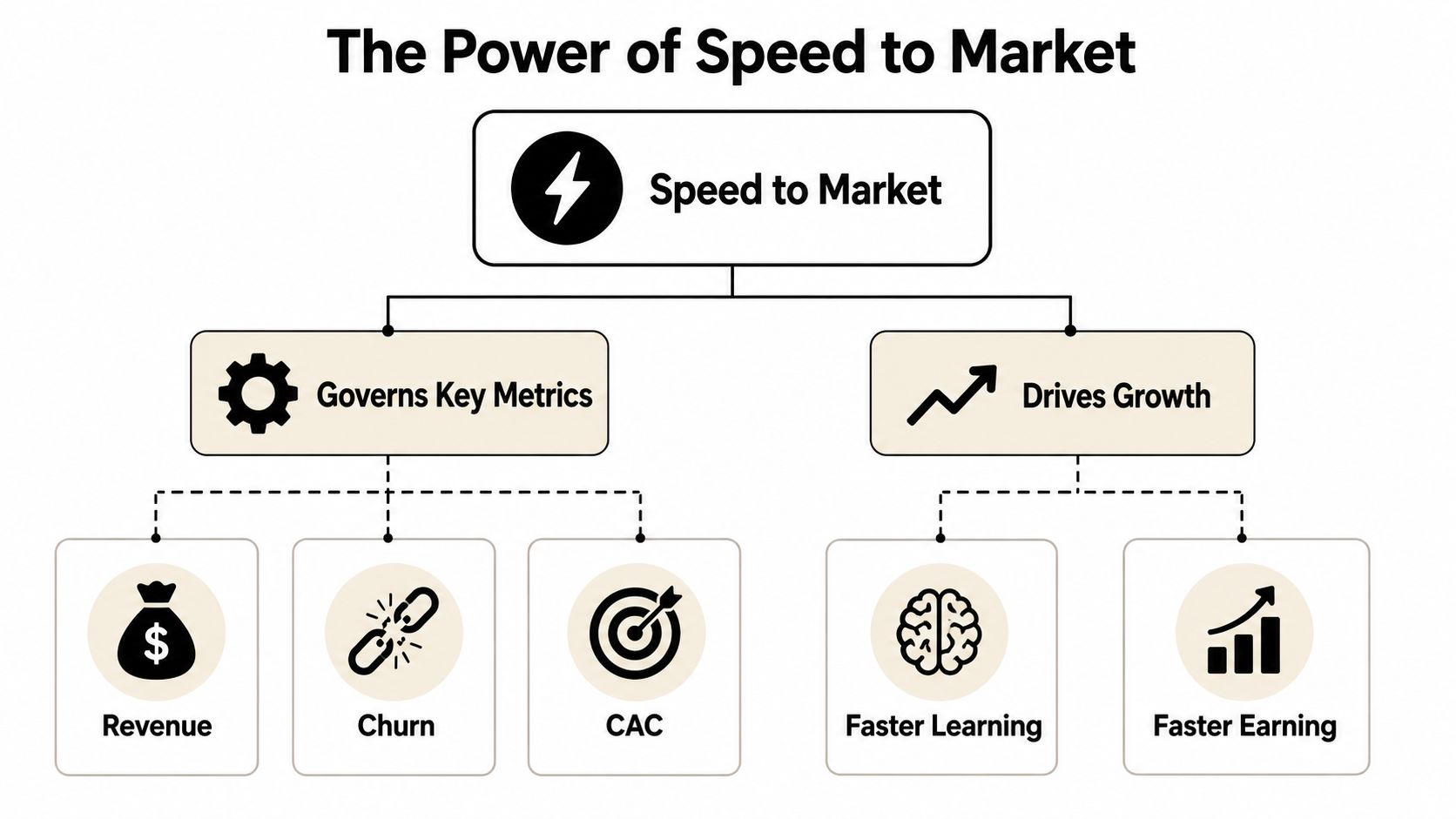
Most B2B dashboards obsess over revenue, CAC, win rate, and churn. Those are outcome metrics. Useful, but late. Speed is the operating metric underneath them.
If you improve speed to market, you don’t just move faster. You increase the rate at which your team learns what buyers want, what messaging works, and which channels produce real pipeline. That learning compounds. A company that runs more feedback cycles usually makes better strategic decisions because it’s working with fresher market evidence.
Early in the process, it helps to visualize how much speed influences the rest of the business.
Treat speed like compounding interest
A slow company pays hidden interest on every delay. Product insight comes later. Revenue starts later. Customer objections surface later. Pricing feedback comes later. Competitors get more time to frame the category.
A faster company gets paid earlier in information.
That’s why I advise leadership teams to stop discussing speed as a soft cultural preference. Define it as an operating discipline with hard boundaries. Research on speed-to-market measurement makes the point clearly. Metrics only become useful when teams specify the exact start and end points of the cycle, and when they track different product types separately so comparisons stay valid, as outlined by Business Innovation Management’s guidance on measuring speed to market.
Build one speed dashboard
If your board deck has no speed layer, you’re missing the control panel. Track a small set of metrics that connect product execution to revenue outcomes:
| Metric | What it should mean inside your company | Why it matters |
|---|---|---|
| Time to market | The exact time from an agreed start point to customer availability | Shows how long delivery actually takes |
| Time to value | How quickly a new customer reaches the first useful outcome | Exposes onboarding and activation drag |
| Lead response time | How fast your team responds when a buyer raises a hand | Reveals GTM execution speed |
| Time to first customer conversations | How long it takes a launch to create real sales calls | Connects release activity to market traction |
A good dashboard creates accountability across functions. Product can’t hide behind shipped code. Marketing can’t hide behind impressions. Sales can’t hide behind “we’ll get to it.”
A short explainer on the commercial side of speed helps frame the issue:
The leadership mistake to avoid
Many teams define speed too loosely. They say they want to move faster, but they haven’t agreed on where the clock starts, where it ends, or which delays matter most.
Practical rule: If two department heads can’t define the same timeline the same way, they’re not managing speed. They’re arguing over anecdotes.
Speed to market belongs on the executive dashboard because it governs how quickly your business turns effort into evidence.
The Playbook Part 1 Accelerating Your Product Engine
The product engine needs to produce market-ready releases, not big internal milestones. If your team still ships in large quarterly batches, you’re paying for delay with confusion, rework, and weak feedback.
The better model is smaller and tighter. Engineering speed to market improves with small, frequent releases because they reduce batch size, lower integration risk, and shorten feedback loops. A practical benchmark is sub-5-minute builds and test suites that finish in under 10 minutes, according to Strapi’s engineering guidance on faster delivery.
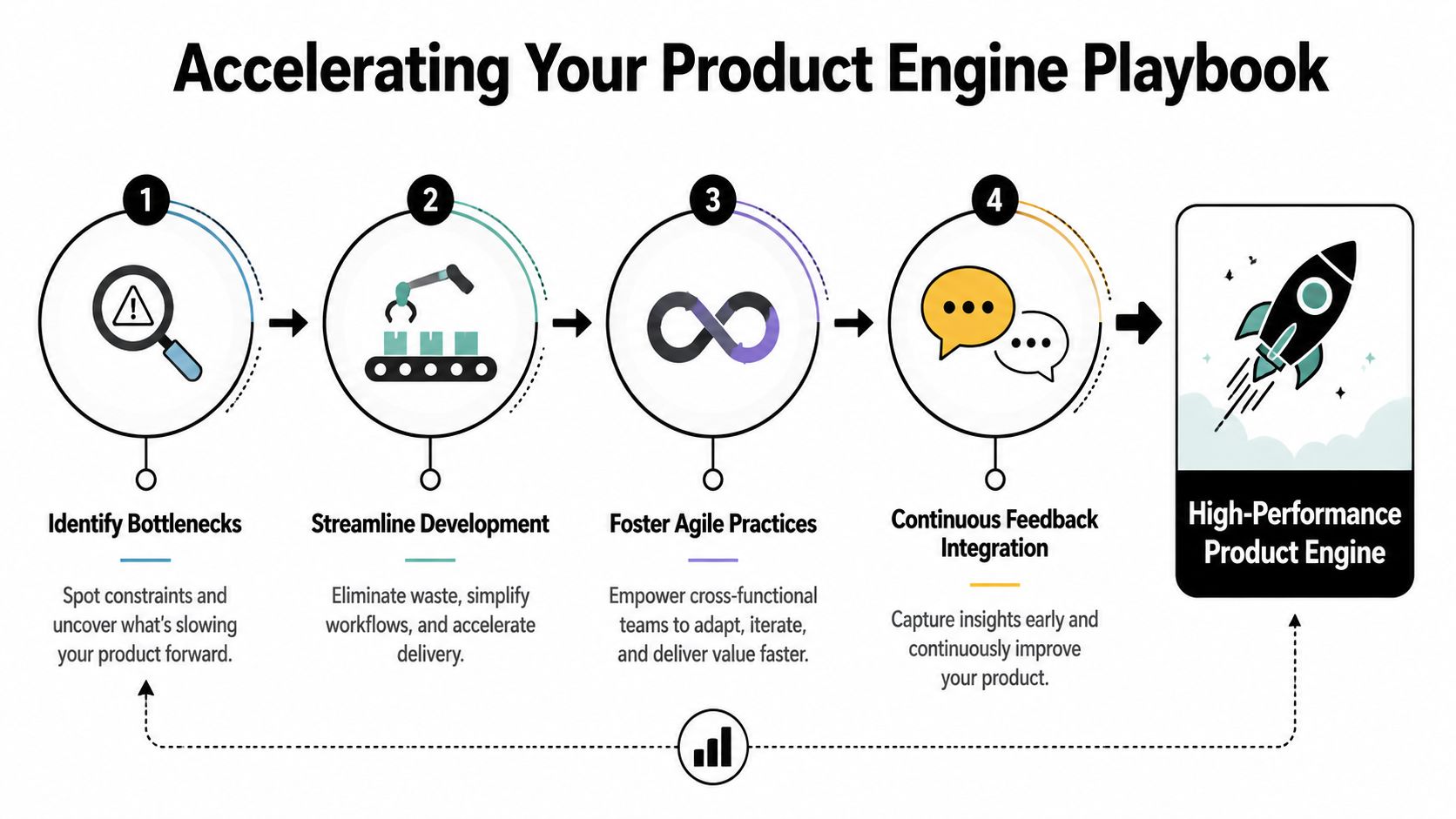
Shrink the batch size
Big releases create fake efficiency. Teams feel productive because they’re bundling many changes into one event. In practice, that creates more dependencies, more QA pain, and slower learning.
Use this operating model instead:
-
Break features into releasable slices Don’t wait for the perfect bundle. Ship the smallest version that can create a real user response.
-
Make CI fast enough to support decisions If engineers wait too long for builds and tests, they delay commits, stack changes, and raise integration risk.
-
Push discovery into the sprint Product managers shouldn’t disappear into long planning cycles while engineers wait for answers.
Use MVPs the right way
An MVP isn’t a stripped-down version of your ambition. It’s a tool for testing the riskiest assumption first. That might be the workflow, the pricing model, the integration requirement, or the trigger that makes a buyer care.
The wrong MVP asks, “What can we launch quickly?”The right MVP asks, “What do we need to learn before we commit more resources?”
That mindset matters even more when content, demos, and onboarding are increasingly supported by automation. Teams exploring natural language generation often discover that the technology isn’t the bottleneck. The bottleneck is how quickly they can test whether users trust, adopt, and repeat the behavior the feature is designed to produce.
Remove avoidable build friction
Not every product needs a fully custom surface area on day one. For landing pages, microsites, or early campaign infrastructure, speed often improves when teams avoid unnecessary engineering work. In those cases, a guide on choosing a no-code website builder can help marketing and product teams stand up launch assets without waiting on the core roadmap.
Small releases don’t lower standards. They expose problems while they’re still cheap to fix.
If your product engine is healthy, you’ll see a pattern. Releases get smaller, deployment confidence goes up, and commercial teams get usable assets earlier. That’s when speed starts turning into traction.
The Playbook Part 2 Your Go-to-Market Launchpad
A product can be ready while the market is still cold. That’s the disconnect that kills launches.
Too many teams build first, then start thinking about audience, messaging, lists, proof, pricing language, and sales enablement. That sequence is backward. Go-to-market work should run beside product development, not after it.

Build demand before the release
The cleanest launch is the one that starts with existing interest. That means your team should already know:
-
Who the ICP is and which segment feels the pain most acutely
-
What message gets a reaction in outbound, content, and demos
-
Which objections repeat so sales and product can address them early
-
What proof the buyer needs before they’ll take a meeting
A strong pre-launch motion often includes waitlists, early-access outreach, founder-led discovery calls, demo-page tests, and message testing with paid traffic or outbound email. The point isn’t vanity. The point is to expose weak positioning before launch amplifies it.
Product and GTM need one timeline
I like to map launches against one shared commercial calendar instead of separate departmental plans.
| Workstream | What should happen before launch |
|---|---|
| Product | Core use case validated, onboarding path clear, demo environment stable |
| Marketing | Messaging tested, landing pages live, core content ready |
| Sales | Objection handling prepared, target accounts defined, outreach sequences drafted |
| Customer success | Early onboarding and feedback capture process ready |
That alignment is where many teams finally understand the full funnel. If your organization still thinks in disconnected handoffs, it helps to revisit the structure of a B2B marketing funnel and map every launch asset to a real buyer stage.
De-risk launch with live market signal
You don’t need perfect certainty. You need enough evidence to avoid launching blind.
Run message tests before the code is final. Show prototypes in sales calls. Test subject lines and landing page headlines against the same pain point. Let actual buyer reactions shape packaging and demos.
The fastest launch is often the one that started selling before the roadmap was fully complete.
When GTM runs in parallel, launch day stops being a guess. It becomes the moment you scale what the market has already started validating.
The Playbook Part 3 From Launch to Lead in Record Time
You ship on Tuesday. By Friday, the team is already questioning the launch.
A few forms came in. Demo requests sat in a queue. Sales started outreach after the announcement instead of before it. Product did its job fast, but go-to-market response moved at normal corporate speed. That is how companies waste the advantage they just earned.
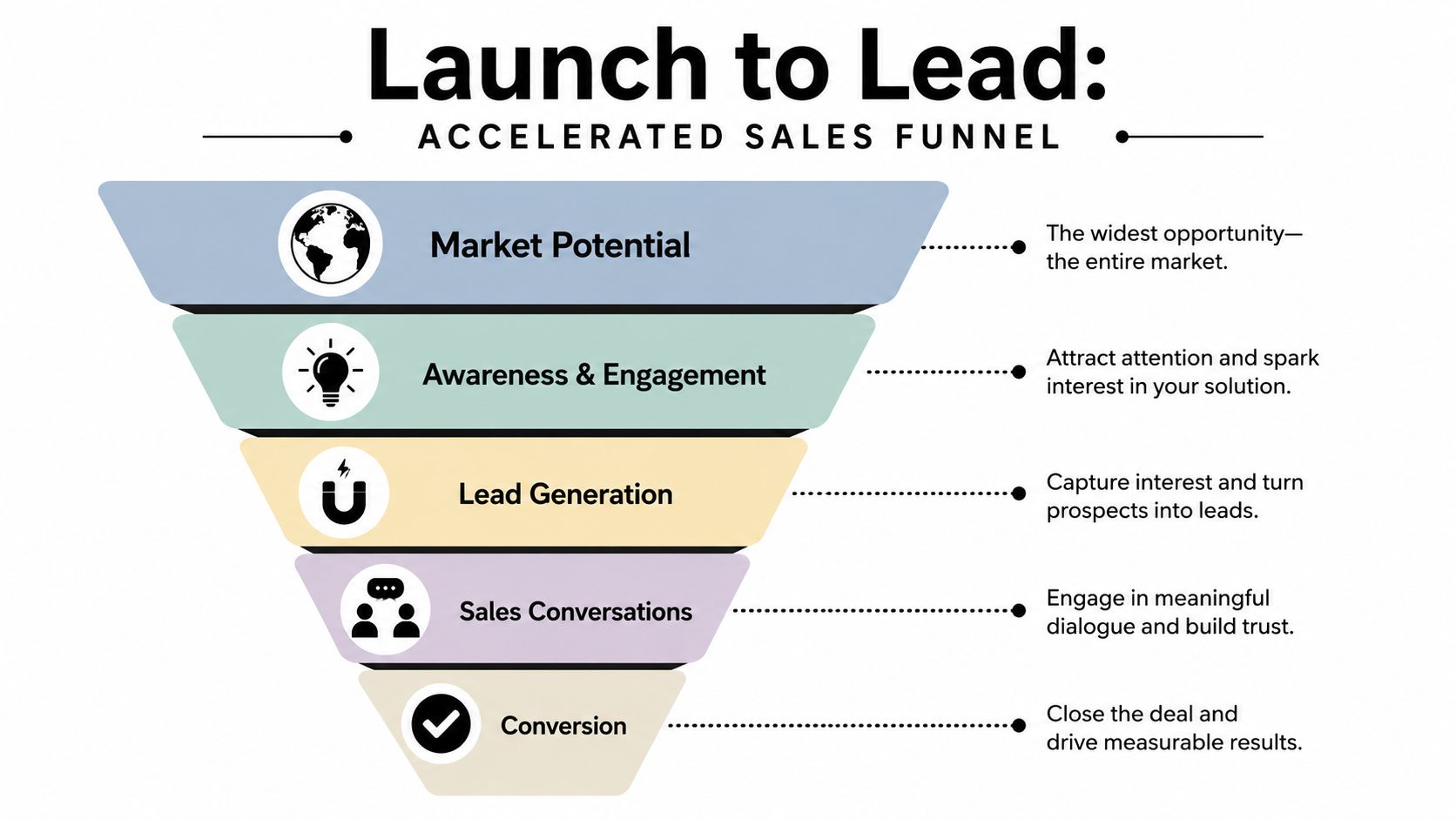
The lag that kills launch momentum
Speed to market does not end at release. It ends when qualified buyers enter active sales conversations.
Analysts cited in Amplemarket’s roundup of speed-to-lead benchmarks found that B2B lead response times are often measured in many hours, while faster teams win materially more revenue. The practical takeaway is simple. A slow first response makes a good launch look weak because interested buyers cool off before anyone engages them.
That is why launch performance should be judged by one question first. How fast did your team turn market attention into booked conversations?
Build a response system before launch day
If launch creates demand, your job is to catch it immediately.
Set up the commercial side before the announcement goes live. Route inbound by account tier, use prewritten outbound sequences for priority targets, define qualification rules in advance, and remove approvals from meeting booking. Speed to lead is an operating decision, not a rep personality trait.
A workable system usually includes:
-
Inbound routing rules that send qualified requests to the right owner fast
-
Prebuilt outbound plays for named accounts already showing fit
-
Clear qualification criteria so reps focus on real opportunities
-
Fast booking paths with fewer clicks, fewer handoffs, and fewer delays
-
Follow-up ownership with one person accountable for first response time
The companies that execute this well treat outbound as part of launch, not as a separate program that starts later. If you need a model for that motion, this guide to lead generation for tech companies shows how teams connect account targeting, outreach, and meeting creation without waiting to build a full SDR function first.
The launch window is short
Buyers pay the most attention when a problem is newly framed, a product update is announced, or timing creates urgency. That attention fades fast.
If your response process is slow during that window, competitors get the meeting, not because their product is better, but because they replied while your team was still sorting ownership.
Product velocity creates interest. Speed to lead turns interest into pipeline.
That is the full-funnel view leaders miss. Shipping fast matters. Responding fast matters more once the market starts raising its hand.
Common Pitfalls and How to Measure True Velocity
A lot of executives hear “move faster” and accidentally create chaos. They pressure teams to ship, compress review cycles, and skip hard conversations about quality, fit, and readiness. That isn’t acceleration. It’s sloppiness with a deadline.
The harder question is the right one. Does faster launch improve outcomes once you account for rework, compliance, and market fit? The strongest neutral guidance frames speed to market as a full lifecycle measure, not a launch-date trophy, and pushes leaders to ask “How fast is fast enough?” and “When does speed hurt conversion?” as discussed in Globalization Partners’ analysis of the speed-to-market tradeoff.
The traps that create fake speed
Some teams look fast internally while getting slower in the market. Watch for these patterns:
-
Shipping without adoption Features go live, but buyers don’t use them or sales can’t explain them clearly.
-
Technical debt for the wrong reason Shortcuts are acceptable when they buy learning. They’re dangerous when they only buy optics.
-
Misaligned functions Product says “released,” marketing says “not ready,” and sales says “we need better proof.”
Measure the full path, not just the release
A better scorecard blends delivery, demand, and outcome.
| Area | What to inspect |
|---|---|
| Product velocity | Cycle time, release cadence, blocked work, rework patterns |
| GTM velocity | Time from launch to first qualified meetings, message iteration speed, follow-up discipline |
| Business velocity | Time to first revenue, sales cycle friction, retention quality after acquisition |
That final layer matters. A company can create pipeline quickly and still lose if it attracts poor-fit customers or overpromises during launch.
For leadership teams, attribution becomes useful. If you can’t see which touches influenced qualified opportunities, you can’t tell whether speed improved the right part of the system. A practical primer on multi-touch attribution can help teams tie faster execution to actual commercial outcomes.
A better definition of fast
Fast doesn’t mean rushed. Fast means your team learns early, fixes quickly, and removes delay where delay adds no value.
Leadership filter: Keep the steps that protect customer trust. Remove the steps that protect internal habit.
If your current process produces polished launches with weak traction, you’re not being careful. You’re being late.
Frequently Asked Questions
Most B2B leaders don’t need more theory here. They need a few direct answers they can act on.
| Question | Answer |
|---|---|
| How do I balance speed and quality? | Don’t trade quality for motion. Trade batch size for learning speed. Release smaller units, validate earlier, and protect the parts of the process that affect trust, compliance, and onboarding. |
| Does speed to market matter if we sell into long enterprise cycles? | Yes. In enterprise, speed matters less as “ship first” and more as “learn first, position first, respond first.” Long sales cycles reward teams that clarify value and engage buyers early. |
| What’s the first change to make this quarter? | Pick one shared definition of speed to market across product, marketing, and sales. Then identify the slowest handoff in that path and fix it before adding new tools or headcount. |
Three direct rules for leaders
-
Define the clock If nobody agrees when a project starts and ends, your reporting is noise.
-
Run product and GTM together Launches fail when commercial work starts after product work.
-
Respond like timing matters If a lead comes in and your team reacts hours later, you’ve already made the market wait too long.
The simplest way to improve speed to market is to stop treating it as one team’s job. It belongs to the whole funnel.
If your product is ready but your pipeline isn’t moving fast enough, Fypion Marketing is one option to shorten the gap between launch and qualified sales conversations. Their model focuses on performance-based B2B outreach, so teams with proven product-market fit can add outbound meeting volume without first building a full in-house cold email operation.