
Email List Segmentation for B2B: Book More Meetings

You built a list, launched a sequence, and watched the campaign disappear into silence. A few opens. A handful of clicks. Almost no replies worth sending to sales. That pattern usually isn’t a copy problem alone. It’s a targeting problem dressed up as an outreach problem.
Most cold email programs fail because they treat a market like a mailing list instead of a set of buying situations. A VP of Marketing at a funded SaaS company, an operations leader at a services firm, and a founder at a lean startup might all fit your broad ICP, but they don’t care about the same pain point, don’t evaluate risk the same way, and won’t respond to the same CTA. Email list segmentation is what turns that mess into something operational.
Why Your Cold Emails Are Being Ignored
The blunt answer is relevance. Most cold emails get ignored because the sender is solving for volume first and context second. The list is broad, the message is generic, and the offer asks too much from people who don’t yet see why they should care.
That approach breaks fast in B2B. Buyers can spot a batch email in seconds. If the subject line feels vague, if the opening line could apply to anyone, or if the pitch ignores their role, they move on. Better writing helps, and these professional email writing tips are useful if your team needs a cleaner standard for tone and structure, but etiquette alone won’t rescue a mismatched audience.
The business case for segmentation is already strong. According to segmentation performance data compiled by Stripo, segmented campaigns achieve 14.31% higher open rates, 101% more clicks, and targeted lists can generate up to 760% more revenue than non-segmented campaigns. Those numbers matter because they reflect a simple operating truth. Relevance compounds.
Generic cold outreach asks the prospect to do the segmentation for you. They have to decide whether your message applies to them. Most won’t spend the time.
In practice, poor segmentation usually shows up in a few ways:
-
One offer for every role. The same email goes to founders, directors, and managers even though each person owns a different problem.
-
Industry-only targeting. “Healthcare” or “SaaS” becomes the whole strategy, with no distinction between maturity, buying motion, or current trigger.
-
Static lists that age badly. A prospect changed jobs, adopted a new tool, or stopped fitting the account profile, but the sequence kept running.
-
Optimization around opens. Teams celebrate subject line gains while booked meetings stay flat.
If you’re trying to improve campaign performance, start with better audience design before you touch sequence length. This guide on improving email open rates with simple tactics is useful, but opens become much easier to lift when the list itself makes sense.
Cold outreach works when the recipient feels that the email was sent for a reason. Segmentation gives you that reason.
Defining Your Segmentation Criteria
A VP of Marketing at a 120-person SaaS company does not read cold email the same way as a demand gen manager at a 20-person startup. One is managing team efficiency, reporting pressure, and tool sprawl. The other is trying to hit pipeline targets with limited headcount. If both get the same sequence, one of them is getting the wrong message.
That is the job of segmentation in cold outreach. Separate contacts by buying situation, not by whatever fields happened to come with the list.
Start with the ICP, not the export
Strong segmentation starts before list building. It starts with a clear view of who buys with the least friction, who feels the problem sharply enough to reply, and who can move a deal internally.
A lot of outbound programs skip that step. They export a large audience, then build filters around available columns. The result looks organized inside the CRM but falls apart in live campaigns because the segments do not reflect why someone would care.
If your ICP is still broad, fix that first. This guide on creating buyer personas for better outreach is a good starting point for tightening role-specific targeting.
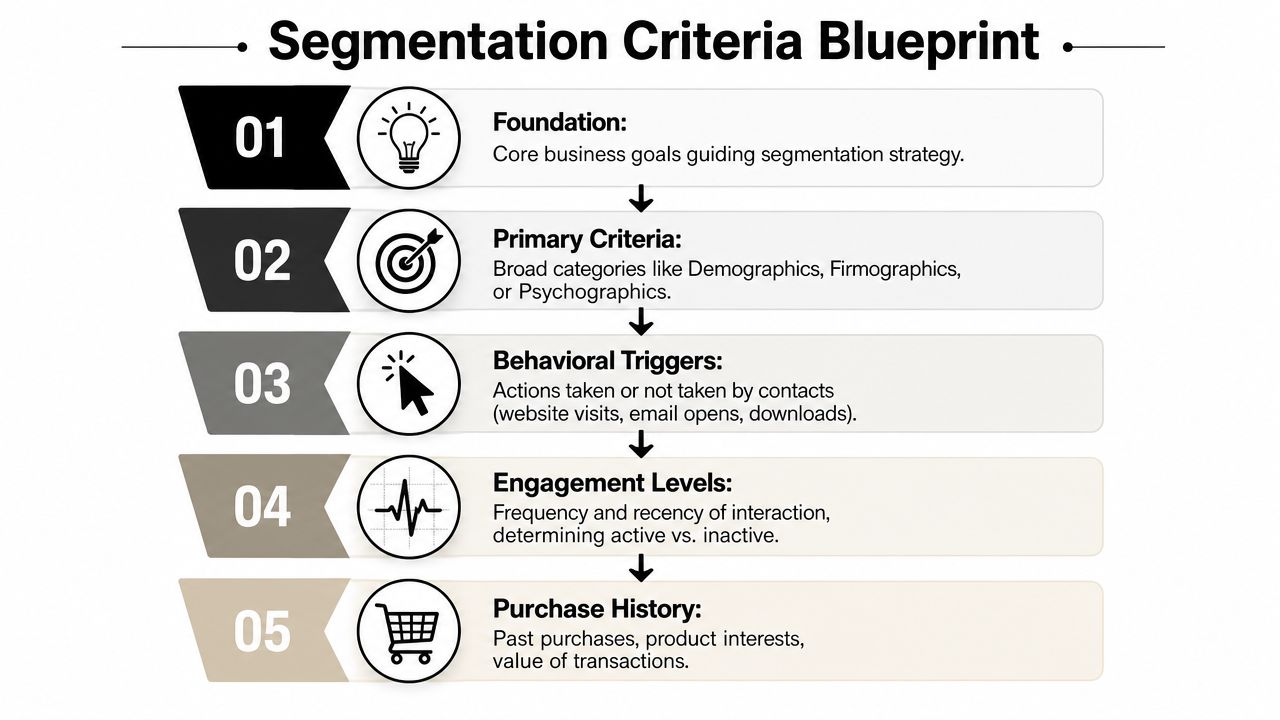
Once the ICP is defined, choose the few criteria that change the conversation.
Use layered criteria that map to buying context
In B2B cold outreach, one field rarely gives you enough signal. Industry alone is too broad. Job title alone is messy. Even technographics can mislead if you do not pair them with role and company stage.
Useful segments usually combine signals from different categories:
-
Firmographic fit. Industry, company size, geography, growth stage, business model.
-
Role relevance. Job title, department, ownership area, level of influence.
-
Technographic context. Core tools, competitor usage, integrations, platform maturity.
-
Behavioral clues. Hiring activity, recent funding, content engagement, website actions, event participation.
-
Lifecycle position. New prospect, recycled lead, stalled opportunity, active account.
The goal is not to collect more fields. The goal is to identify which fields change pain, urgency, budget, or message angle.
I usually start by asking three questions. Does this variable affect the problem they feel? Does it affect the language they use to describe it? Does it affect whether they can act on it now? If the answer is no across all three, it probably does not deserve segment-level status.
Avoid segments that look smart but do not scale
Over-segmentation is common in teams that are trying to personalize aggressively. They build tiny audiences with six or seven filters, write custom copy for each one, and end up with volumes too small to test. Then the team cannot tell whether the offer worked, the segment was weak, or the copy missed.
A better operating rule is simple.
Practical rule: If a segment cannot support repeat testing, treat the field as a personalization variable, not a separate campaign lane.
That trade-off matters in cold outreach more than it does in inbound. Data is often incomplete, title formats are inconsistent, and intent signals can be stale within weeks. A segment that depends on perfect enrichment usually breaks in production.
Build segments around situations, not categories
For a SaaS company selling to marketing teams, these segment types tend to produce clearer messaging and better meeting quality:
| Segment type | Better example | Why it works |
|---|---|---|
| Broad | Marketing leaders in SaaS | Too wide to support one angle |
| Better | Series A to B SaaS, marketing director level | Similar growth pressure and role ownership |
| Strong | Series A to B SaaS using a competitor and hiring demand gen roles | Clear pain, likely budget, active trigger |
| Strong | Enterprise SaaS on HubSpot with multi-region teams | Different scale, process, and buying friction |
Notice what is happening in the stronger examples. The segment is not just who they are. It includes what is likely happening inside the account right now.
That is where cold outreach segmentation gets more effective. Instead of static buckets like “healthcare leads” or “mid-market contacts,” build dynamic groups around conditions that change messaging. New hire surge. Recent funding. Tool migration. Expansion into a new region. Open roles tied to the function you serve. Those signals are often imperfect, but they still outperform generic segmentation because they give your email a reason to exist.
If you work in a niche category, examples from adjacent verticals can still help sharpen sourcing logic. This guide on sourcing real estate email lists effectively shows the value of defining list criteria around actual use case and fit instead of raw volume.
What to ignore early
Some filters create extra work without improving relevance:
-
Minor title variations when the function and buying role are the same
-
Tiny geographic splits unless region affects compliance, language, or sales coverage
-
Weak interest tags without a clear action behind them
-
Long chains of filters that no one on the team can maintain reliably
Good segmentation creates clear groups. High-performing segmentation creates groups your team can source, tag, message, test, and refresh without rebuilding the system every month.
Building and Enriching Your B2B Contact List
A segment is only as good as the data behind it. In cold outreach, that usually means dealing with incomplete records, stale fields, and contact data pulled from multiple sources that don’t agree with each other. The fix isn’t to wait for perfect data. It’s to build a list workflow that improves quality before the campaign starts.
Here’s a practical view of that workflow.
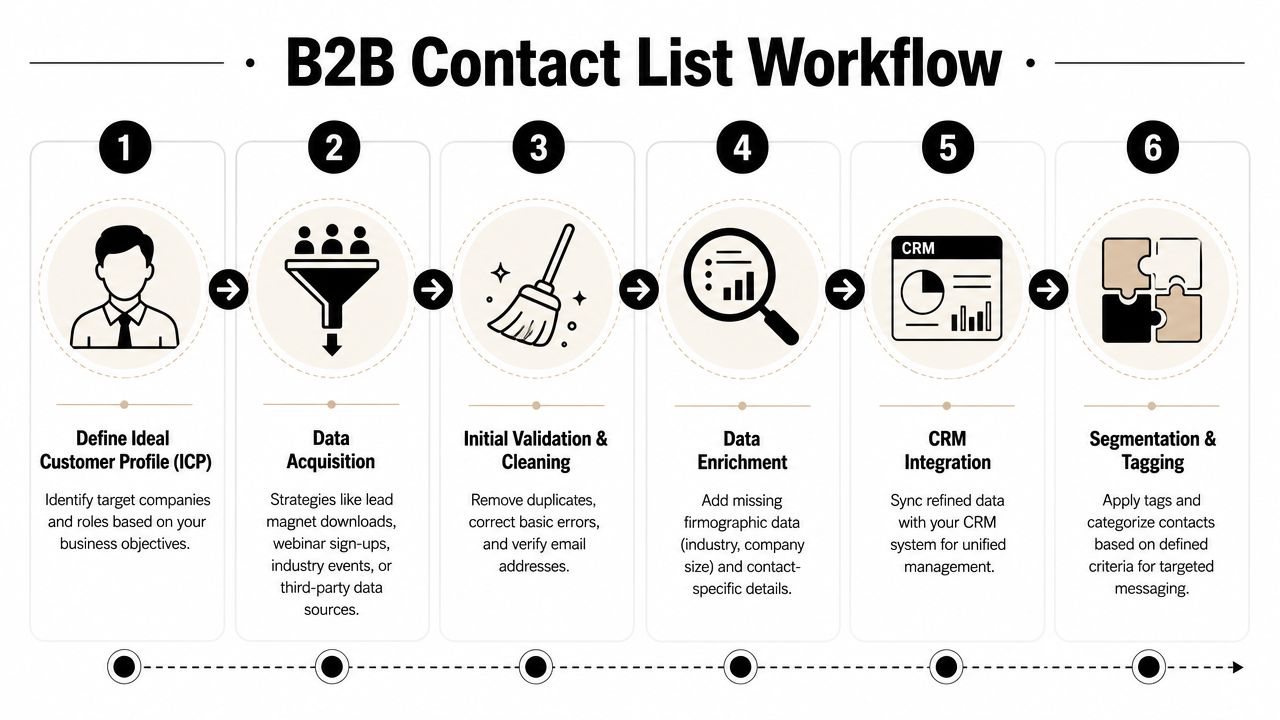
Source for fit, not just reach
Organizations commonly identify sources for names. LinkedIn Sales Navigator, Apollo, ZoomInfo, Clay, company websites, event attendee lists, and CRM recycling are common starting points. The key difference is how tightly you define extraction rules.
Instead of exporting “all Heads of Marketing in SaaS,” narrow the source logic around an actual buying situation. Pull companies in a specific band of maturity. Add known tool usage. Exclude accounts that don’t match your sales motion. Include only titles that can influence the problem your offer solves.
If you’re in a niche market, examples from adjacent verticals can help you think through sourcing structure. For instance, this guide on sourcing real estate email lists effectively is useful because it shows how list quality improves when market filters and data hygiene come before send volume.
For teams comparing platforms and workflows, this roundup of sales prospecting tools can help map which tool should handle sourcing, enrichment, and sequencing.
Clean first, enrich second
Don’t enrich messy records. Clean them first. Remove duplicates, standardize company names, normalize title variants, and flag records that don’t meet your minimum ICP threshold.
Then enrich around fields that support segmentation and messaging. The best enrichment categories for cold outreach usually include:
-
Company context such as industry, employee band, funding status, hiring signals, and region
-
Role context including function, seniority, and likely ownership of the pain point
-
Technology context like CRM, MAP, analytics, support stack, or relevant competitor usage
-
Trigger context such as recent hiring, expansion, product launch activity, or content engagement
Not every field needs to be perfect. But the fields that drive targeting and copy need to be consistent.
The difference between a static list and a working outbound dataset is whether the record tells you what to say, not just who to send to.
Place the video after you’ve mapped the sourcing and enrichment process internally. It gives a useful visual reference for list-building workflow.
Add behavioral data wherever possible
Static firmographic data helps you identify fit. Behavioral data helps you identify timing. That’s a major distinction.
Mailchimp notes in its overview of email segmentation best practices that the most effective segmentation relies on behavioral and lifecycle data, not just static demographics. It recommends prioritizing signals like purchase history, website activity, and email engagement, and using automated workflows so segments update as contact behavior changes.
In B2B cold outreach, you won’t always have rich first-party behavior for every prospect. But when you do have it, use it aggressively. Site visits, previous replies, webinar registrations, content downloads, and CRM stage changes often tell you more than industry alone.
The enrichment mindset that actually works
Think of enrichment as a triage system:
-
Fit fields decide whether a prospect belongs in your market.
-
Message fields shape angle and CTA.
-
Timing fields decide when to send and whether to prioritize.
-
Automation fields determine how the contact should move between segments over time.
That sequence keeps the list useful. Without it, enrichment turns into database decoration.
Implementing Segments with Tags and Filters
Most segmentation plans either become operational or die in a spreadsheet. If your segments only exist as ideas in a strategy doc, they won’t change campaign performance. They need to live inside the CRM or outbound system as tags, custom fields, and dynamic filters that update without manual cleanup every week.

Separate fields by job
The cleanest setup uses three distinct building blocks.
| Data structure | Best use | Example |
|---|---|---|
| Tags | Fast labels for campaign logic | , , |
| Custom fields | Stable attributes | employee range, CRM used, lifecycle stage |
| Smart lists or filters | Live audience definitions | SaaS + VP Marketing + no reply + active interest |
Tags are flexible, but they get messy when teams use them for everything. Custom fields are more disciplined, but too many become hard to maintain. Smart lists are where the system becomes useful because they combine the underlying data into a sendable audience.
If you’re connecting tools across CRM, enrichment platform, and sequencer, this walkthrough on CRM integration is a useful reference point.
Build dynamic segments, not one-off exports
A common mistake is exporting a filtered CSV, uploading it into the sequencer, and calling that a segment. That’s not a segmentation engine. That’s a temporary audience snapshot.
Use rules that keep segments live. A practical example might look like this:
-
Company type is B2B SaaS
-
Employee band falls within your target range
-
Role contains VP Marketing, Head of Demand Gen, or Director of Growth
-
Engagement status shows no reply in a recent period
-
Suppression rules exclude active opportunities, current customers, and unsubscribed contacts
That creates a reusable lane for outreach and retesting. As records change, the segment changes with them.
Naming conventions matter more than people expect
Poor naming kills scalability. If one teammate tags “SaaS,” another writes “software,” and a third uses “b2b_saas,” the system becomes unreliable.
Use a simple pattern:
-
for industry
-
for function
-
for company band
-
for stack
-
for behavior or event
-
for lifecycle state
That structure makes filters readable and helps operators spot errors quickly.
Bad segmentation usually isn’t a strategy failure. It’s an operations failure caused by inconsistent fields and unclear ownership.
Keep suppression logic just as strict as targeting logic
The best cold outreach systems are good at exclusion. Every segment should have negative filters, not just inclusion rules.
At minimum, suppress:
-
current customers
-
open deals
-
recent hard bounces
-
unsubscribed contacts
-
contacts already active in another outbound sequence
-
prospects whose segment no longer matches your offer
That last one matters. If a prospect moved from startup to enterprise conditions, your original angle may now be wrong. Dynamic filtering prevents stale messaging from dragging down performance.
Audit segments like product assets
Segments should be reviewed the same way you’d review workflows or landing pages. Ask:
-
Is this segment still large enough to support testing?
-
Do the tags still reflect current data definitions?
-
Are we seeing overlap with other campaign lanes?
-
Does this segment justify unique messaging?
If the answer is no, merge it, simplify it, or retire it. A lean segmentation system outperforms a complex one that nobody trusts.
Tailoring Your Messaging for Maximum Impact
Segmentation only pays off when the message changes with the segment. Many organizations stop at surface personalization. They add a first name, mention a company, maybe reference an industry. That isn’t enough for B2B cold outreach. The fundamental shift happens when the angle, proof, and call to action change based on what that segment values.
A startup CTO and an enterprise CFO can both influence the same purchase. They still need different emails.
Change the conversation, not just the tokens
The CTO usually cares about implementation friction, team bandwidth, speed, and whether the product fits the existing stack. The CFO cares about cost control, risk, return, and process. If both contacts receive the same “quick chat?” email with the same value proposition, one of them is reading the wrong story.
Segmentation gets practical. You’re not writing one universal sequence anymore. You’re building message families.
| Element | Segment A: Startup CTO | Segment B: Enterprise CFO |
|---|---|---|
| Core concern | Shipping faster with fewer operational bottlenecks | Protecting budget and reducing financial waste |
| Opening angle | Product velocity, integrations, lean execution | Efficiency, cost visibility, procurement discipline |
| Proof style | Technical fit, workflow simplicity, team adoption | Business case, control, reduction of avoidable spend |
| CTA | Short technical fit discussion | Short call around financial impact and rollout scope |
| Tone | Direct, product-aware, concise | Structured, risk-aware, business-oriented |
Example of how the copy should shift
For a startup CTO, the email might lead with a workflow problem:
Your team probably doesn’t need another platform. You need fewer handoffs, cleaner integrations, and less time lost to manual work.
That line works because it respects a technical buyer’s skepticism. It doesn’t oversell. It frames the problem around execution.
For an enterprise CFO, the opening should sound different:
When teams buy point solutions faster than finance can evaluate them, software spend expands long before efficiency does.
Now the frame is control and resource allocation. Same product category. Different buying lens.
What personalization at scale actually looks like
Good personalization in cold outreach isn’t handcrafted trivia. It’s pattern-based relevance. That means using segment-level truths rather than pretending every email was written from scratch.
The best teams usually vary these elements by segment:
-
Pain point framing based on role and company stage
-
Objection handling based on likely buying friction
-
Proof type based on what the persona trusts
-
CTA language based on decision authority and urgency
A useful way to pressure-test your copy is this. Remove the company name and first name. If the email still clearly sounds like it belongs to one narrow segment, you’re in good shape.
Message check: If the same draft could be sent to a founder, a department head, and a finance lead without major rewrites, the segment is still too broad.
Borrow communication discipline from other service contexts
Strong segmented messaging isn’t unique to SaaS. Service businesses learn the same lesson fast. Even outside B2B tech, clear audience-aware communication improves response quality. This piece on client communication best practices for salons is a good reminder that people respond better when messages match expectations, timing, and relationship context.
What doesn’t work
Some personalization tactics look impressive but underperform in real pipelines:
-
Forced compliments about a recent post or podcast appearance
-
Overwritten openers trying too hard to prove research
-
Role-agnostic CTAs that ignore buying authority
-
Feature dumps with no segment-specific reason to care
The highest-performing cold emails usually feel restrained. They sound like someone understood the recipient’s situation, chose one relevant angle, and respected the reader’s time.
Booked meetings don’t come from sounding personalized. They come from being relevant enough that replying feels worth it.
Measuring and Optimizing Your Segmentation Strategy
A segment is only useful if it produces qualified meetings at a lower cost and with less manual work. I have seen outbound teams build beautiful segment trees in the CRM, then realize the highest-response bucket never turns into real pipeline. Clean logic is nice. Sales movement matters more.
That changes what you measure.
Open rate can still help diagnose subject lines or inbox placement, but it should not drive segmentation decisions on its own. In cold outreach, the question is whether a segment creates enough relevance to earn a reply from the right person, then carries through to a real sales conversation.
Track metrics that map to pipeline quality
Review performance at the segment level, not just at the campaign level. A campaign can look healthy overall while one segment books meetings and another produces polite dead-end replies.
Track:
-
Reply rate to see whether the segment-message match is strong enough to start conversations
-
Positive reply rate to separate interest from unsubscribes, referrals, and brush-offs
-
Qualified meetings booked to measure whether the segment is attracting accounts that fit your sales criteria
-
Stage conversion by segment from meeting to opportunity or next accepted pipeline stage
-
Revenue per email sent, if your attribution model is clean enough to trust
For a broader measurement framework, this guide to email marketing KPIs that actually drive business growth is a useful reference.
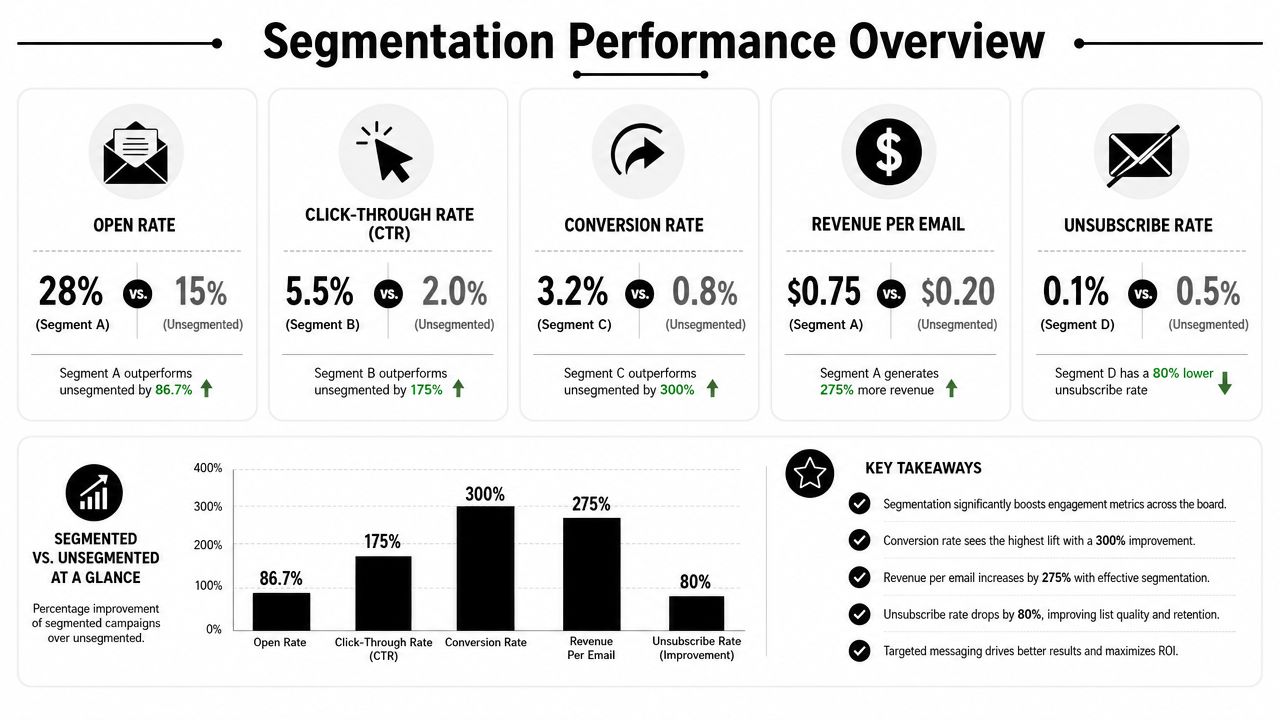
Cold outreach adds another layer that standard email reporting often misses. You are working with incomplete data, changing job scopes, and intent signals that are often inferred rather than confirmed. Because of that, segment health also depends on operational indicators such as contact coverage, tag accuracy, overlap between lists, and how quickly a segment can be refreshed without manual cleanup.
Run controlled tests instead of stacking changes
Optimization breaks down when teams change the segment, the copy, the CTA, and the send timing in the same week. If results improve, nobody knows why. If results drop, nobody knows what to fix.
Test one variable at a time:
| Test type | What changes | What stays fixed |
|---|---|---|
| Segment vs broad list | audience definition | same offer and copy structure |
| Segment-specific copy vs generic copy | message angle | same audience |
| Trigger-based segment vs static segment | timing logic | same offer |
| CTA variant by role | ask and next step | same segment and core value proposition |
In practice, behavior-based segments usually beat static firmographic buckets once volume is high enough to support them. The trade-off is maintenance. A segment built around hiring activity, recent funding, tech adoption, or site behavior can outperform a simple industry list, but only if the signal is refreshed often enough to stay true.
Audit for segment decay
Segments lose value gradually.
Contacts switch companies. Tags stop syncing. Sales teams redefine qualification without updating filters. Two campaigns start hitting the same account under different labels. Six weeks later, reply rates slip and nobody can tell whether the issue is messaging, market fit, or list logic.
Review these questions on a fixed schedule:
-
Are multiple segments targeting the same contacts with slightly different logic?
-
Are some segments too small to justify custom copy and reporting?
-
Are tags still connected to meaningful message changes?
-
Are behavior-based triggers still current, or are they pulling in stale accounts?
-
Are booked meetings concentrated in a few segments while the rest create activity without pipeline?
Good segmentation is a working system, not a one-time setup. The best teams prune segments aggressively, merge weak buckets, and keep investing in the slices that consistently turn cold outreach into qualified conversations.
If a segment looks organized but does not book meetings, remove it.