
Sales Outsourcing B2B: Guide To Scaling Your Revenue

Your pipeline probably isn’t broken because your team lacks effort. It’s usually broken because the scaling model no longer fits the stage you’re in.
A founder hires one SDR and asks for research, list building, sequencing, follow-up, CRM hygiene, and meeting setting. A sales director adds headcount, then discovers the full burden isn’t salary alone. It’s onboarding, management time, tooling, inconsistent output, and the lag between hiring and useful pipeline. At that point, sales outsourcing b2b stops looking like a shortcut and starts looking like a systems decision.
The companies that use outsourcing well don’t treat it as “rent some reps.” They use it to buy speed, specialization, and accountability. The companies that use it badly outsource activity, then wonder why they got noise instead of revenue.
Is In-House Sales Scaling Holding You Back
The warning signs are familiar. Your account executives are prospecting when they should be closing. Your sales manager is reviewing outreach copy instead of coaching deals. Your pipeline depends on a few people doing too many jobs at once.

That’s why sales outsourcing b2b has moved from edge tactic to mainstream growth lever. The market itself shows where buyer behavior is heading. The global B2B sales outsourcing services market is valued at approximately USD 127.02 billion in 2026 and is projected to reach USD 260.65 billion by 2035, reflecting a 9.78% CAGR, according to Business Research Insights on the B2B sales outsourcing services market.
The real bottleneck isn’t effort
Most in-house teams don’t fail because they lack smart people. They fail because they overload generalists with specialist work.
A good outbound function needs clean targeting, usable data, strong copy, inbox management, follow-up discipline, qualification logic, CRM reporting, and a clean handoff to sales. One person rarely does all of that well for long. Even when they can, it usually doesn’t scale predictably.
Practical rule: If your closers are spending meaningful time creating pipeline from scratch every week, your sales model is leaking capacity.
Why outsourcing makes sense now
Modern buyers live in digital channels. Outreach, qualification, and meeting creation increasingly happen before a rep ever gets live buying signals. That changes the economics of pipeline creation. Instead of building every capability internally, many teams now keep strategy and closing in-house, then outsource top-of-funnel execution to a partner with existing systems.
That’s the useful lens for this topic. Sales outsourcing b2b isn’t a replacement for your revenue team. It’s a way to extend it without carrying all the fixed cost and operational drag of internal expansion.
The right outsourced setup gives you three things in practice:
-
Faster coverage: You reach more of your addressable market without waiting for internal hiring cycles.
-
Better specialization: Data work, outreach execution, and qualification can sit with people who do that all day.
-
Cleaner accountability: It becomes easier to judge output when the partner is tied to outcomes instead of internal busyness.
What good looks like
Good outsourcing doesn’t hide behind activity. It doesn’t celebrate high email volume or packed calendars if sales rejects the meetings.
Good outsourcing produces qualified conversations that your account executives want. That distinction matters because a busy calendar can still be a weak pipeline.
Decoding B2B Sales Outsourcing Models
Think of sales outsourcing b2b the same way you’d approach a construction project. You don’t hire one contractor to pour the foundation, wire the building, install the plumbing, and finish the interiors. You bring in specialists for different stages, then make sure the work connects cleanly.
The same logic applies to outsourced sales. Different models solve different pipeline problems.
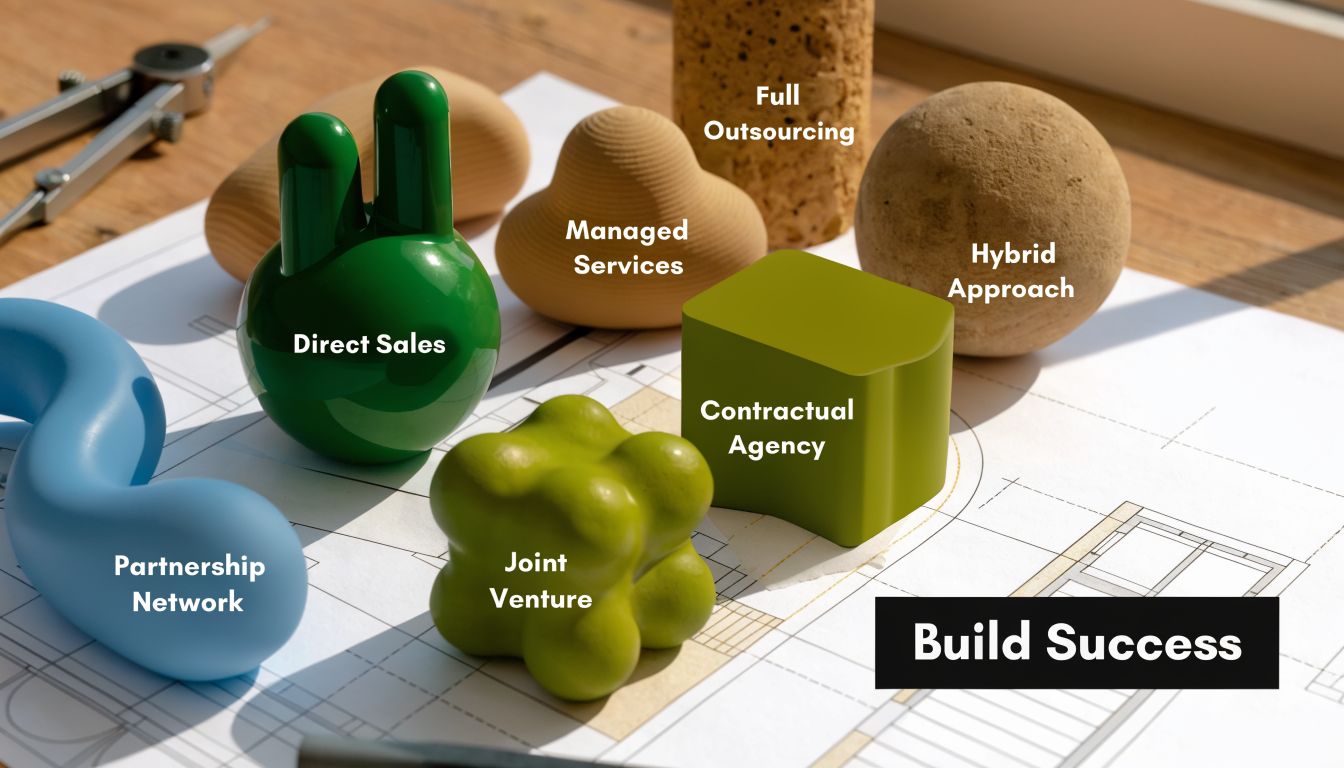
Lead generation as the foundation
This is the base layer. A lead generation partner handles audience definition, list building, message development, and outbound execution across channels such as cold email and phone.
This model fits companies that know who they want to sell to but can’t consistently reach enough of those buyers. It’s especially useful when the internal team has product-market fit and a working sales motion, but not enough prospecting capacity.
The main deliverable is market coverage and conversation creation. If the provider is good, they also sharpen your ICP by showing which segments respond, which titles engage, and which messages fall flat.
For teams weighing this option, an overview of outsourcing inside sales helps clarify where prospecting support ends and deeper sales execution begins.
Appointment setting as the framing
Appointment setting is narrower. The provider’s job is to turn outreach into booked meetings that fit agreed criteria.
This model works when your internal account executives or founders are strong on discovery and closing, but their calendars aren’t full enough. You don’t need someone to own the whole funnel. You need someone to create qualified first conversations at a steady pace.
The risk is obvious. If qualification is weak, appointment setting can fill calendars with people who are curious but not viable buyers. That’s why this model only works when qualification rules are explicit and enforced.
The more complex your sale is, the more dangerous vague definitions of a “qualified meeting” become.
Outsourced closers as the finishing layer
Some companies outsource later-stage selling. That can include discovery, demos, follow-up, proposal management, and even closing.
This model is best reserved for simpler offers, clear buying triggers, or situations where the outsourced team has real subject matter fluency. It can work for defined territories, transactional sales motions, or overflow coverage. It usually struggles when the sale depends on deep product expertise, multi-stakeholder navigation, or technical trust.
In practice, most B2B teams should be cautious here. Outsourcing top-of-funnel is usually easier than outsourcing persuasion in a complex deal.
Revenue operations as the infrastructure
The least discussed model is outsourced revenue operations. This includes CRM design, reporting, routing logic, enrichment workflows, sequence management, and process discipline.
It matters because many “sales problems” are really operating problems. You can hire more reps, but if the targeting is messy, fields are inconsistent, and handoffs break, more activity just creates more confusion.
Choosing the right layer to outsource
A simple way to decide is to look for the actual failure point:
-
Not enough target accounts reached: outsource lead generation.
-
Outreach happens, but meetings are inconsistent: outsource appointment setting.
-
Deals stall after first call: keep closing closer to home unless the sale is simple.
-
Data and handoffs are chaotic: fix revenue operations before adding more outbound.
The strongest setups usually aren’t all-or-nothing. They outsource one bottleneck, keep strategic control in-house, and expand only after the economics work.
Comparing Pricing and Contract Structures
Most sales outsourcing b2b decisions go wrong before outreach even starts. The problem isn’t the campaign. It’s the contract structure.
If you pay for the wrong thing, you’ll get more of the wrong thing. A provider paid on effort protects effort. A provider paid on closed revenue may ignore everything outside near-term deals. A provider paid on qualified meetings has a stronger reason to care about relevance and attendance, assuming the qualification standard is written clearly.
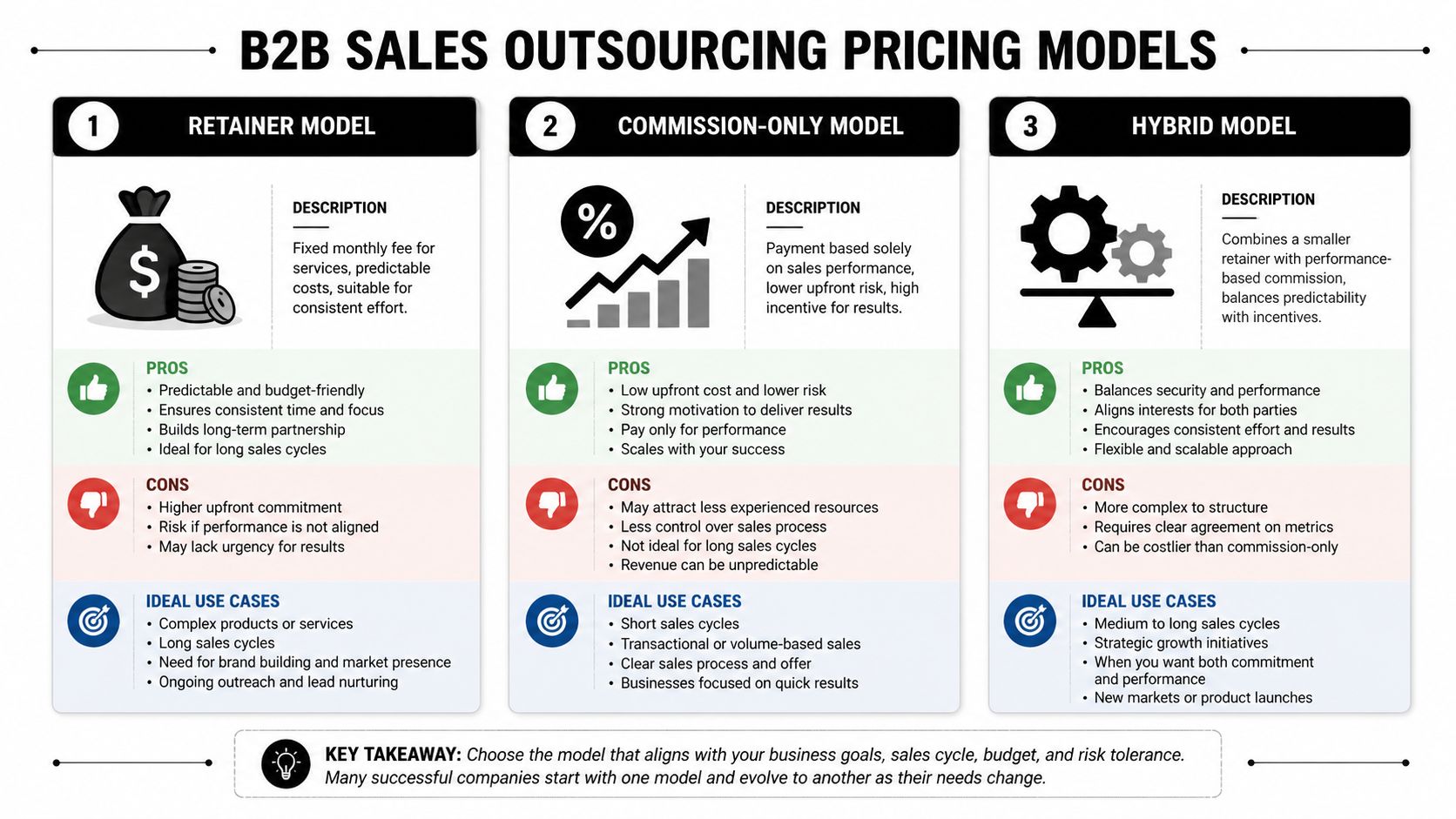
The three common pricing models
Here’s the practical comparison.
| Model | How It Works | Best For | Primary Risk |
|---|---|---|---|
| Retainer | Fixed monthly fee for ongoing sales development work | Teams that want stable delivery and can manage vendor accountability closely | You can end up paying for activity even when quality slips |
| Commission-only | Partner gets paid only when revenue closes | Offers with short cycles and direct attribution to the provider’s influence | The partner may chase easy wins and avoid harder but strategic opportunities |
| Performance-based | Payment is tied to defined outcomes such as qualified meetings | Teams that want tighter alignment between spend and pipeline creation | Poor meeting definitions can create quantity without real sales value |
A lot of teams also use hybrids, but the decision framework stays the same. What exactly triggers payment, and does that trigger match the business outcome you care about?
For a deeper look at how outcome-based buying works, this guide on price per lead models is useful because it forces the same core question. What are you really purchasing?
Why unit economics matter more than headline price
A low monthly fee can be expensive if the meetings don’t convert. A high per-meeting price can be cheap if those meetings consistently turn into pipeline.
That’s why the strongest way to judge outsourcing is through unit economics. According to Leadscale’s guide to B2B sales outsourcing and ROI measurement, the foundation is cost-per-opportunity and cost-per-qualified-meeting, and the core formula is:
Meetings Delivered × Held % × SQL Conversion Rate × Average Deal Value × Close Rate = Monthly Pipeline Revenue
This formula changes the conversation fast. Instead of arguing about email volume or rep hours, you’re asking whether a meeting source produces revenue-shaped outcomes.
How I evaluate each model in practice
Retainers can work. They’re often the easiest model for a provider to operate under because staffing and management are predictable. But they require buyer discipline. If your team doesn’t inspect quality hard, a retainer can drift into “we did the work” reporting.
Commission-only sounds attractive because it shifts risk away from the buyer. In reality, it often creates another problem. The provider only gets paid when revenue closes, but they don’t control all the variables between first outreach and signed deal. That can produce distorted behavior, weak collaboration, or a refusal to take on complex sales cycles.
Performance-based models are usually the cleanest middle ground when your need is pipeline creation, not outsourced closing. They make sense when you can define a qualified meeting in operational terms and verify it in your CRM.
If you can’t define what counts as a qualified meeting, don’t sign a pay-per-meeting contract yet. Fix the definition first.
What to calculate before you sign
Use a few simple checks before choosing a structure:
-
Map the payment trigger: Is payment tied to activity, meetings, opportunities, or closed business?
-
Check your internal handoff: If AEs don’t follow up quickly, even a good partner will look worse than they are.
-
Model the downstream math: Use your own held rate, sales acceptance logic, and close pattern.
-
Stress-test edge cases: Ask what happens with no-shows, reschedules, duplicates, or disqualified meetings.
-
Tie reporting to CRM reality: Don’t rely on a vendor spreadsheet as the system of record.
One practical example in the market is Fypion Marketing, which uses a pay-per-meeting structure for B2B cold email outreach rather than upfront fees or retainers. That model is relevant when a company wants to de-risk top-of-funnel spend and judge the partner on booked, pre-agreed meetings rather than activity volume.
The real trade-off
The best pricing model isn’t the cheapest one. It’s the one that makes bad performance hard to hide.
For most companies outsourcing prospecting and appointment generation, that usually means some form of outcome-based structure backed by clear qualification standards, clean CRM visibility, and downstream conversion tracking.
The Strategic Benefits and Hidden Risks of Outsourcing
The case for sales outsourcing b2b is stronger than it used to be because the old objection, “serious companies don’t outsource pipeline,” isn’t how the market behaves anymore.
According to Martal’s B2B prospecting research page, 79% of companies outsourcing B2B prospecting report faster market expansion and lead generation, and 78% of B2B respondents deem outbound sales outreach essential to their growth strategy. Those two figures matter together. They suggest outsourcing is being used not as a side experiment, but as an operating choice tied to growth.
Where outsourcing creates leverage
The first advantage is speed. A capable partner already has people, workflows, and outreach discipline in place. That removes a lot of the delay that comes with hiring and building from scratch.
The second advantage is specialization. Prospecting quality usually improves when list research, message testing, inbox handling, and meeting qualification are run by people who do those jobs repeatedly. Internal teams often ask one person to own all of it, and that creates uneven output.
The third advantage is flexibility. If you want to test a new segment, region, or offer positioning, an external team can often support that without forcing a permanent internal hiring decision.
What often goes wrong
Outsourcing isn’t automatically efficient. Bad outsourcing creates distance between your brand and your buyers.
Three risks show up repeatedly:
-
Brand dilution: If the provider doesn’t understand your tone, category, or buyer problems, outreach sounds generic fast.
-
Weak feedback loops: Internal teams can miss frontline objections if the vendor doesn’t log insight well.
-
Misaligned incentives: If the contract rewards activity or loose meetings, quality drops and everyone argues later.
A full calendar is not proof of traction. It may just be proof that the partner learned how to book polite conversations.
The risks that matter more in complex sales
The more nuanced the deal, the more careful you need to be. In regulated, technical, or multi-stakeholder environments, qualification standards matter far more than surface-level personalization. A partner can sound polished and still pass through the wrong opportunities.
Data handling also deserves more scrutiny than many teams give it. When external teams work across prospect records, messaging, and CRM workflows, sloppiness creates more than inefficiency. It creates trust problems internally.
When outsourcing works best
The best outcomes usually come from a narrow role for the partner and strong ownership from the client. Keep positioning, offer strategy, and close control in-house. Let the outsourced team handle high-volume, process-heavy work where repeatability matters.
That combination tends to preserve brand quality while still giving you the scale benefits outsourcing is supposed to provide.
How to Choose the Right B2B Sales Outsourcing Partner
Most vendors sound similar on sales calls. They all promise meetings, process, data, and visibility. The difference usually appears later, in how they qualify buyers, how they report bad news, and whether they can operate inside your market without sounding like tourists.

One of the biggest blind spots in this category is vertical complexity. As noted in Konsyg’s discussion of sales outsourcing in the USA, there’s a real lack of guidance around industry-specific compliance and qualification standards, especially in areas like healthcare and enterprise SaaS. That gap matters because a partner can be competent in generic outbound and still be unfit to represent a complex offer.
The non-negotiable evaluation checklist
A strong partner should pass five tests.
-
ICP understanding: They should be able to restate your ideal customer profile in plain language, not just repeat firmographic filters.
-
Qualification discipline: Ask how they decide whether someone is merely interested versus commercially relevant.
-
Process transparency: You should see how data is sourced, how messaging is approved, and how meetings are verified.
-
Reporting hygiene: CRM-first visibility matters more than polished slide decks.
-
Category fit: In complex markets, they need enough fluency to recognize red flags, buying committees, and common blockers.
If you’re comparing options for outsourced prospecting, a breakdown of what a lead generation agency should own can help separate strategic partners from simple meeting shops.
Questions worth asking on every vendor call
Use sharp questions. Vague answers now become expensive problems later.
How do you define a qualified meeting for companies with long sales cycles?
Walk me through how you reject bad-fit prospects before they ever hit my AE’s calendar.
What does your team do when the market says our messaging is wrong?
Show me what your reporting looks like inside a client CRM, not in a separate presentation.
These questions do two things. They test capability, and they test honesty. A good partner won’t pretend every campaign works immediately or every segment responds the same way.
Look for operational proof, not pitch polish
A serious partner should be able to show the mechanics behind the promise. Ask for examples of handoff notes, qualification fields, outreach review workflows, and meeting validation logic. Ask who owns copy. Ask who owns data. Ask who catches mistakes before they reach prospects.
A short video walkthrough can also help you pressure-test how mature their process is:
Red flags I would not ignore
Some warning signs are subtle, but they matter.
-
They speak in activity terms first: “emails sent,” “contacts loaded,” and “touchpoints completed” shouldn’t be the headline.
-
They can’t explain disqualification: If everything sounds bookable, quality control is weak.
-
They rely on generic scripts: That’s usually a sign they sell capacity, not precision.
-
They avoid compliance questions: In technical or regulated markets, that’s disqualifying.
The right partner doesn’t just create meetings. They protect your team from avoidable pipeline pollution.
Defining Success with KPIs and Watertight SLAs
A lot of outsourced programs fail because the buyer tracks the wrong scoreboard. Activity is easy to measure. Revenue contribution is harder. That’s exactly why weak vendors push activity and strong operators insist on outcome metrics.
The critical distinction is this. Emails sent, calls made, and reply counts tell you what the provider did. They do not tell you whether sales got something useful.
The KPI that exposes lead quality
The most important number in outsourced prospecting isn’t meeting volume. It’s whether your sales team accepts those meetings as real opportunities.
That’s where the AE acceptance rate is paramount. According to Martal’s B2B sales benchmarks discussion, the MQL-to-SQL conversion bottleneck represents an 85% drop-off in many B2B funnels. That’s the core issue outsourced programs must solve. If meetings look good on paper but your AEs reject them, the vendor is creating MQL-like noise, not sales-ready pipeline.
Your AE acceptance rate tells you whether the partner understands your market or just understands calendar software.
Metrics that actually matter
A useful KPI set is small and commercial.
-
Meetings held: Booked meetings don’t matter if people don’t show.
-
AE acceptance rate: Did sales agree the meeting met the bar?
-
Cost per qualified meeting: What did it cost to generate something your team can use?
-
Cost per opportunity: What did it cost once accepted meetings moved downstream?
-
Pipeline generated: What real commercial value emerged from the program?
These metrics force the conversation toward quality, handoff, and conversion. They also expose whether the issue is vendor quality or internal follow-up.
For teams tightening measurement discipline, this overview of lead generation KPIs is a useful companion because it separates signal from vanity.
What belongs in the SLA
A good SLA is operational, not decorative. It should define exactly what must be true before a meeting counts.
Include items like:
-
Target account fit: Company type, market, and role relevance.
-
Problem relevance: The prospect has a use case that matches your offer.
-
Meeting conditions: Attendance rules, reschedule handling, and duplicate prevention.
-
Sales handoff details: Notes, context, and qualification fields required before the call.
-
Dispute process: How rejected meetings are reviewed and resolved.
Where teams get lazy
The most common mistake is using a vague phrase like “qualified meeting” and assuming both sides mean the same thing. They usually don’t.
The second mistake is leaving sales out of the definition. Marketing, SDR leadership, and procurement may all approve the contract, but account executives are the people who feel the pain of low-quality meetings first. They should help define the qualification threshold before the first campaign launches.
The practical standard
If a metric can improve while revenue quality worsens, it isn’t a primary KPI. That’s the test.
Held meetings, AE acceptance, opportunity creation, and pipeline contribution survive that test. Raw activity doesn’t.
Building Your Outsourced Sales Engine for 2026
The smart way to think about sales outsourcing b2b is not “Should we outsource sales?” It’s “Which part of revenue creation should stay internal, and which part should be handled by a specialist system?”
That framing matters because most companies don’t need to outsource everything. They need to outsource the repetitive, process-heavy parts that slow down internal sellers. Prospecting, appointment generation, data management, and early qualification are often the best candidates. Positioning, pricing, late-stage discovery, and closing usually stay closer to the core team.
The ROI question most guides avoid
One of the biggest gaps in this space is that most advice never gets specific about payback logic. As noted in UnboundB2B’s review of sales outsourcing companies, most content fails to address the payback period or long-term ROI, even though that’s the question buyers need answered.
That’s why performance-based structures matter. They create the clearest path to answer a practical question: when does outsourced pipeline become self-funding? If your spend is tied directly to accepted meetings or other defined outcomes, you can model break-even far more cleanly than with a broad retainer wrapped around vague activity.
The operating model likely to win
The future isn’t fully outsourced sales, and it isn’t fully in-house either. It’s a hybrid.
A lean internal team should own strategy, messaging approval, sales feedback, and closing. External specialists should handle the parts that benefit from concentrated execution and repeatable process. That structure gives you speed without giving away commercial judgment.
If you need a clearer framework for defining outsourced responsibilities, it helps to understand what SLA means in BPO because service-level design is what turns outsourcing from a vendor relationship into an accountable operating system.
For teams actively refining their outbound motion, this guide to building a sales pipeline is a practical next step because it ties partner execution back to the broader revenue engine.
What to do next
Start narrower than you think. Choose one ICP, one offer, one qualification standard, and one reporting framework. Then inspect the downstream economics ruthlessly.
If the partner can produce accepted meetings that move into opportunity creation at a cost your business can support, expand. If they can’t, don’t rescue the program with more activity. Fix targeting, messaging, or qualification first.
If you want a performance-based partner for outsourced B2B lead generation, Fypion Marketing offers cold email outreach on a pay-per-meeting model, with no upfront fees, retainer, or setup costs. That structure can make it easier to test sales outsourcing b2b without committing to the fixed overhead of building more internal SDR capacity first.