
Price Per Lead: Your Guide to B2B Costs & ROI in 2026
A 4.5x gap separates some B2B lead channels in recent benchmark data. Trade shows and in-person events can run far higher per lead than multi-channel prospecting. That spread matters, but it does not answer the budget question a sales leader has.
I talked to a revenue team recently with a headline CPL that looked great on paper. Their lead source was cheap, volume was high, and reporting looked efficient. But once SDR follow-up, no-shows, poor-fit accounts, and low meeting acceptance were included, their effective cost per qualified meeting was over 20 times the raw lead price.
That is the core pricing problem.
Price per lead is only useful if everyone agrees on what counts as a lead in business and what should happen after that contact enters the funnel. An email form fill, an enriched contact record, an MQL, and a booked meeting are different products with different economics. Treating them as equivalent is how teams end up comparing vendors on unit price while missing the impact on pipeline.
Directors of sales and demand gen should evaluate lead pricing in two layers. First, look at the raw cost to acquire the contact. Then track what that contact becomes: qualified meeting, opportunity, pipeline, and closed revenue. A higher CPL can be a strong buy if conversion quality holds. A low CPL can be expensive if it creates junk follow-up and weak meetings.
This guide focuses on that gap between lead price and revenue outcome, because that is where lead generation programs either earn their budget or waste it.
What Is Price Per Lead and How Is It Calculated
Price per lead and cost per lead usually mean the same thing. It’s the amount you spend to generate one lead. The basic formula is simple:
| Formula | Meaning |
|---|---|
| Total campaign cost / total leads | Your average cost for each lead created |
The formula is easy. The hard part is defining both sides correctly.
Imagine buying food. A raw lead is the bag of ingredients. A qualified meeting is the plated meal. Both have a price, but they are not interchangeable. If one vendor gives you email addresses and another gives you booked calls with decision-makers who match your ICP, comparing them as if they’re the same product will distort every budget discussion.

What goes into total cost
In B2B, “total cost” is almost never just media spend. It usually includes ad spend, list acquisition, enrichment tools, CRM and automation software, agency fees, copywriting, landing page work, and internal labor from SDRs, marketers, and sales ops.
That’s why teams often understate their real price per lead. They count the LinkedIn invoice but ignore the team time spent sourcing lists, fixing routing, following up on weak submissions, and scrubbing junk contacts. On paper the campaign looks efficient. In practice, sales is absorbing the hidden bill.
A clean baseline calculation should include:
-
Channel spend: Ads, sponsorships, content promotion, event fees, list costs.
-
Execution costs: Agency fees, freelancers, software, data tools.
-
Internal labor: Time spent by marketing, SDRs, AEs, and ops.
-
Lead handling costs: Qualification, routing, enrichment, and follow-up.
What counts as a lead
Most reporting often breaks down. “Lead” can mean a newsletter signup, a content download, a form fill, a booked demo, or an SQL. Those are not equal in value.
Lead pricing in SaaS has become sharply tiered. General SaaS leads such as newsletter signups or content downloads average $41.40, standard B2B SaaS leads average $63.40, MQLs and SQLs range from $150 to $250, and enterprise SaaS leads range from $350 to $550 according to Adamigo’s 2026 benchmark summary.
A lead definition that’s too loose makes marketing look efficient and sales look ineffective.
If your team needs a tighter internal definition, it helps to align around the stages described in this guide on what is a lead in business. That alignment matters because pricing only makes sense when everyone agrees on what was purchased.
A practical baseline
Start with one channel. Calculate total spend. Count only leads that meet your minimum acceptance criteria. Then break those leads into raw, marketing-qualified, sales-qualified, and booked meetings.
That single exercise usually reveals the core issue. You’re not dealing with one price per lead. You’re dealing with multiple prices for multiple levels of sales readiness.
B2B Price Per Lead Benchmarks You Should Know in 2026
Across B2B, the headline CPL benchmark often cited is $237. Useful for context, but weak for decision-making on its own.
That average compresses very different buying environments into one number. A legal services campaign, a SaaS outbound program, and a trade show pipeline push can all sit inside the same benchmark range while producing completely different sales outcomes. For a director of sales, the better question is not whether your CPL is above or below average. It is whether that spend produces qualified meetings your team can close.
Here’s the benchmark view worth keeping in front of both sales and marketing.
| Industry / Channel | Average CPL (Blended) | Notes |
|---|---|---|
| All B2B sectors | $237 | Broad blended average across sectors |
| Legal Services | $650 | Highest industry CPL in the benchmark set |
| B2B SaaS | $188 | Lower than the broad blended average |
| Trade shows and in-person events | $840 | Most expensive channel in the benchmark set |
| Multi-channel prospecting strategies | $188 | Lowest channel benchmark cited in the set |
What these benchmarks actually tell you
Benchmarks are reference points, not buying instructions.
A higher CPL can be perfectly rational if the lead quality is stronger, the average deal size is larger, or the path to a booked meeting is shorter. I have seen teams celebrate a low CPL from gated content, then realize sales accepted very little of that volume. I have also seen expensive event leads work because the meetings were with active buying committees.
The gap between raw lead cost and sales value is where teams usually misread benchmark data.
Trade shows are a good example. They often produce the highest visible CPL because the budget includes booth costs, travel, sponsorship fees, and staff time. That price can still work if the event reliably produces meetings with target accounts. Multi-channel prospecting tends to look cheaper at the lead level because it avoids event overhead and gives teams faster feedback on targeting and messaging.
How sales leaders should use benchmark data
Use benchmark ranges to pressure-test your assumptions, then compare them against the numbers that matter inside your funnel.
Review benchmarks against:
-
Qualified meeting rate: How many purchased or generated leads turn into conversations your AEs want.
-
Sales acceptance rate: Whether the SDR to AE handoff is producing real pipeline opportunities or just activity.
-
Average deal economics: A $400 lead can be fine in a category with high contract value and strong close rates.
-
Channel fit: Whether the source consistently reaches the personas and accounts your team is paid to win.
If your dashboard still stops at CPL, it is incomplete. This guide to lead generation KPIs for 2026 is a useful reference for choosing the metrics sales and marketing should review together.
Qualification criteria matter here too. A vendor can hit a benchmark CPL by sending cheap names, or miss that benchmark while delivering contacts your team can effectively work. Tighten the definition before you compare vendors, and make sure both teams agree on how to qualify sales leads.
Benchmarks show what the market pays for lead volume. Your team still has to decide what it should pay for qualified meetings.
The strongest use of benchmark data is internal. It helps you spot channels that are drifting, vendors that price aggressively without delivering quality, and reporting that makes lead volume look healthier than pipeline creation.
Key Factors That Drive Your Price Per Lead
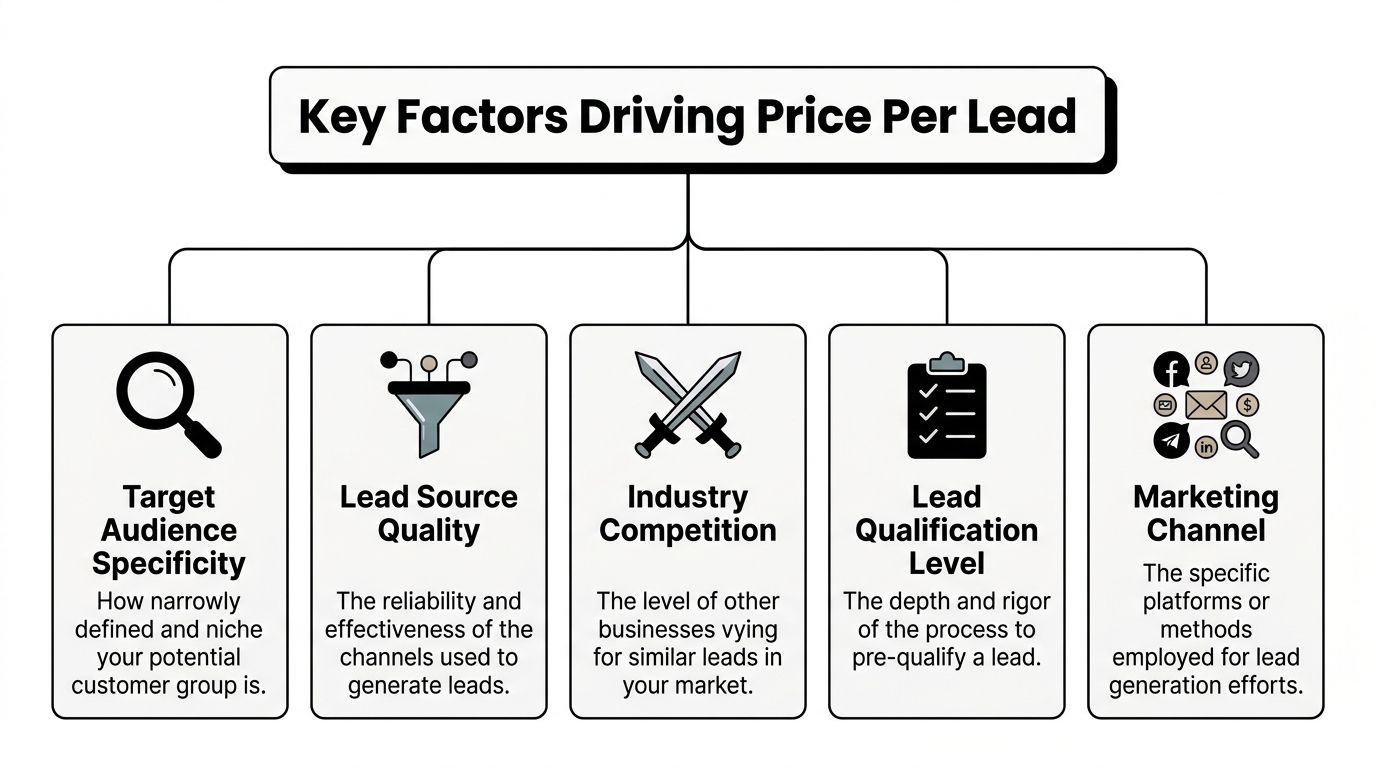
A lead price changes fast once you change what the vendor has to find, filter, and deliver. Two companies selling into the same category can see very different CPL because they are buying different levels of precision and different levels of sales readiness.
Audience specificity changes the cost fast
Broad targeting lowers list costs and usually makes campaign volume easier to find. Precision does the opposite. If you want finance leaders in a narrow company-size band, using a defined tech stack, with a visible buying trigger, the market is smaller and the work per prospect is higher.
That higher price can be the right decision.
I would rather pay more for a list that matches the accounts sales wants than save money on names that never become real conversations. Cheap reach helps only if the business can monetize it.
Qualification depth changes what you are buying
Lead pricing often gets distorted because buyers compare a contact record, a hand-raiser, an MQL, and a booked meeting as if they were interchangeable units. They are not. The deeper the screening process, the more labor sits behind each lead, and the more the vendor will charge.
That is usually rational pricing, not inflation.
If your team needs a clearer standard before evaluating vendors, use this guide on how to qualify sales leads. It helps separate early interest from sales-ready demand.
There is also a budget trade-off here. Paying for cheaper raw leads shifts qualification cost to your SDR team. Paying more for pre-qualified leads or meetings shifts that work to the vendor. The line item gets bigger, but the internal cleanup work often gets smaller.
Channel choice shapes economics
Channel economics are rarely just media economics. They include setup time, targeting accuracy, conversion friction, and follow-up load on sales.
Paid channels can scale faster, but competition raises costs quickly in crowded B2B categories. Outbound can look cheaper on paper, yet poor data, weak copy, or low reply handling capacity can erase that advantage. Organic programs often produce stronger economics over time, but they require patience and usually do not solve this quarter’s pipeline gap.
The practical question is not which channel has the lowest CPL. It is which channel produces qualified meetings at an acquisition cost your team can support. If you need a framework for that math, this practical ROI guide for marketing programs is a useful reference.
Geography affects lead cost
Regional differences change pricing before campaign performance is even considered. Media costs, buyer density, language requirements, and local competition all influence what a lead costs in each market.
That is why one global CPL target usually creates bad decisions. North America, EMEA, and APAC often need different expectations, different messaging, and sometimes different channels. A vendor that looks expensive in one region can still be efficient if that market converts into meetings and revenue at a stronger rate.
Unit economics decide what your business can support
The final constraint is not the quoted CPL. It is your conversion model. A business with strong win rates and high lifetime value can pay more per lead than a business with low ACV, long payback periods, or weak close rates.
Lead buying demands serious attention. If a lead source costs more but consistently produces meetings that turn into pipeline, it may be the better buy. If a low-cost source floods the funnel with contacts sales rejects, the savings disappear in SDR time, AE frustration, and missed revenue capacity.
Practical rule: Judge lead cost against expected qualified meetings, pipeline created, and customer economics. CPL on its own is only the entry price.
Beyond Price Per Lead Calculating True ROI
The biggest mistake in lead generation is treating lower CPL as automatic progress. It isn’t. What matters is whether the lead source creates pipeline at a cost your business can support.

A raw lead only becomes valuable if it moves through qualification, into sales conversation, and eventually into revenue. That’s why effective cost per qualified meeting is the more useful operating metric for B2B leaders. It tells you what you paid for a sales-ready outcome, not just a name in the database.
Two campaigns can have opposite economics
One case highlighted exactly why headline CPL can mislead. In that example, CPL rose 83% to $110, but effective cost per qualified lead fell 54% to $129 because qualification rates improved from 25% to 85% according to First Page Sage’s analysis.
That’s the pattern experienced teams watch for. A channel can look more expensive at the top of funnel while becoming more efficient where sales feels the impact.
A cheap lead that doesn’t convert is infinitely expensive.
Use effective cost per qualified meeting
A director of sales usually cares about four practical questions:
-
How many leads came in?
-
How many met our qualification standard?
-
How many became meetings?
-
How much pipeline did those meetings create?
If you stop at question one, you’ll favor low-cost volume. If you keep going, you start seeing the actual buying value of the source.
Here’s a simple comparison model.
| Lead type | Example economics | What it tells you |
|---|---|---|
| Raw lead | $3 lead converting at 0.5% produces $600 CAC, plus hidden sales costs | Low headline cost can still create expensive customer acquisition |
| MQL | $150 MQL converting at 20% produces $750 CAC | Higher per-lead price may still be more operationally efficient |
The hidden sales cost matters. AEs and SDRs still spend time chasing low-fit leads. Calendar slots get wasted. Follow-up sequences get clogged. Forecast confidence weakens because the top of funnel is inflated with noise.
The practical math sales teams should review
For each source, calculate:
-
Cost per raw lead
-
Cost per accepted lead
-
Cost per qualified meeting
-
Cost per opportunity
-
Cost per customer acquired
Then compare those numbers against gross margin and lifetime value. That’s the language finance trusts.
If your team wants a cleaner template for that analysis, this guide on how to calculate marketing ROI is a useful operational starting point.
A short walkthrough can help reinforce the logic:
-
Scenario one: Low-cost leads enter the CRM in volume, but few meet qualification criteria. SDRs do more filtering. Meetings stay weak. The campaign looks cheap but underperforms where it counts.
-
Scenario two: Leads cost more upfront, but a larger share fit the ICP and accept meetings. Sales spends less time sorting, more time selling. The campaign looks expensive and often produces better economics.
A quick explainer can help if you’re aligning a cross-functional team on the difference between lead cost and business return.
Why qualified meetings are the better buying lens
A booked meeting isn’t the end goal. But it is usually the cleanest handoff point between marketing or outbound and sales. It’s also where quality becomes visible.
Once you frame price per lead through that lens, vendor evaluation gets easier. You stop asking who can deliver the cheapest records. You start asking who can consistently deliver sales conversations that fit your market, your deal profile, and your team’s capacity.
Comparing Lead Pricing Models CPL vs PPA
Different pricing models shift risk in different directions. That’s what buyers should pay attention to first.
Standard CPL
Under a standard cost per lead model, you pay for a lead once it meets an agreed definition. That definition might be as loose as a form fill or as strict as an MQL.
The upside is scale. CPL models can generate volume, and they’re common across paid media, content syndication, and list-building campaigns. The downside is that the buyer often carries more of the quality risk. If the leads are technically valid but commercially weak, sales still has to sort through them.
This model works best when your team has:
-
Strong SDR capacity: Someone can quickly filter and follow up.
-
Tight lead acceptance rules: Marketing and sales agree on what counts.
-
Reliable conversion data: You know what a lead from each source turns into.
Pay per appointment
Under a pay per appointment or pay per qualified lead model, the vendor gets paid when a prospect reaches a deeper qualification stage, often a booked meeting with pre-agreed criteria.
That structure is usually better aligned with sales outcomes because the vendor carries more performance responsibility. The trade-off is obvious. Unit prices are higher, and qualification definitions need to be much tighter to avoid disputes.
This model tends to fit companies that already know their ICP, sales motion, and close process. One example in this category is performance-based lead generation, where payment is tied more closely to sales-ready outcomes than top-of-funnel activity.
When lead quality is hard to control internally, paying for meetings can reduce operational drag even if the sticker price is higher.
Monthly retainers
Retainers are different. You pay for effort, access, and execution capacity rather than a fixed number of leads or meetings.
That can make sense when the work includes strategy, infrastructure, campaign building, testing, and continuous optimization. It can also create the weakest direct link between spend and outcome if the engagement is poorly structured. A bad retainer hides under activity reports. A good retainer creates transparent accountability around pipeline movement.
Side-by-side decision view
| Model | What you pay for | Main advantage | Main risk | Who carries more performance risk |
|---|---|---|---|---|
| CPL | Lead volume at an agreed definition | Easier to scale volume | Quality variation | Buyer |
| PPA / PPL | Qualified lead or booked meeting | Better alignment with sales outcomes | Higher unit price and stricter acceptance criteria | Vendor |
| Retainer | Ongoing execution and effort | Strategic flexibility | Weaker direct tie to outcomes if poorly managed | Mostly buyer |
The right model depends on your operating maturity. If your offer is proven, your sales team can close, and your bottleneck is qualified conversations, performance-based pricing usually creates cleaner accountability than buying raw lead volume.
How to Choose and Negotiate with a Lead Gen Vendor
Vendor selection gets easier when you stop evaluating promises and start evaluating definitions. If a vendor can’t explain what counts as a lead, who qualifies it, and when you pay, the discussion is already off track.
For performance-based B2B appointment setting, benchmark pricing commonly lands at $100 to $500 per qualified lead or $200 to $1,000+ for enterprise-level booked meetings, with pricing driven by qualification depth according to Callbox’s appointment setting pricing overview. That range is wide because the product is wide. A lightly screened contact and a confirmed meeting with a senior decision-maker are different deliverables.
Green flags
-
Transparent qualification criteria: The vendor defines firmographic fit, buyer role, intent standard, and disqualification rules in writing.
-
Clear source explanation: They tell you how leads are generated, not just how many they can send.
-
Operational reporting: They show accepted leads, rejected leads, meetings held, and feedback loops from sales.
-
Contract flexibility: They allow room to refine targeting and qualification after early campaign feedback.
-
Commercial alignment: Their pricing model reflects outcomes, not just activity.
If you’re comparing options across agencies and software providers, it helps to explore vendor pricing structures so you can see how differently providers package service, support, and performance accountability.
Red flags
-
Vague language: “High-quality leads” with no precise acceptance standard.
-
Vanity metrics: Heavy focus on opens, clicks, impressions, or list size without pipeline discussion.
-
Locked contracts: Long commitments with weak exit terms and no performance clauses.
-
Lead dumps: Big volumes delivered with little context, little qualification, and little concern for sales acceptance.
-
No dispute process: Nothing documented for how rejected leads or bad-fit meetings are handled.
What to negotiate before signing
Use the proposal stage to define the commercial rules. Don’t leave them for later.
Ask for these items in writing:
-
Accepted lead definition: Company type, role, geography, use case, and meeting criteria.
-
Replacement policy: What happens when a lead misses the agreed standard.
-
Timing rules: Whether no-shows, reschedules, or duplicate contacts are billable.
-
Feedback cadence: How often sales and the vendor review quality together.
A useful starting point is to review what a lead generation agency should document before launch. The strongest vendors won’t resist these questions. They’ll expect them.
Conclusion Focusing on Pipeline Value Not Lead Volume
Price per lead still matters. It’s just not the number that should drive the decision on its own.
The useful shift is from lead cost to pipeline value. A lower CPL can still create weak economics if sales has to burn time on bad-fit contacts. A higher-priced source can be the smarter buy when it produces qualified meetings, better conversion, and cleaner handoff into the pipeline.
The right price per lead is the one your business can support through conversion rates, deal value, and lifetime value. That’s why sales and marketing should review lead sources by effective cost per qualified meeting, not just raw top-of-funnel volume.
If your current reporting still rewards the cheapest names in the CRM, it’s worth auditing the numbers again. Track what each source becomes after qualification. That’s where real ROI shows up, and that’s where better buying decisions start.
If you want a simpler way to buy pipeline instead of raw lead volume, Fypion Marketing offers a performance-based B2B lead generation model focused on booked, qualified meetings through cold email outreach. That structure can be useful for teams that already know their ICP and want tighter alignment between spend and sales outcomes.