
LinkedIn B2B Leads: A Playbook for 2026
Most advice on LinkedIn gets the order wrong. It tells you to post more, comment more, and send more connection requests. That creates activity, not pipeline.
If you want linkedin b2b leads that turn into qualified meetings, treat LinkedIn as one part of a performance system. The platform matters because buyers are there, but volume alone won’t save weak positioning, loose targeting, or sloppy follow-up. LinkedIn has become the primary B2B social acquisition channel, with 89% of B2B marketers using it for lead generation, 62% saying it produces leads, and roughly 80% of B2B social media leads coming from LinkedIn according to Skrapp’s LinkedIn statistics roundup. That tells you where attention is. It does not tell you how to turn that attention into sales conversations.
The playbook that works is narrower. Build a profile that converts profile views into trust. Build lists with intent, not just relevance. Use short, personalized sequences that earn replies. Warm accounts with content and comments. Then move positive conversations into a qualification flow that can be measured the same way you’d measure cold email, outbound calling, or a pay-per-meeting program.
Build Your Foundation for High-Intent Leads
“Be active on LinkedIn” is incomplete advice. Prospects don’t book meetings because you were active. They book because, after seeing your profile, they believed you understood their problem and were worth replying to.

A strong personal profile does the work of a landing page. That means your headline, about section, featured assets, and recent activity all need to answer one question fast: why should this buyer talk to you?
Turn your profile into a buyer-facing page
Most sellers still write profiles like resumes. Buyers don’t care that you “help organizations utilize synergies.” They care whether you can help them fix a painful, current problem.
A practical profile structure looks like this:
-
Headline that names the outcome: Say who you help and what result you work toward.
-
About section that handles objections early: Mention the type of companies you work with, the pain you solve, and your approach.
-
Featured section with proof assets: Use short case summaries, a teardown, a one-pager, or a useful resource.
-
Experience section written for prospects: Focus less on duties, more on the type of commercial problems you solve.
If your audience spans multiple segments, tighten your language by clarifying whether you’re speaking to a true market or just a broad industry category. This short piece on market vs industry is useful because weak targeting usually starts with weak category thinking.
Practical rule: If a prospect lands on your profile and can’t tell who you help within a few seconds, your outreach is working harder than it should.
Align the company page without hiding behind it
Company pages matter, but they don’t carry outbound on their own. Buyers click them to validate that you’re real, not to decide whether they’ll reply. Keep the page clean, current, and consistent with your messaging, but don’t expect it to outperform a sharp personal profile.
What usually works better is message alignment across both surfaces:
-
Use the same core problem statement on your profile and company page.
-
Keep visual proof consistent, including client categories, use cases, or product screenshots.
-
Make the CTA obvious, whether that’s a consultation, a resource, or a direct conversation.
A lot of teams overcomplicate this. They polish branding for weeks, then send outreach from profiles that still read like job-seeking pages. If you want a sharper reference model, this LinkedIn lead generation playbook is useful for seeing how profile positioning and outreach strategy should support each other.
What doesn’t work
Here are the profile mistakes that subtly kill response rates:
-
Generic authority claims: “Thought leader,” “growth expert,” and “passionate about helping businesses succeed” say nothing.
-
Feature-heavy language: Buyers respond to business problems, not tool menus.
-
No proof path: If someone is curious, there should be something easy to click.
-
Mismatch between outreach and profile: If your message talks about demand generation but your profile talks mostly about recruitment, trust drops immediately.
On LinkedIn, trust gets built in layers. Your message starts the conversation. Your profile decides whether the conversation continues.
Master Precision Prospecting on LinkedIn
Bad prospecting creates fake negatives. You assume LinkedIn doesn’t work, when the actual issue is that you targeted a giant pool of vaguely relevant people and hoped personalization would rescue it.
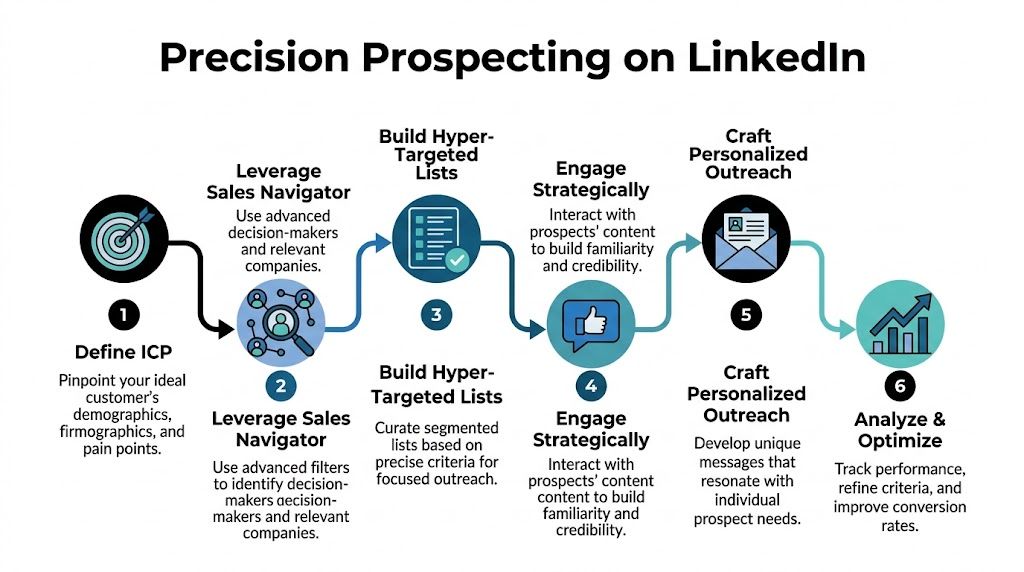
The fix is precision. Start with a narrow list of accounts and titles where your offer is most likely to create urgency. Then segment by problem, trigger, and buying context.
Start with Boolean before you touch advanced tooling
Even without a premium seat, Boolean search helps you surface better-fit people than feed scrolling ever will. Use combinations of role, function, pain language, and exclusions.
Examples of search logic:
-
Role-based search: VP OR Head OR Director AND Demand Generation
-
Pain-based search: RevOps OR Revenue Operations AND attribution
-
Exclusion search: marketing NOT recruiter NOT hiring
The point isn’t complexity. The point is control. You’re trying to reduce noise before it reaches your outreach workflow.
A simple working process:
-
Define your ICP by company type, buyer role, and likely pain.
-
Write three to five search strings around that pain.
-
Save promising profiles into named lists.
-
Review manually before outreach starts.
For teams writing messages after list-building, this library of cold LinkedIn message templates can help translate segmentation into actual copy angles.
Use Sales Navigator like a filter stack, not a database
Sales Navigator becomes valuable when you stop using it as a giant list source and start using it as an intent sorter. Layer filters so the people you pull already resemble buyers, not just professionals.
Useful filter combinations include:
-
Seniority + function: Narrow to likely decision-makers.
-
Company headcount bands: Match your delivery model and deal size.
-
Geography: Keep compliance, language, and market context clean.
-
Posted content keywords: Find people already talking about the problem you solve.
-
Company growth indicators: Look for accounts going through change, because change creates buying windows.
This walkthrough is worth watching if you want a visual breakdown of list-building workflow:
Build lists around buying context
A useful outbound list isn’t “CMOs in SaaS.” That’s still too broad. A useful list sounds more like this:
| Segment | Why it matters |
|---|---|
| Recently promoted revenue leaders | New owners often reevaluate process and vendors |
| Founders with sales-led growth motions | They usually feel pain faster and respond to direct value framing |
| Marketing leaders posting about pipeline quality | Their language gives you message hooks |
| Companies expanding headcount in GTM functions | Growth often creates execution gaps |
Precision prospecting works when each list implies a different message. If the same opening line fits every segment, the segment is still too broad.
What to avoid
-
Role-only targeting: A title without context isn’t targeting.
-
Huge saved searches: More names don’t equal more pipeline.
-
Single-person accounts: Build around account clusters where possible, not isolated contacts.
-
No manual review: Filters help, but they don’t replace judgment.
Great LinkedIn prospecting feels slower at first. It speeds up later because the conversations are more relevant, the objections are more predictable, and the handoff to qualification gets cleaner.
Craft High-Reply Outreach Sequences
The fastest way to lose on LinkedIn is to treat it like email with profile photos. Buyers can smell that instantly.
The difference between weak and strong outreach isn’t usually the offer. It’s how naturally the conversation starts. A 2025 benchmark found that personalized connection requests generated a 9.36% response rate versus 5.44% without a message, and the best two-step campaigns combined a message with a profile visit to reach an 11.87% reply rate, according to the Belkins LinkedIn outreach study. The same benchmark also showed that acceptance rates were nearly identical with and without a message, which means optimizing for acceptance alone is the wrong game.
What matters is reply quality.
A simple sequence that behaves like a human
Here’s a sequence structure that works better than the usual connect-and-pitch routine:
-
Touch 1: Visit the profile
-
Touch 2: Send a personalized connection request
-
Touch 3: Follow up with a short message tied to a specific problem or trigger
-
Touch 4: Send a brief, lower-friction nudge
-
Touch 5: If relevant, hand off to email or another channel with continuity in the message
Often, teams over-automate. Automation can support research, drafting, and list ops, but the actual buyer-facing message still needs context. If you’re exploring where AI fits without turning outreach robotic, this guide on Enhance sales outreach with artificial intelligence is a practical reference.
Sample LinkedIn Outreach Sequence Messages
| Stage | Message Template Example |
|---|---|
| Profile view | No message. Review their profile, recent posts, and company changes first. |
| Connection request | “Hi [Name], saw your post on [topic]. Your point about [specific detail] stood out. Would be glad to connect.” |
| First DM after acceptance | “Thanks for connecting. Noticed your team is focused on [initiative]. I speak with a lot of [role] leaders who hit friction around [problem]. Curious if that’s on your side too.” |
| Follow-up DM | “One reason I ask: this usually shows up when teams are trying to improve pipeline quality without adding more channel noise. If useful, I can share the pattern I keep seeing.” |
| Direct meeting ask | “If this is a priority this quarter, open to a short call to compare notes and see if there’s a fit?” |
A real-world messaging contrast
A weak opener sounds like this: “Thanks for connecting. We help companies scale revenue through our advanced platform. Can I get 30 minutes next week?”
That message fails for three reasons. It asks too much too early. It centers the seller. And it gives the buyer no reason to believe the sender understands their situation.
A better opener ties to context and leaves room for dialogue. Something like, “Saw you’re hiring across sales and marketing. That usually creates handoff issues before it creates efficiency. Are you seeing any of that yet?” works because it sounds observed, not broadcast.
Buyers reply when the message feels written for them, not for the campaign.
Write for continuation, not conversion
The first message does not need to close the meeting. It needs to earn the next message. That’s where many outbound teams get impatient.
A strong sequence usually follows this progression:
-
Recognition of something specific about the prospect
-
Relevance tied to a business issue
-
Curiosity that invites a response
-
Value once the conversation opens
-
Ask only after relevance is established
For cross-channel consistency, keep your follow-up language aligned with your email motion. These cold email follow-up templates are useful because the best LinkedIn sequences and best email sequences share the same discipline: short messages, clear context, and a low-friction next step.
What doesn’t work anymore
-
Instant pitch after acceptance
-
Paragraph-length intros
-
Fake familiarity
-
Empty compliments
-
Calendar links dropped in message one
LinkedIn outreach performs best when it feels like a professional conversation that can become a sales conversation, not a sales message pretending to be social.
Use Content as Your Lead Generation Flywheel
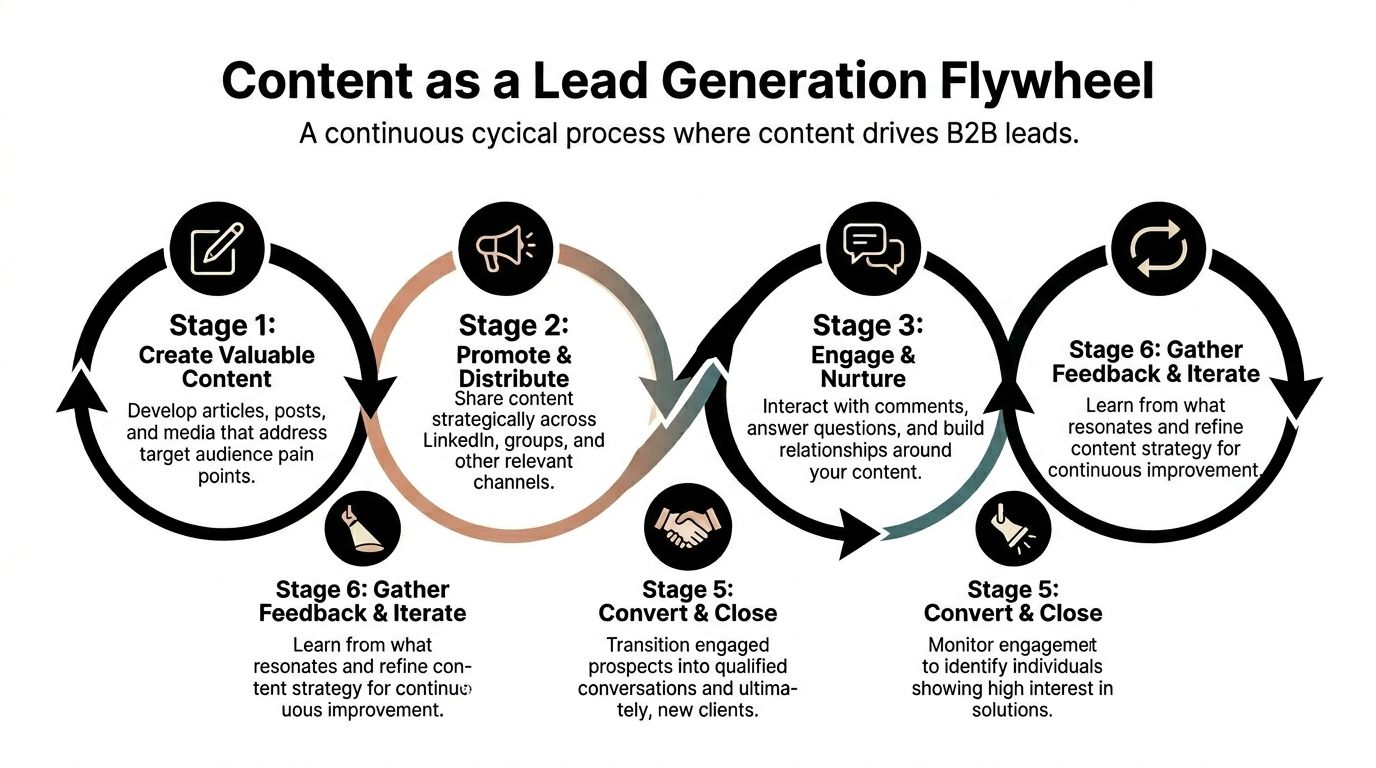
Outbound gets easier when your name is familiar before the first message arrives. That doesn’t mean you need to become a creator. It means you need enough visible thinking that your target accounts can recognize your point of view.
Current LinkedIn strategy is shifting toward authentic engagement and employee-driven visibility, not generic company-page broadcasting, as discussed in this analysis of LinkedIn marketing and employee-led visibility. That’s the useful takeaway. Personal authority now carries more commercial weight than many teams expect.
Use comments to warm cold accounts
Comments are underrated because they don’t look scalable. That’s exactly why they work. A thoughtful comment on the right prospect’s post often does more than another generic connection request.
The useful pattern is simple:
-
Comment where your buyers already pay attention
-
Add interpretation, not applause
-
Stay close to the commercial problem
-
Use comments to build familiarity before outreach
Example. If a VP of Sales posts about pipeline inconsistency, don’t reply with “Great insight.” Add a short point about where pipeline usually breaks operationally. Now you’ve shown relevance in public before you ever enter the inbox.
Post for trust, not impressions
Your own content doesn’t need to be frequent. It needs to be legible to the ICP. The easiest structure is Problem, Agitate, Solve.
That looks like this in practice:
| Post element | What to write |
|---|---|
| Problem | Name a painful issue your buyer already recognizes |
| Agitate | Show what that issue causes downstream |
| Solve | Offer a practical perspective, framework, or next step |
A few examples of posts that support linkedin b2b leads:
-
Break down a common funnel mistake your ICP keeps making
-
React to a market shift and explain its practical impact
-
Share a short before-and-after process change without exaggerating results
-
Publish a contrarian take on a tactic buyers overuse
Content should make outbound feel familiar. If your posts and comments don’t support your message angle, they’re probably just feeding vanity metrics.
Make consistency easier
Teams often don’t fail because they lack ideas. They fail because posting falls behind delivery, meetings, and internal work. A lightweight publishing system helps. If you need a simple operational guide, this PostPlanify guide on LinkedIn scheduling covers the mechanics well.
Content also works better when it connects with your broader acquisition model. If you’re trying to balance outbound and inbound instead of treating them as separate departments, this piece on inbound lead generation is a useful counterweight.
The core principle is straightforward. Comments warm the account. Posts build authority. Outreach converts the attention into a conversation. Together, they create a flywheel that makes each cold touch less cold.
Convert Conversations into Qualified Meetings
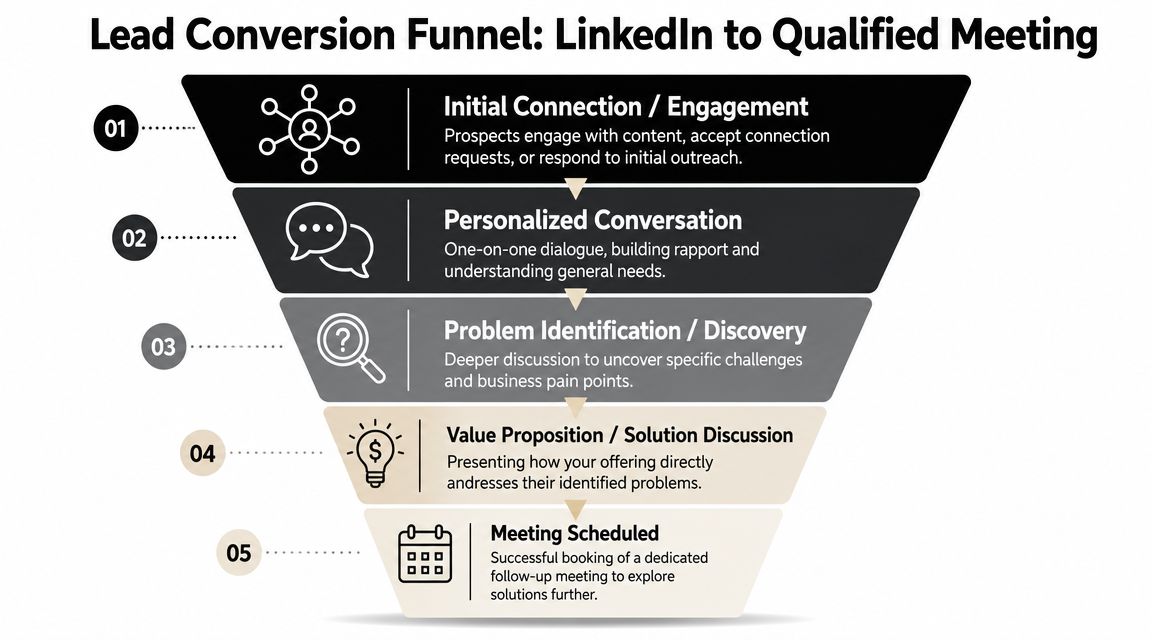
A LinkedIn lead isn’t a result. It’s an opening.
Many teams overcount success at the exact point where revenue risk begins. They celebrate connection volume, acceptance, profile views, and likes. None of those tell you whether the conversation will become a qualified sales appointment.
Move off-platform at the right moment
You don’t need to rush a call request, but you do need to recognize buying intent when it appears. The transition usually happens after the prospect confirms a real pain, a current priority, or dissatisfaction with the status quo.
A clean handoff message can be as simple as:
-
“That helps. It sounds like this is more than a minor annoyance.”
-
“I have a few ideas based on what you described.”
-
“Open to a short call to see whether any of them fit your process?”
Short works better than polished.
For paid campaigns, reducing friction matters just as much. LinkedIn Lead Gen Forms have an average completion rate of 13% compared with 4.02% for traditional landing pages, according to Firebrand’s LinkedIn B2B lead generation best practices. That’s useful when you’re pairing outbound support with paid demand capture. If someone clicks but doesn’t want to leave the platform, the form keeps momentum alive.
Qualify before you celebrate
A booked meeting only matters if it matches your sales criteria. That means the rep or founder handling the conversation needs a consistent qualification lens.
A simple qualification checkpoint looks like this:
| Qualification area | What you’re listening for |
|---|---|
| Problem clarity | Is the pain specific and operational, or vague and exploratory? |
| Priority | Is this active now, or just intellectually interesting? |
| Ownership | Is the person involved in the buying process? |
| Fit | Does the account match your target market and delivery model? |
The KPI that matters isn’t “Did they reply?” It’s “Did this conversation create a real selling opportunity?”
Measure LinkedIn like a revenue channel
The right dashboard is boring. That’s a good sign.
Track business metrics such as:
-
Positive reply rate: Not every reply is useful. Separate interest from noise.
-
Lead-to-meeting rate: This tells you whether your messaging and qualification are aligned.
-
Qualified meeting rate: This is the metric that matters in performance-based outbound.
-
Pipeline contribution by segment: So you know which lists deserve more effort.
This is also where multi-channel follow-up becomes powerful. A buyer may respond on LinkedIn, ask for details by email, and book through a calendar workflow. If those handoffs aren’t tracked, you’ll underestimate what LinkedIn is contributing.
The same discipline applies to your broader sales process. This visual guide to a sales process flowchart is a good reference for mapping when a social conversation becomes a sales-qualified opportunity.
Your B2B Lead Generation Tech Stack and Best Practices
Tech does not fix weak targeting or soft qualification. It gives a good outbound process consistency, visibility, and cleaner handoffs.
For linkedin b2b leads, the stack needs to support one job: turn the right accounts into qualified meetings you can attribute to pipeline. That requires more than a connection tool. You need a system that keeps list quality high, gives reps enough context to write relevant outreach, and records what happened after the reply.
The core stack
A working setup usually has four parts:
-
Sales Navigator for account selection and contact discovery
-
A CRM such as HubSpot or Salesforce for stage tracking and reporting
-
Research tools to add buying context before outreach starts
-
Sequencing and task tools to manage follow-up across LinkedIn and email
What matters is how these parts connect.
A prospect gets added to a defined segment. Research fills in account context, trigger points, and role relevance. Outreach starts with a clear message tied to that segment. Replies get labeled by intent, not dumped into one generic bucket. Qualified interest moves into the CRM with enough detail for sales to act on it without rereading a full DM thread.
That last part gets missed often. If the SDR books a meeting but the AE cannot see why the prospect took the call, meeting quality drops fast.
For teams running LinkedIn alongside email, Fypion Marketing offers a performance-based cold email model built around qualified meetings rather than retainer-based activity. That matters if LinkedIn is one part of a broader outbound engine instead of a standalone lead source.
Automation rules that protect results
LinkedIn automation should reduce admin work, not fake human behavior.
Use it for research support, reminders, workflow steps, and draft preparation. Keep message review, segmentation decisions, and qualification in human hands. The trade-off is simple: more automation saves time early, but it usually lowers reply quality and increases account risk if you push it too far.
A few operating rules help:
-
Keep sending patterns stable. Sudden jumps in invites or messages create unnecessary risk.
-
Review templates by segment. If a message could go to five different buyer types unchanged, it is too generic.
-
Separate volume problems from targeting problems. More activity rarely fixes weak list construction.
-
Track outcomes past the reply. A sequence that gets interest but produces poor meetings needs revision, not praise.
Best practices that hold up under pressure
The strongest teams keep one source of truth for account status, conversation history, and qualification notes. Once that information gets split between inboxes, spreadsheets, and rep memory, reporting becomes unreliable and pipeline forecasting turns into guesswork.
They also write from the list backward. Segment first, then build copy, then decide cadence. Many teams do the reverse and wonder why replies sound polite but go nowhere.
Review replies every week. Look for recurring objections, wrong-person responses, and interest that stalls before booking. Those patterns usually point to one of three issues: weak account selection, unclear positioning, or bad timing.
Protect the account, too. A restricted LinkedIn profile slows the whole program down. Short-term convenience is not worth losing a channel that can consistently start sales conversations with the right buyers.
A durable LinkedIn program looks like outbound with tighter targeting, stronger identity signals, and stricter qualification. That is the standard if you care about meetings that convert to pipeline, not activity that looks good in a dashboard.