
Cold Email Copywriting: A Guide to Booking More Meetings
Most cold email advice is stuck in the wrong decade.
It tells you to personalize harder. Add the first name. Mention the company. Reference a LinkedIn post. Compliment the latest funding round. Then it acts surprised when the email still gets ignored.
That approach misses how busy B2B buyers read. They skim on mobile. They decide in seconds whether your message is relevant. If your copy opens with fake familiarity instead of a sharp problem they care about, you lose before your pitch starts.
Cold email copywriting that books meetings is less about sounding personal and more about proving relevance fast. The strongest campaigns don’t win because the writer is clever. They win because the targeting is tight, the message matches a real pain point, and the ask is easy to answer.
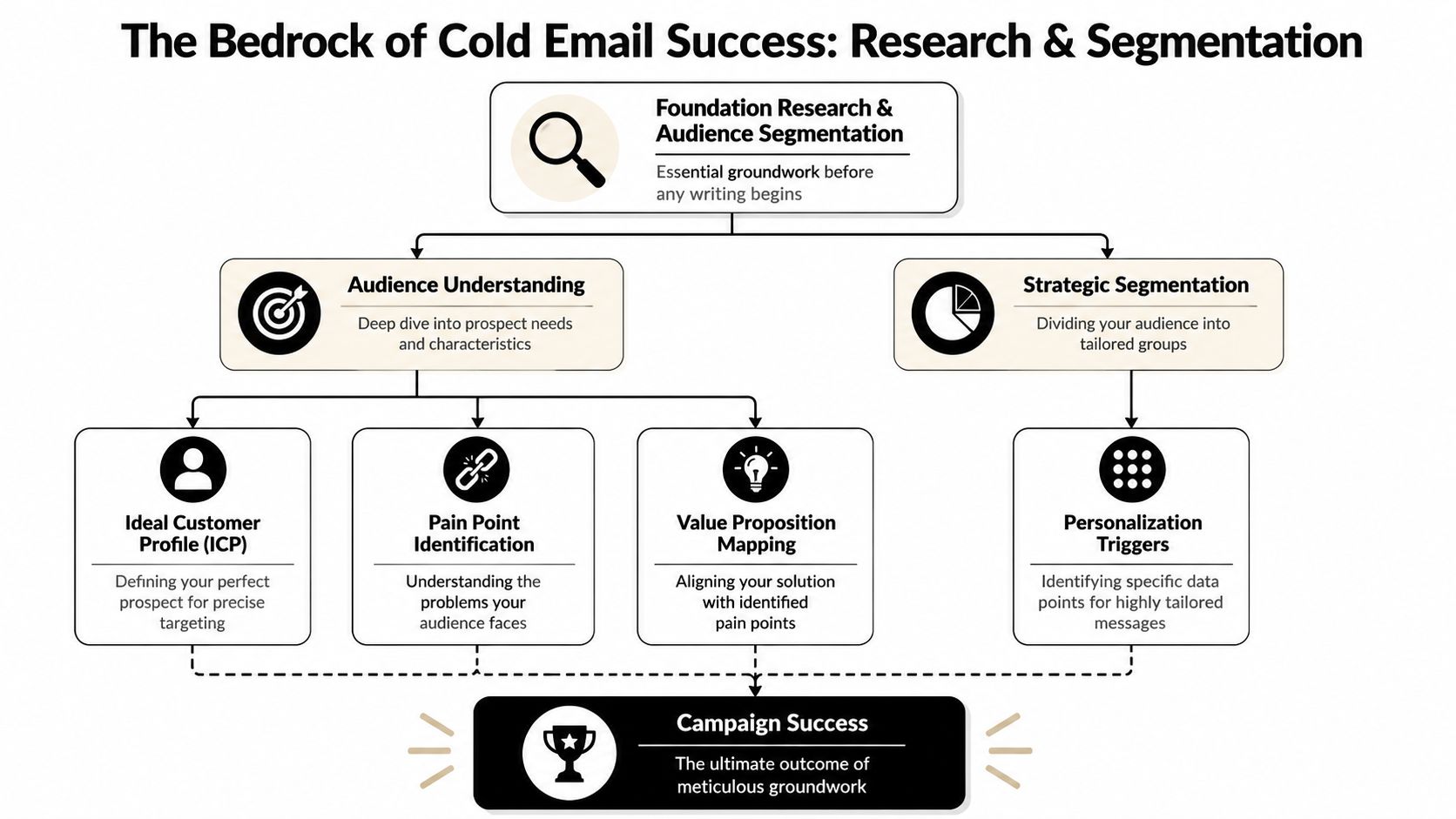
The Foundation Research and Audience Segmentation
Cold email performance is set before the first line gets written.
Weak campaigns usually start with a loose market, a mixed list, and a message forced to cover too many situations at once. That is why two teams can offer the same service and get very different results. Saleshandy’s analysis found average cold email reply rates around 3.7%, while top performers reached 8% to 12%. Their write-up ties that gap to list quality and targeting precision, not copy polish alone (Saleshandy cold email statistics).
Build segments around buying conditions
A cold email segment needs to reflect why a buyer might care now. Broad labels such as “B2B SaaS” create generic copy because the problems inside that category are too different. A Series A company hiring its first SDR team has a different buying context from a PE-backed SaaS firm trying to raise pipeline efficiency across an existing sales floor.
I segment accounts by buying conditions, not surface traits:
-
Growth stage: seed, Series A, growth-stage, PE-backed, mature
-
Go-to-market motion: founder-led, inbound-led, outbound-led, partner-led
-
Operational trigger: sales hiring, category expansion, new pricing, agency replacement, enterprise push
-
Role-level pain: pipeline coverage, rep productivity, attribution visibility, deal quality, speed to first meeting
That structure gives the copy a job. It also keeps the message relevant on mobile, where executives decide fast whether an email maps to a live problem or gets archived.
Research the trigger, not the trivia
Relevance beats personalization because it respects how B2B buyers read. A CRO checking email between meetings does not care that you noticed a podcast appearance. They care whether you identified a problem tied to headcount, pipeline, conversion, or channel performance.
The best research inputs are operational. Hiring pages. New product or integration pages. Funding announcements. Sales leadership changes. Pricing updates. Expansion into a new segment. Each one gives a reason the message matters now.
A simple test helps here. If the opener does not answer “why are you reaching out now?” within a sentence or two, the research is too shallow.
Teams trying to systemize this process often need cleaner ways to turn account signals into usable outreach angles. Structured workflows for optimizing sales team performance can help operationalize that handoff between research and execution. For a broader framework on turning market data into sharper targeting decisions, Fypion’s article on market research insights is a useful reference.
Map pain before you write
Before drafting copy for any segment, answer three questions:
| Segment question | What you need to know | Why it matters in copy |
|---|---|---|
| What changed? | Hiring, expansion, flat pipeline, leadership shifts | Creates timing and context |
| What is breaking? | Low meeting quality, SDR bottlenecks, weak outbound consistency | Gives the email a concrete pain point |
| What outcome matters? | More qualified meetings, cleaner targeting, less rep time wasted | Frames a practical result |
The limitations of average personalization become clear. Referencing a LinkedIn post adds surface familiarity. Tying recent SDR hiring to likely list quality issues, slow ramp, or poor meeting conversion gives the buyer a reason to respond.
Use segmentation to sharpen the copy
Segmentation is not just list management. It determines how specific the copy can be.
If one sequence targets founders, heads of sales, and RevOps leaders, the message gets diluted fast. The founder reads for efficiency and control. The VP Sales reads for coverage and conversion. The RevOps lead reads for process and data quality. One email trying to satisfy all three usually says nothing with enough precision to earn a reply.
I would rather launch five smaller campaigns with narrow messaging than one large campaign with safe copy. In practice, quality consistently beats list size. Smaller, cleaner segments produce stronger problem-solution fit, better replies, and more useful feedback for the next iteration.
Crafting Subject Lines and Openers That Get Clicks
Clever subject lines are overrated.
For B2B tech outreach, the job is simpler and harder than that. Get a busy executive on a phone to think, “This looks relevant enough to open.” That standard rules out gimmicks, fake familiarity, and subject lines written for desktop previews instead of real inbox behavior.
Mobile context changes the writing. A VP Sales scanning email between meetings will see a fragment, not your full setup. That is why relevance beats personalization here. “Loved your recent post” burns characters and says nothing useful. “Lead quality for new SDR hires” gives the reader a business context in a few words.
Write for the preview, not your own draft
Strong subject lines are usually short because short survives truncation and gets understood faster. But short only works when the meaning is immediate.
Three subject line angles work well in outbound for B2B tech:
-
Direct relevance: “Outbound for new SDR team”
-
Operational friction: “Lead quality at [company]”
-
Specific outcome: “More qualified demos from outbound”
All three do the same thing. They frame a problem or result the prospect already cares about.
What underperforms:
-
Generic pitch language: “Increase revenue fast”
-
Surface personalization: “Loved your LinkedIn post”
-
Compressed offer copy: subject lines trying to explain the whole service before the email is opened
For more examples, Fypion’s breakdown of best email subjects for sales is a useful reference.
The opener has to justify the interruption fast
The first sentence carries more weight than the subject line. If it does not confirm relevance right away, the open was wasted.
Weak openers usually fail in one of three ways. They start with politeness. They introduce the sender before the problem. Or they force personalization that has no connection to a buying issue.
A stronger opener gives the prospect a reason they are seeing this email now.
Here are three patterns that consistently hold attention:
-
Trigger-based “Saw you’re hiring outbound reps, which usually creates pressure on list quality, messaging consistency, and ramp time.”
-
Pain-led “Founder-led outbound usually breaks once the team needs repeatable meeting volume across multiple reps.”
-
Observation with implication “Noticed your team is moving upmarket, which usually changes who replies and what messaging gets traction.”
Each one respects the reader’s time. Each one also does more than personalize. It interprets the signal.
That distinction matters. Good cold email copy does not prove you researched the account. It proves you understand what the research means.
Pair the subject line with the first sentence
I review subject lines and openers as a set, not as separate lines. A strong pair creates continuity. The subject hints at the issue. The opener sharpens it.
For example:
| Weak pair | Stronger pair |
|---|---|
| Subject: Quick question | Opener: Hope you’re well, my name is… |
| Subject: Congrats on the funding round | Opener: Loved the announcement and wanted to reach out… |
| Subject: Quick idea for growth | Opener: I help companies like yours grow faster… |
The stronger versions work because they reduce the mental load on the reader. The prospect does not need to decode why the email matters.
Use a simple mobile-first filter
Before sending, check both lines against three questions:
-
Would this make sense if only the first few words show on a phone?
-
Does the opener explain the timing or business context immediately?
-
Does the message sound like a real operator raising a relevant issue?
If not, rewrite it.
Plain language wins here. Specific business relevance wins more often than first-name personalization. And for executive audiences, that is usually the difference between an email that gets skimmed and one that gets a reply.
Writing Persuasive Body Copy and Irresistible CTAs
Cold email body copy fails for a simple reason. The sender tries to sound personalized instead of becoming relevant fast.
Executives reading on a phone do not need proof that you visited their LinkedIn profile. They need a reason to care in the first screen. If that reason is weak, the rest of the copy does not matter.
Relevance beats flattery
The job of the body copy is to connect a visible business context to a likely operational problem, then present a credible next step.
That is different from generic personalization. Saying “loved your post” or “congrats on the funding” signals effort, but it rarely creates urgency. A sharper line points to the consequence behind the trigger.
| Weak approach | Better approach |
|---|---|
| “Loved your recent LinkedIn post on growth.” | “Saw your team is hiring SDRs, which usually means the old outbound process is getting stretched.” |
| “Congrats on the funding round.” | “Post-funding, most teams need pipeline faster than they can hire and ramp reps.” |
| “Impressed by your product launch.” | “A new product line usually creates a targeting problem before it creates pipeline.” |
The stronger version gives the prospect something useful to evaluate. It respects time, and it works better on mobile because the point is clear without extra setup.
Keep the body compressed
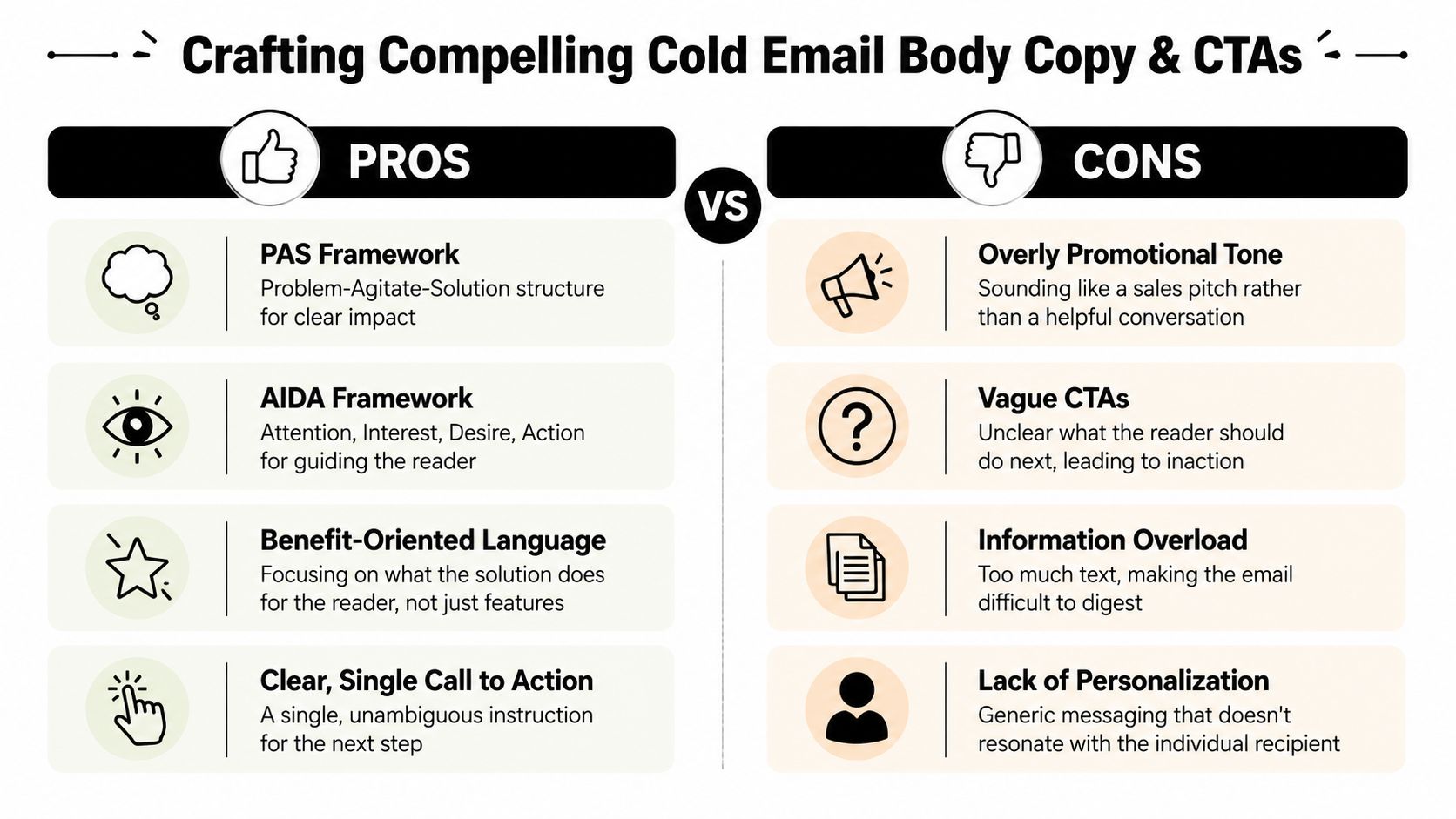
Cold email body copy should do four things in very little space:
-
Name the likely problem
-
Show the cost of leaving it alone
-
Suggest a specific path to improvement
-
Ask for a low-effort reply
I still use a compressed PAS structure for this. The mistake is stretching it into a mini sales letter. Good body copy is tight enough to read between meetings.
Saw you’re expanding the sales team. That usually creates pressure to produce pipeline before new reps are fully ramped. We help B2B teams build targeted cold outreach campaigns so reps spend more time in qualified conversations instead of sorting weak lists. Worth a look?
That is enough for a first touch.
It gives context, pressure, and a plausible fix. It does not dump features, force a case study, or spend a paragraph introducing the company.
Attachments and heavy graphics usually hurt more than they help in first-touch outreach. They add friction, create trust issues, and can work against inbox placement. Keep the body plain, readable, and easy to process on a phone.
Here’s a practical walkthrough that complements this section:
Write CTAs that are easy to answer
A good CTA does not ask for a meeting before interest exists. It asks for a simple decision.
For B2B tech outreach, three CTA types work well:
-
Interest CTA: “Worth a look?”
-
Priority CTA: “Is this something your team is focused on this quarter?”
-
Routing CTA: “Would this sit with you or your sales leader?”
Those prompts are easier to answer from a phone than:
-
“Book time on my calendar”
-
“Can we schedule a 30-minute demo?”
-
“Please review the attached deck”
I prefer CTAs that allow a binary or low-effort response. Yes, no, not now, or wrong person. That lowers reply friction and gives the prospect a fast way to engage without committing to a call.
One trade-off matters here. Lower-friction CTAs often increase reply volume, but some replies will be softer. That is still useful if your team knows how to qualify in the response thread instead of forcing qualification into the first email.
For more closing-line examples, Fypion’s guide on how to close out an email has useful patterns.
Designing Follow-Up Sequences That Convert Without Annoying
More follow-ups do not fix weak relevance.
For mobile-first executives, a sequence works when each touch helps them decide, fast, whether the problem matters. That is a different standard than old-school personalization. Using a first name, company mention, or recycled “bumping this” line does not earn another read. A sharper angle does.
As noted earlier, effective outbound usually takes more than one touch. The mistake is treating follow-ups like reminders instead of new entries into the same conversation. Each email should stand on its own, especially for prospects reading between meetings on a phone and only catching the first few lines.
Each follow-up needs a distinct reason to exist
In B2B tech campaigns, I want every touch to answer one question: what new information does this add for the prospect?
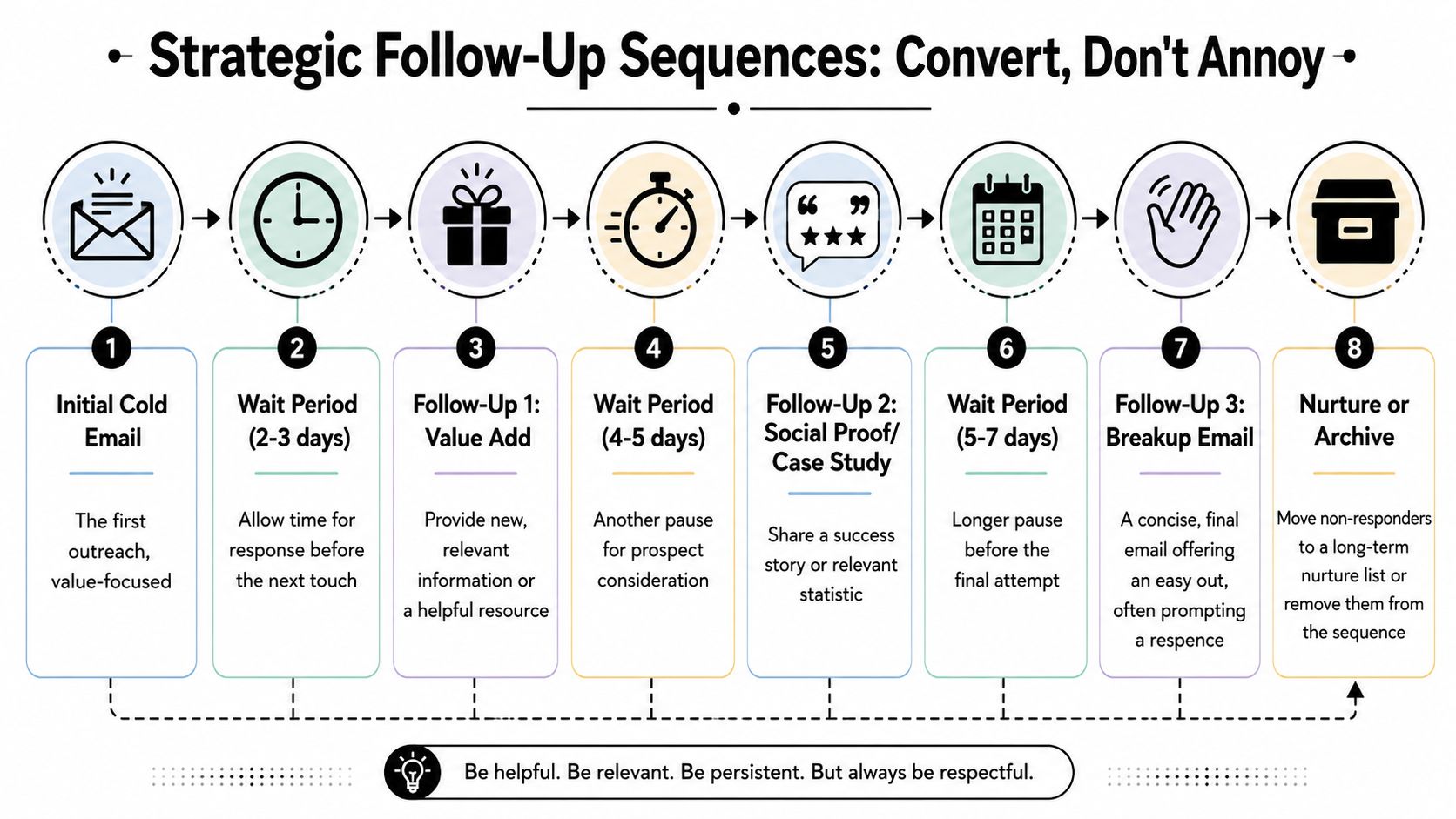
A sequence like this gives you enough range without becoming repetitive:
-
Initial email Lead with one relevant operational pain point and a low-effort CTA.
-
Insight follow-up Add a useful observation tied to the prospect’s role. For a VP of Sales, that might be slow pipeline coverage. For a RevOps leader, it might be poor handoff quality or weak segmentation.
-
Reframe the cost Shift the issue from one business consequence to another. Move from “not enough meetings” to “wasted rep time” or from “low reply rates” to “bad fit entering the funnel.”
-
Credibility touch Share a brief proof point, customer pattern, or execution detail that shows you understand the problem in practice.
-
Close-the-loop email Offer an easy out. This usually gets more honest replies than another ask for time.
That structure works because it prioritizes relevance over personalization. The prospect does not need a compliment. They need a reason to care.
Replace filler follow-ups with decision-useful context
Weak follow-ups create inbox fatigue because they ask the prospect to do the work. Strong follow-ups reduce the work.
| Weak follow-up | Stronger follow-up |
|---|---|
| “Just following up on this.” | “One issue behind low reply rates is broad targeting. Good copy cannot rescue the wrong segment.” |
| “Wanted to bump this to the top of your inbox.” | “Teams often assume they need better messaging when the bigger problem is that SDRs are reaching mixed-intent accounts.” |
| “Any thoughts?” | “If this is not a priority this quarter, I can close this out. If it is, I can send the first angle we would test.” |
This is the standard I use with follow-ups. Every message should make sense even if the prospect missed the earlier one. That keeps the thread readable and lowers the chance that your sequence feels like pressure.
Cadence matters, but context matters more
A steady send schedule helps, but timing alone does not save a bad sequence. If touch two, three, and four all repeat the same offer, the prospect experiences it as noise.
Keep the emails short. Change the angle. Respect the screen size and attention span of the person reading it. Senior buyers often scan on mobile, so long setup paragraphs and recycled openers lose them before the actual point appears.
There is a trade-off here. More variation across follow-ups usually improves reply quality, but it also takes more research and message planning up front. That extra work is worth it. One well-built five-step sequence usually outperforms a rushed seven-step sequence filled with generic reminders.
If you need proven starting points, this library of cold email follow-up templates for B2B outreach is a useful shortcut.
Mastering Deliverability to Land in the Primary Inbox
Inbox placement usually breaks before copy does.
I see teams blame messaging because it is the visible part of the campaign. The actual failure often sits in the setup. A weak domain, poor list hygiene, or a volume jump that came too early can bury solid emails before a prospect has any chance to judge the offer.
That matters even more with mobile-first executives. If your message reaches Promotions, spam, or a crowded secondary tab, you do not get a second chance to prove relevance. Deliverability shapes whether your pain-point-driven copy gets seen at all.
Treat deliverability as part of performance, not a technical side task
Cold email copywriting is tied to infrastructure. The writing can be strong, concise, and relevant to the account, but inbox providers still evaluate domain reputation, authentication, send patterns, bounce behavior, and engagement quality.
The copy itself also affects placement. Long HTML blocks, image-heavy emails, multiple links, oversized signatures, and attachment-heavy first touches add friction. So does generic personalization at scale. If a campaign sounds mass-produced, recipients ignore it, delete it, or mark it as junk. That response hurts future placement.
This is one reason I push relevancy over superficial personalization. A plain-text email that speaks to a real operational problem usually performs better than a flashy template stuffed with {{first_name}} tokens and company trivia.
Keep the setup tight before you scale volume
Outbound teams do not need to become email admins. They do need control over the basics.
Use a simple pre-launch standard:
-
Authenticate the sending domain correctly: SPF, DKIM, and DMARC should be configured before the first campaign goes live.
-
Ramp volume gradually: New inboxes need a controlled sending pattern before they can support larger campaigns.
-
Verify data constantly: Bad emails create bounces. Bad segmentation creates low engagement. Both hurt sender reputation.
-
Send plain, readable emails: One link is usually enough. In many campaigns, zero links works better.
-
Watch reply quality by segment: Strong engagement from the right accounts supports reputation over time.
If your team needs a technical refresher, this guide to email authentication protocols for outbound email setup covers the core requirements.
Operational mistakes hurt deliverability faster than teams expect
Deliverability problems are often self-inflicted. The pattern is familiar. A team buys old data, mixes several ICPs into one campaign, sends the same angle to all of them, then increases daily volume because reply rate is weak. Inbox providers read that as low-value mail.
The fix is usually more restraint, not more activity.
Tight segmentation helps here. Relevant messaging earns opens, replies, and saves from the right people. That engagement supports inbox placement. Generic personalization does the opposite. It may look customized in the draft, but if the message is irrelevant to the prospect’s actual priorities, the negative signal shows up fast.
Some teams use platforms like Smartlead, Instantly, or Maildoso to manage sending infrastructure. Others outsource the full workflow. Fypion Marketing is one example of a service that handles research, technical setup, copy, list building, and ongoing optimization for cold email campaigns.
How to Measure and A/B Test Your Cold Email Campaigns
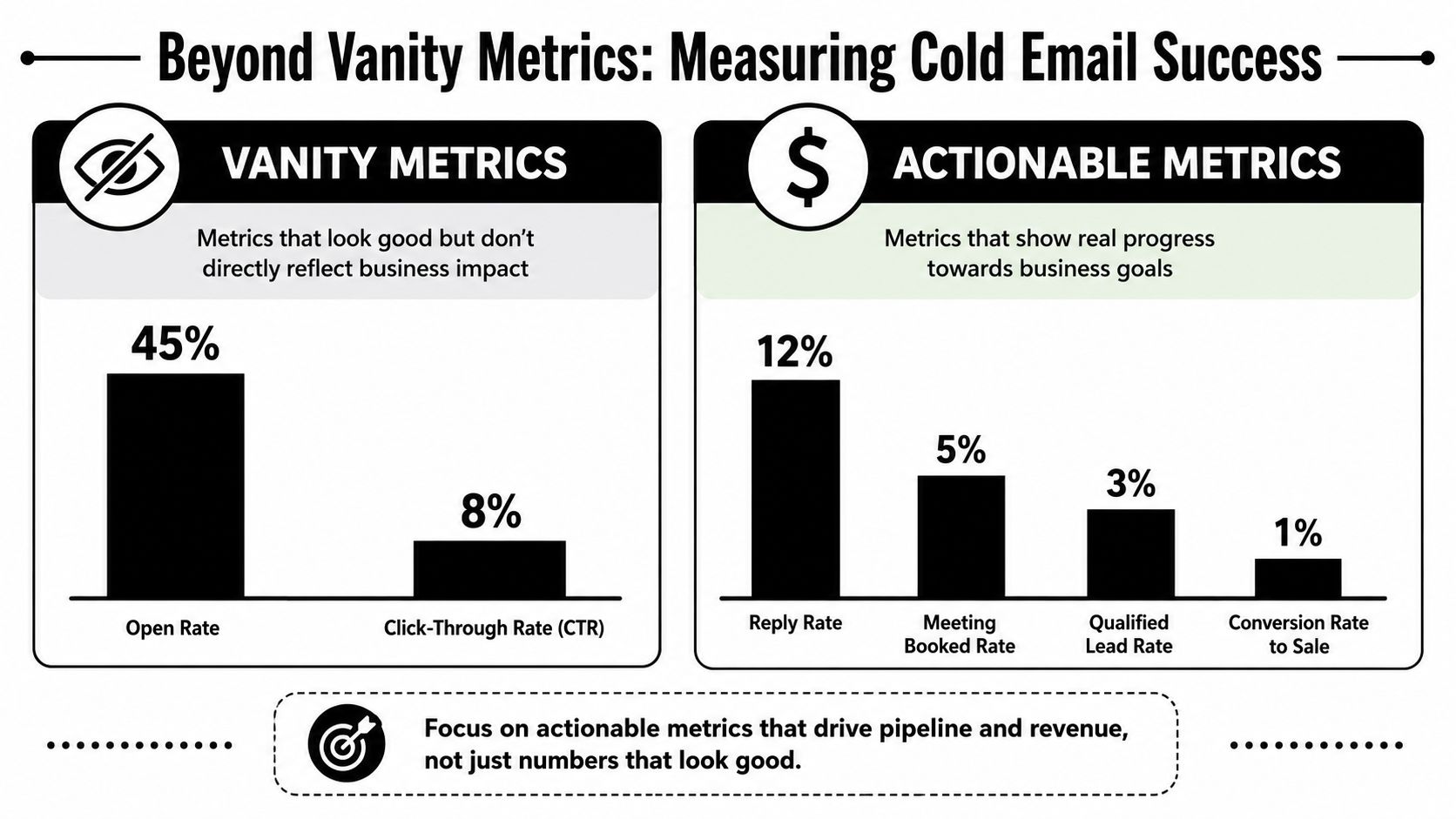
Teams often overvalue opens and undervalue conversations.
Open rate can help diagnose deliverability or subject line issues, but it won’t tell you whether your campaign is producing pipeline. Cold email copywriting should be judged by commercial outcomes, not vanity metrics.
Track the metrics that affect revenue
The core metrics I’d watch are:
-
Positive reply rate: Not all replies matter. Separate interest from objections, unsubscribes, and wrong-person responses.
-
Meeting booked rate: This shows whether the copy creates enough trust to move to a call.
-
Qualified meeting rate: Booked meetings mean little if the account is a poor fit.
-
Pipeline contribution: The only reason to run outbound at scale is to generate sales opportunities.
That means you need a reply taxonomy. Tag responses by type so you can see whether a test improved real buying intent or just produced more noise.
Test one variable at a time
Most A/B testing in outbound is junk because too many things change at once. If you change the subject line, the opener, and the CTA in the same test, you won’t know what caused the result.
A cleaner framework looks like this:
| Test type | Change | Keep constant |
|---|---|---|
| Subject line test | Only the subject line | Same audience, same body, same timing |
| Hook test | Only the first sentence | Same subject line, same CTA, same segment |
| CTA test | Only the ask | Same audience, same opener, same offer |
This sounds obvious, but teams ignore it constantly.
Match tests to segment quality
A bad audience can make a good variant look weak. Before calling a test, check whether both versions went to comparable segments. Title mix, company stage, and problem fit all affect outcomes.
I prefer to test inside narrow cohorts rather than across a giant blended list. That way, the result tells you something useful about messaging instead of averaging out across incompatible buyers.
A/B testing doesn’t rescue poor targeting. It helps you refine a message that already matches the right market.
Test the right copy elements first
Start with the parts that create the biggest performance swings:
-
The hook Pain-point-led versus trigger-led versus direct relevance.
-
The CTA Interest-based versus routing-based versus timing-based.
-
The angle Pipeline problem versus efficiency problem versus market-entry problem.
Leave micro-edits for later. Swapping a single adjective rarely changes outcomes. Shifting the business problem often does.
One more practical point. Don’t confuse activity with progress. If a campaign gets plenty of opens but weak positive replies, the issue is usually message relevance, offer fit, or segment choice. If opens are poor, work backward into inbox placement and subject line quality.
If you want a system for reviewing experiments, segmenting results, and feeding insights back into campaigns, Fypion can support that process through managed outbound strategy and execution.
Fypion Marketing helps B2B companies run cold email programs on a performance basis, with outreach strategy, market research, technical setup, list building, copywriting, and optimization handled as one system. If you want qualified meetings instead of another batch of generic templates, see how Fypion Marketing approaches cold outreach.