
Unlock Market Research Insights: Drive B2B Growth in 2026

Your team already has data. CRM records. Closed-lost notes. Demo transcripts. Product usage patterns. LinkedIn filters. Review-site complaints. Competitor pages. Hiring signals. Funding news.
Yet the cold emails still sound like they were written for a market, not for a buyer.
That’s the problem. Most outreach doesn’t fail because cold email is broken. It fails because teams mistake contact volume for market understanding. They build a list, add light personalization, launch a sequence, and hope relevance appears downstream. It doesn’t.
Useful market research insights do something different. They narrow the field. They show which segment is overlooked, what changed in that segment, which pain point is urgent enough to earn a reply, and how that should change your targeting, your copy, and your offer.
Why Most B2B Outreach Fails
A familiar pattern shows up in underperforming outbound programs.
A marketing director approves a new campaign. Sales wants pipeline quickly. The team buys a broad list, writes a competent but generic sequence, and sends it to thousands of contacts across several industries. The emails aren’t terrible. They’re just easy to ignore.
The message usually sounds like this: “We help companies streamline growth, improve efficiency, and scale revenue.” That line can apply to almost anyone, which means it lands with no one in particular.
The real issue isn’t email
Teams often blame deliverability, timing, or reps. Those factors matter. But bad targeting creates bad outcomes long before the first message hits an inbox. If you’re deciding between inbound vs outbound marketing, this is the practical overlap many teams miss. Outbound only works when the audience definition is tight enough to make the message feel discovered rather than distributed.
There’s also a technical layer. If your campaigns are reaching inboxes inconsistently, the infrastructure issue can magnify a research problem. A useful primer on that side is this guide to email deliverability services.
Broad targeting creates fake scale. You get more sends, not more fit.
Large list, weak intelligence
This is why serious companies invest in research. In 2022, the global market research industry generated more than $82 billion in revenue, more than double its 2008 level, according to industry statistics compiled here. That isn’t a niche function. It reflects how central data-driven decision-making has become.
For outbound teams, the takeaway is simple. Research isn’t a separate planning exercise. It’s the part that tells you:
-
Who to target when a category is too broad
-
What to say when a pain point varies by growth stage
-
When to reach out when timing matters more than title
-
What to ignore so reps stop chasing segments that never convert
What weak outreach looks like
A campaign usually underperforms when it relies on one of these shortcuts:
-
Title-only targeting where “VP Sales” is treated as a complete audience strategy
-
Surface personalization that mentions a recent post but skips the buyer’s real operating problem
-
Category-level assumptions like treating all SaaS companies or all agencies as if they buy for the same reason
-
Feature-led copy that explains the product before proving the problem is understood
Good outreach starts earlier. It starts when the team finds a segment others group too broadly, then writes to the conditions that segment is dealing with.
From Raw Data to Actionable Insight
Teams often don’t lack data. They lack a method for turning it into decisions.
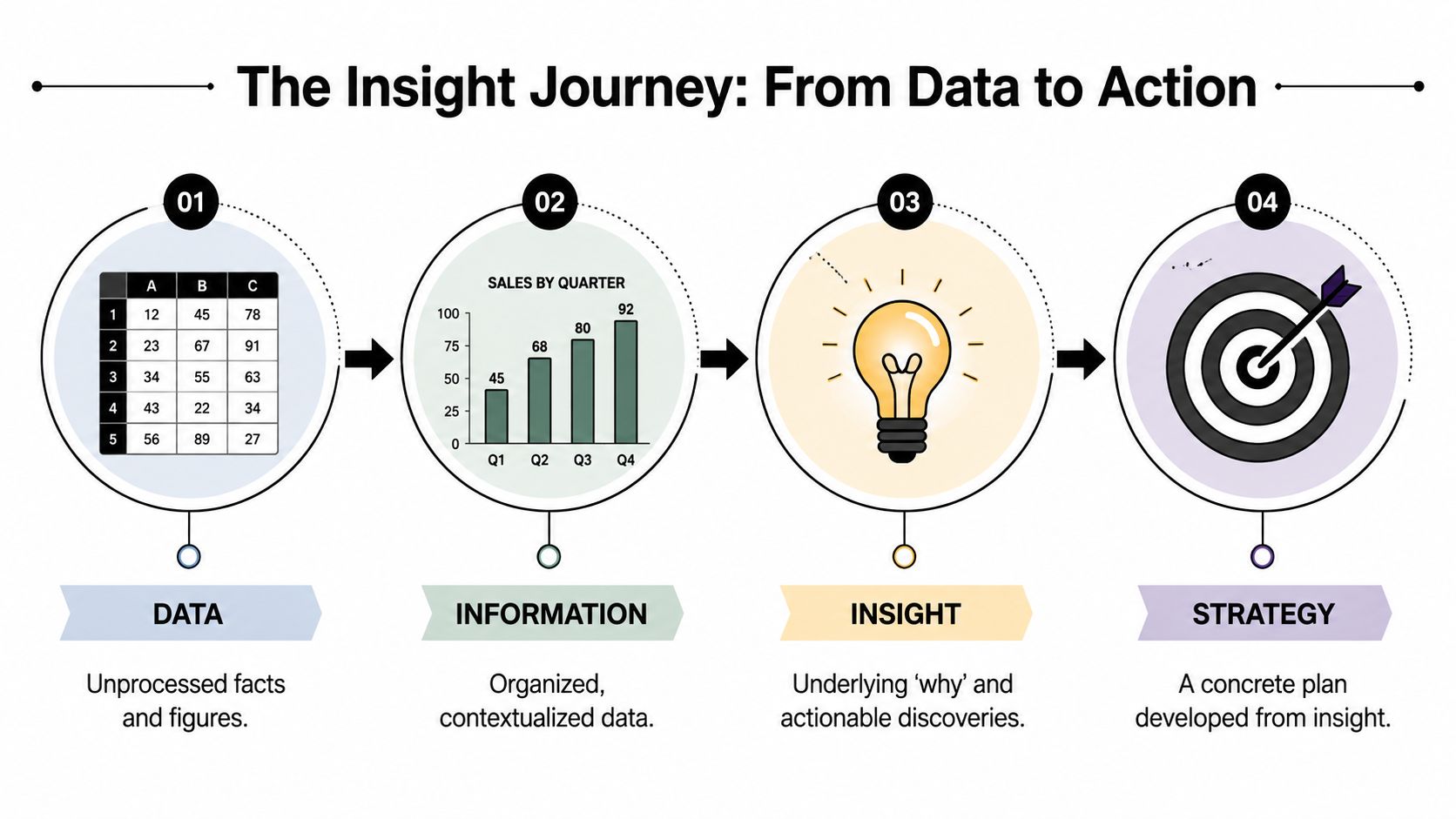
Raw data is just material. It’s like a pile of bricks. Information is knowing how many bricks you have and what type they are. An insight is realizing those bricks can build a bridge over one exact gap your buyers keep running into. Strategy is deciding where to build that bridge first and how to sell it.
A useful hierarchy
Here’s the difference in practical terms:
| Stage | What it is | Example |
|---|---|---|
| Data | Unprocessed inputs | Job changes, funding news, CRM notes, call transcripts |
| Information | Organized facts | “Manufacturing firms mention implementation delays more than reporting issues” |
| Insight | Non-obvious meaning | “Ops leaders at multi-site manufacturers don’t need another dashboard. They need faster handoff visibility between plants.” |
| Action | Campaign decision | Build a list around multi-site operations leaders and write around delay visibility |
A lot of outbound teams stop at information. They collect signals, sort them, maybe build a dashboard, and assume they now have insight. They don’t.
An insight must change behavior. If it doesn’t alter your list criteria, message angle, offer, or sequence logic, it’s just an interesting observation.
What real market research insights include
Good market research combines primary research like interviews, surveys, and observation with secondary research, then uses statistical analysis, data modeling, and visualization to turn inputs into decisions, as explained in this overview of how market research works in practice.
For cold email, that translates into a smaller operating model:
-
Collect direct evidence from customers, prospects, sales calls, and support conversations.
-
Add market context from competitor positioning, category language, review sites, and public company signals.
-
Look for repeated tension rather than repeated words.
-
Turn that tension into a segment hypothesis.
-
Test that hypothesis with copy and targeting, not with internal debate.
If your team is still defining audience fit too loosely, this breakdown of ICP in sales is useful because it forces a tighter view of who should enter the campaign in the first place.
Practical rule: If the finding doesn’t tell your SDR who to email differently on Monday, it isn’t an insight yet.
A simple test
Ask three questions about anything your team calls an insight:
-
Is it specific to a segment?
-
Does it reveal a cause, not just a pattern?
-
Does it point to one clear action in outreach?
If the answer to any of those is no, keep digging.
That discipline matters because the U.S. market research and public opinion polling industry was estimated at $37.7 billion in 2026, with 46,569 businesses operating in the space, according to IBISWorld’s industry profile. A large share of that value comes from doing exactly this work well: converting noise into choices.
How to Find Your Best B2B Audiences
Most strong B2B segments don’t announce themselves. You have to detect them by combining signals that look minor on their own but become useful together.
The mistake is relying on demographic filters alone. Industry, employee count, and title can help narrow a list, but they rarely explain why one prospect replies and another ignores you. The better opportunities often sit inside an existing market, hidden in behavior, timing, and operating context.
Start with your best current customers
Don’t begin with the total addressable market. Begin with the accounts that already bought, onboarded well, and stayed engaged.
Look at what they share beyond firmographics:
-
Buying trigger such as expansion, leadership change, or new compliance pressure
-
Internal friction like handoff gaps, reporting mess, or team onboarding drag
-
Operational pattern such as multiple business units, channel complexity, or fast hiring
-
Language used in calls and emails before they agreed to a meeting
That’s where segmentation gets sharper. You stop saying “mid-market SaaS” and start saying “SaaS firms with newly built outbound teams that need message consistency before ramp stalls.”
A practical next step is tightening your email list segmentation around those real conditions instead of broad audience labels.
Use research sources buyers reveal themselves through
You don’t need an expensive study to find usable segments. You need a disciplined routine.
Competitor pages and category messaging
Review competitor homepages, solution pages, customer stories, webinar titles, and ad copy. Don’t copy claims. Look for repetition and omission.
If five competitors all speak to enterprise security leaders, that doesn’t automatically mean you should. It might mean the underserved segment is implementation owners or revenue operations teams who feel the pain first but don’t control the category narrative.
Review sites and community language
G2, Capterra, Reddit, LinkedIn comments, niche Slack groups, and support forums can surface language your internal team would never invent. Watch for recurring complaints about rollout effort, team adoption, data quality, approval cycles, or handoff delays.
Those complaints often reveal better entry points than polished testimonials do.
Sales Navigator and trigger events
LinkedIn Sales Navigator is useful when you stop using it only as a title filter. Use it to spot change:
-
New executive hires that often trigger audits of vendors and process
-
Recent funding that changes urgency, headcount plans, and scrutiny
-
Team build-out visible through clustered hiring
-
Market expansion signaled by location growth or role distribution
Find underserved segments, not just visible ones
A major gap in common advice is that it doesn’t show teams how to combine behavioral data, segmentation, and qualitative interviews to find underserved segments. The more useful view is that opportunity often sits in smaller groups missed by standard demographic targeting, as discussed in this explanation of underserved market segments.
That matters in B2B outreach because broad targeting usually overweights obvious segments. Everyone chases the same headline audience. Fewer teams ask which subsegment has a distinct pain, weak vendor attention, and enough urgency to respond now.
The strongest segment is often not the biggest one. It’s the one whose problem is clear, expensive, and badly addressed.
For software firms building outbound around this kind of specificity, these go-to-market resources for software firms can help pressure-test how narrow your audience definition should be.
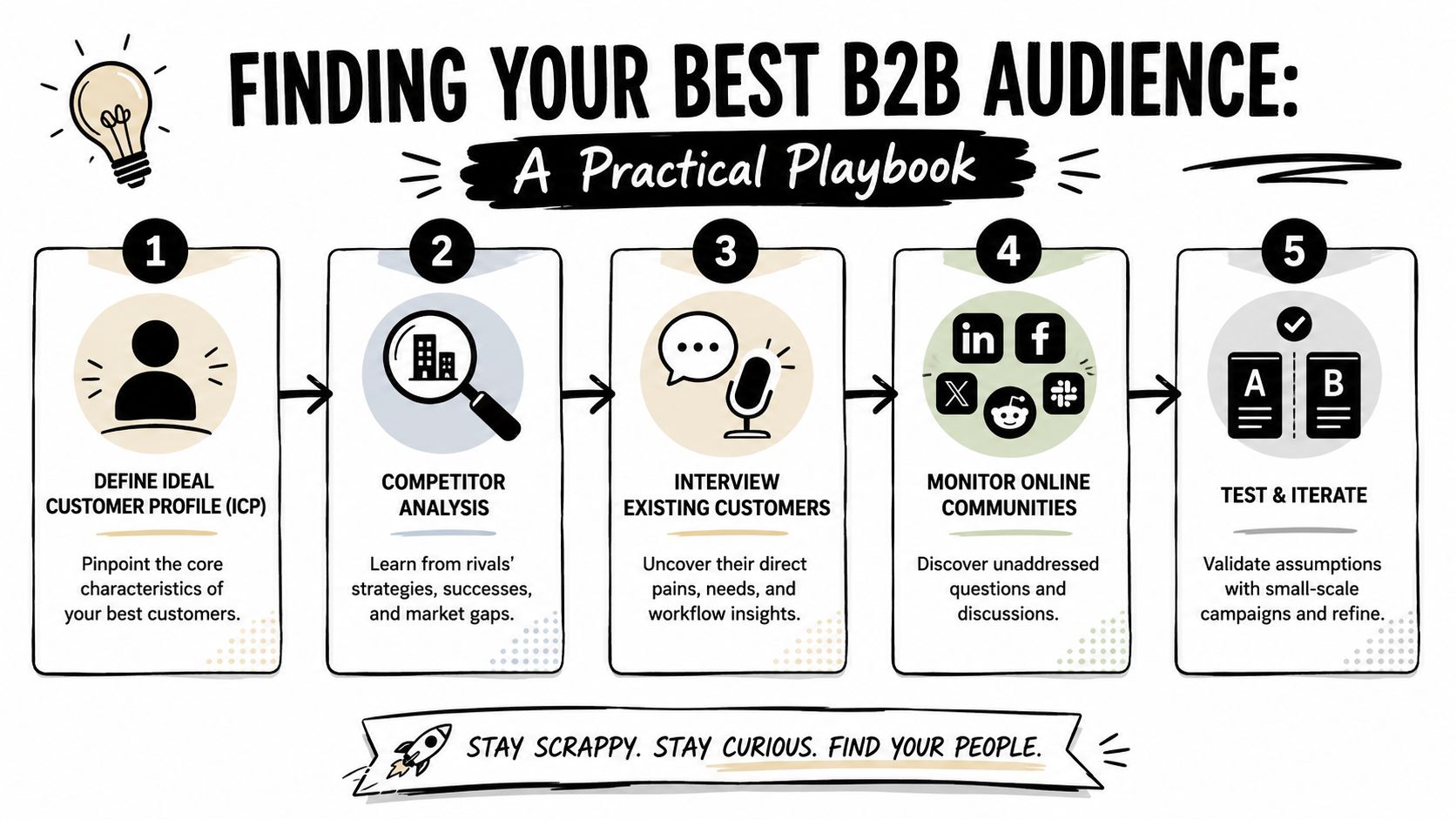
A scrappy workflow that works
Instead of a giant research project, use a weekly operating loop:
-
Pull closed-won and closed-lost notes Compare why deals moved versus stalled.
-
Interview a small set of customers Ask what was already broken before they looked for a solution.
-
Map competitors by audience focus Note who they speak to, what they ignore, and where their copy feels generic.
-
Build one segment hypothesis Example: “Regional logistics firms with multi-location operations and new sales leadership.”
-
Launch a small campaign Test one message angle tied to that exact operating issue.
-
Review replies qualitatively Positive replies, objections, confusion, and forwarding behavior all matter.
Many teams often overcomplicate things. You don’t need perfect certainty. You need enough signal to create a segment-specific campaign that teaches you more than another broad blast ever will.
From Insight to High-Performing Campaigns
A sales leader approves a cold email campaign, the list looks large enough, and the copy sounds polished. Two weeks later, reply quality is weak, meetings are thin, and nobody can tell whether the problem was the segment, the message, or the offer. That usually happens when research stays at the category level instead of being turned into campaign decisions.
Strong outreach comes from translating insight into four working choices: who goes on the list, what problem earns the opening line, which trigger makes the timing believable, and what ask feels reasonable for that buyer.

Messaging that sounds specific
Say your research shows a repeat pattern in growth-stage B2B firms. Sales hiring increased, onboarding expanded, and message consistency slipped before leadership noticed it in pipeline reviews.
A weak email says:“We help B2B companies improve outbound performance with better messaging and lead generation.”
A stronger email says:“Noticed your team has added sales headcount recently. That often creates message drift before it shows up in meeting quality or objection handling. We help revenue teams tighten outbound messaging before those gaps spread across the team.”
That second version works because it names a current operating issue, not a generic business goal. It also gives the prospect a reason to care now. If you want a practical way to structure those message angles, this messaging framework is a useful reference.
Specificity has a trade-off. Tighter messaging usually lowers total addressable volume, but it raises relevance. For pipeline teams, that trade is often worth making because a smaller list with clear pain will outperform a broad list filled with weak-fit accounts.
Targeting that matches the message
Good research gets wasted when targeting stays broad.
If the insight is about message drift after team expansion, the list should reflect signs of recent hiring, team growth, or sales leadership change. If the insight is about reporting lag in distributed operations, the list should skew toward companies with multi-location complexity. The targeting logic should make it obvious why this account belongs in the campaign.
| Insight | List criteria | Exclude |
|---|---|---|
| New sales team growth creates message inconsistency | Companies with recent sales hiring, heads of sales, enablement leaders, growth-stage firms | Mature firms with flat hiring |
| Multi-location ops create reporting lag | Operators with distributed teams, regional managers, ops leaders | Single-location businesses |
| New finance leadership triggers tool review | Recently hired finance leaders, controller or VP Finance roles | Firms with stable leadership and no visible change signals |
Many outbound teams lose signal because they write a sharp email for one subsegment, then send it to a mixed audience. Once that happens, performance data stops being useful. A poor result could mean the insight was wrong, the list was wrong, or both.
Offers and KPIs that support pipeline decisions
The first ask should match problem awareness. A prospect who just recognized an internal issue usually will not book a long demo from a cold email. A short teardown, a benchmark comparison, or a brief working session is often easier to accept because it fits the buyer’s level of commitment.
The same principle applies to measurement. Opens can still help diagnose inbox placement or subject line issues, but they are weak indicators of market insight quality. Better signals are closer to revenue reality:
-
Positive replies from the exact segment the campaign targeted
-
Qualified meetings that match your sales team’s acceptance criteria
-
Objections that show whether the pain is real, mistimed, or framed poorly
-
Internal forwarding that suggests the problem matters beyond one contact
Reply analysis matters more than teams admit. A “not a priority” response tells you something different from “we already fixed this” or “send this to our enablement lead.” Those distinctions shape the next list pull, the next angle, and the next offer.
Execution quality still matters. Mail Merge for Gmail’s cold email guide covers the mechanics of writing outreach that is clear, credible, and easy to respond to. Insight gives you the angle. Good email construction makes that angle readable.
Faster feedback beats bigger campaigns
Broad buyer personas age quickly, especially in crowded B2B markets where hiring plans, leadership changes, and channel mix shift quarter by quarter. Circana’s article on finding underserved consumer markets through detailed data makes a useful point that also applies here. Finer-grained signals can reveal overlooked demand pockets that broad categories miss.
In B2B outbound, that means using campaign feedback to find underserved segments before competitors do. One cluster of positive replies from regional operators, newly promoted sales leaders, or finance teams during a system transition can be more valuable than a larger batch of vague interest from a generic audience.
A short walkthrough helps here:
Field note: Campaigns improve faster when teams treat replies as research input, not just sales outcomes.
Some teams build this loop internally. Others use partners. Fypion Marketing says its process includes market research, list building, personalized outreach, and campaign management tied to booked qualified meetings.
The practical point is simple. Market research insights only create pipeline impact when they change targeting, messaging, timing, and the ask. If those four pieces stay generic, the research stays theoretical.
Cold Email Examples That Actually Work
The quality gap between generic outreach and insight-led outreach is obvious when you put the emails side by side.
That’s why this work has become more valuable, not less. The people who do it well are building a durable skill set. The market research analyst role that supports this kind of work has a median annual wage of $76,950 and projected employment growth of 7% from 2024 to 2034, according to O*NET’s occupation summary.

Example one
Before
Subject: Helping your team grow
Hi {{FirstName}},
We help companies improve sales performance through lead generation and outreach optimization. We’ve worked with many businesses to streamline prospecting and increase meetings.
Open to a quick call next week?
Best, {{Name}}
Why it gets ignored
It’s broad, vendor-centered, and detached from any specific business condition. The reader has to do all the work to decide if it matters.
After
Subject: New sales hires usually expose message gaps
Hi {{FirstName}},
Saw your team has been adding sales roles.
When teams grow quickly, reps often inherit different versions of the pitch, objection handling gets inconsistent, and reply quality starts drifting before leadership sees it clearly in pipeline reviews.
We help teams tighten outbound messaging and audience targeting so new reps ramp on a sharper message from the start.
Worth a conversation if that’s on your radar?
Best, {{Name}}
Example two
Before
Subject: Can we help with operations?
Hi {{FirstName}},
Our platform helps businesses improve visibility and efficiency across operations. I’d love to show you how it works and see if there’s a fit.
Do you have time this week?
Thanks, {{Name}}
Why it gets ignored
“Visibility” and “efficiency” are filler words unless the email attaches them to a lived problem.
A cold email works when the buyer feels recognized before they feel pitched.
After
Subject: Reporting friction across locations
Hi {{FirstName}},
Noticed you’re overseeing multiple locations.
A lot of ops leaders don’t struggle with lack of data. They struggle with delayed handoffs between sites, which then turns weekly reporting into manual cleanup instead of useful decision-making.
We’ve been helping teams approach that issue with tighter process visibility and cleaner outbound communication between revenue and ops stakeholders.
Should I send over the angle in a short note?
Best, {{Name}}
Example three
Before
Subject: Quick intro
Hi {{FirstName}},
I’m reaching out because we help finance teams save time and improve reporting. We’d love to show you our solution.
Interested?
Regards, {{Name}}
After
Subject: New finance leaders usually review reporting workflows early
Hi {{FirstName}},
Congrats on the new role.
When finance leaders step into a company, one of the first friction points they uncover is usually reporting that technically works but depends on too many manual workarounds across teams.
If you’re reviewing that area now, I can share how similar teams frame the issue internally before they evaluate tools or outside support.
Open to that?
Regards, {{Name}}
Why these versions work better
They all do three things:
-
Anchor to a plausible trigger instead of pretending the outreach happened randomly
-
Name an operational problem instead of leading with product language
-
Offer a next step that fits first contact rather than asking for a hard meeting too soon
If you want additional copy mechanics, Mail Merge for Gmail’s cold email guide is a useful complement on structure and writing basics. And once replies start coming in, these cold email follow-up templates help keep the conversation moving without falling back into generic follow-ups.
Start Building Your Insight Engine
Teams often treat market research as a planning task. The better approach is to treat it as an operating system for outbound.
You gather signals from customers, prospects, competitors, and the market. You turn those signals into a segment hypothesis. You build a list that matches the hypothesis, write copy around the pressure that segment is feeling, and study the replies for what they reveal next. Then you repeat.
What works and what doesn’t
A lot of outbound waste comes from avoidable habits.
-
What works - Narrow segments built around pain, timing, and context - Buyer language pulled from interviews, calls, reviews, and objections - Small tests that reveal whether a segment-message fit is real - Reply analysis used as research, not just campaign reporting
-
What doesn’t - Huge lists built only on title and industry - Generic value propositions that could fit any vendor - Internal assumptions replacing buyer evidence - Vanity metrics standing in for pipeline quality
Keep the loop running
The strongest market research insights usually don’t come from a single survey or workshop. They come from accumulation. Sales hears one objection. Success hears another. Marketing notices a pattern in which offers resonate. Product sees repeated friction during onboarding. Together, that becomes a segment-level view you can act on.
The point isn’t to know the whole market. It’s to know enough about one neglected segment to speak to it better than everyone else.
That’s the practical standard for cold email. Not more personalization theater. Not more list volume. Better pattern recognition, applied directly to targeting and message choice.
If your team already knows this approach makes sense but doesn’t want to build the research, infrastructure, list, copy, and optimization loop internally, outside execution can make sense.
Fypion Marketing works with B2B companies on performance-based cold email outreach, including audience research, customized list building, messaging development, campaign setup, and ongoing optimization tied to qualified meetings. If you want a second set of eyes on your current targeting or need help turning market research insights into booked pipeline, start with their free consultation.