
Email Delivery Consulting To Fix Your Inbox Placement
Email delivery consulting is all about figuring out why your emails are hitting the spam folder or just vanishing into thin air, and then fixing it so they actually land in the inbox. It’s a mix of technical deep-dives, reputation management, and smart strategy to get your campaigns seen.
Think of it as hiring a master logistician for your digital messages.
Why Your Emails Vanish and How To Fix It
It’s one of the most maddening problems in the digital world. You pour time into crafting the perfect email, hit “send,” and… nothing. It just disappears into a digital black hole. You’re not alone in this - it’s a massive, often invisible drain on your campaign ROI.
It’s like paying for a premium courier service that consistently loses a big chunk of your packages before they ever reach the customer’s front door.
The Growing Inbox Placement Crisis
This isn’t just a small hiccup; the email deliverability crisis has become a serious bottleneck for countless businesses. The latest data shows that only about 83.1% of marketing emails ever make it to the inbox globally. That means a staggering 16.9% just don’t get there.
About 10.5% of those messages are dumped straight into spam, and another 6.4% go missing entirely. This isn’t just a technical glitch; it’s a direct hit to your bottom line. Every single email that fails to deliver is a lost chance at a conversation, a demo, or a sale. The old days of just “blasting” a list and hoping for the best are long gone.
The core of the problem is trust. Mailbox providers like Gmail and Yahoo are now incredibly sophisticated gatekeepers. They use complex algorithms to shield their users from junk mail, because their number one job is to keep inboxes clean and relevant.
To get through, you have to prove your messages are legitimate, wanted, and valuable. That takes a lot more than just writing good copy. You need to get your hands dirty with the technical side of things:
-
Technical Authentication: This means getting your domain records (SPF, DKIM, DMARC) set up correctly. Think of these as your email’s digital passport - without them, you’re not getting past the border guards.
-
Sender Reputation: This is a score you build over time. It’s based on your sending habits, how many of your emails bounce, and how many people mark you as spam. A bad reputation follows you everywhere.
-
List Quality: You absolutely have to keep your contact lists clean. Sending to a bunch of invalid or “accept-all” addresses is a surefire way to kill your reputation. If this is a pain point, we’ve got a guide on how to verify accept-all emails that can help.
Trying to untangle all these complexities on your own is tough. This is exactly where professional email delivery consulting comes in. A real expert can diagnose the root causes of your deliverability problems and lay out a clear roadmap to get you back in the inbox, turning a huge liability into a real competitive edge.
Understanding The Three Pillars Of Email Deliverability
Getting your emails delivered successfully isn’t just a matter of luck. It’s a science, and it all boils down to three core pillars. When you work with an email delivery consulting expert, their entire job is to get these three areas dialed in so your messages actually land where they’re supposed to: the inbox.
Think of it like building a house. Each pillar is a critical part of the foundation. If one is weak, the whole structure is at risk of crumbling. Let’s break down exactly what these are, using a few simple analogies to clear things up.
Pillar 1: Technical Authentication
First up, technical authentication is basically your email’s official ID. It’s a set of digital handshakes - protocols like SPF, DKIM, and DMARC - that prove to mailbox providers like Gmail and Outlook that you are who you claim to be.
Imagine trying to deliver an important package to a high-security building. You’d need a uniform, an ID badge, and a marked vehicle to get past the front gate. Without that proof, security would turn you away in a heartbeat. That’s exactly what technical authentication does for your emails; it’s the non-negotiable first step to even get considered for the inbox.
A critical part of understanding email deliverability is recognizing that mailbox providers are fundamentally gatekeepers. Their primary job is to protect their users, and proper authentication is the first checkpoint every sender must pass.
Pillar 2: Sender Reputation
Next, we have sender reputation. This is essentially a credit score for your email domain and IP address. It’s a number that mailbox providers use to decide how trustworthy you are, and it’s built slowly over time based on everything you send.
Every single campaign you run nudges this score up or down. Sending clean emails that get opened and clicked? Your score goes up. Sending to a messy list full of bounces and getting hit with spam complaints? Your score plummets, and your emails start going straight to junk. A high reputation score opens doors, while a low one gets them slammed in your face.
Pillar 3: Audience Engagement
Finally, there’s audience engagement. This is the real-world proof that people actually want to hear from you. Mailbox providers are always watching to see how people interact with your messages, and they use that data to judge whether your emails are valuable or just noise.
Positive signals are the lifeblood of any healthy email program. These are things like:
-
Opens and Clicks: The most basic sign that people find your content relevant.
-
Replies: A huge positive signal. When someone takes the time to actually reply, it tells providers your email sparked a real conversation.
-
Forwards: Someone sharing your email is a powerful endorsement.
On the flip side, negative signals - like unsubscribes, instant deletions, and especially spam complaints - scream to providers that your content is unwelcome.
Nailing the balance between these three pillars is everything. To dive deeper, you can explore some of the core email deliverability best practices that put these concepts into action.
What An Email Delivery Consultant Actually Does
So, you’re thinking about hiring an email delivery consultant, but what do they really do all day? It’s a fair question. The role can feel a bit abstract.
Think of them as a specialist doctor for your email program. You bring them in for a full health check-up, where they diagnose what’s wrong, prescribe a treatment plan, and help you maintain long-term health. It’s a methodical process that moves from discovery to hands-on fixing and ongoing care.
It all starts with a deep-dive audit. The consultant puts on their detective hat and meticulously investigates every single part of your email process. They’re hunting for the root causes of your deliverability problems, not just the symptoms. They’ll scrutinize your technical setup, pick apart your sending habits, and analyze the quality of your lists.
This initial phase is all about uncovering the hidden gremlins sabotaging your inbox placement. It’s rarely one single “smoking gun.” Instead, the goal is to build a complete, holistic picture of your email program’s health.
The process usually breaks down into three core pillars that a good consultant will analyze and optimize.
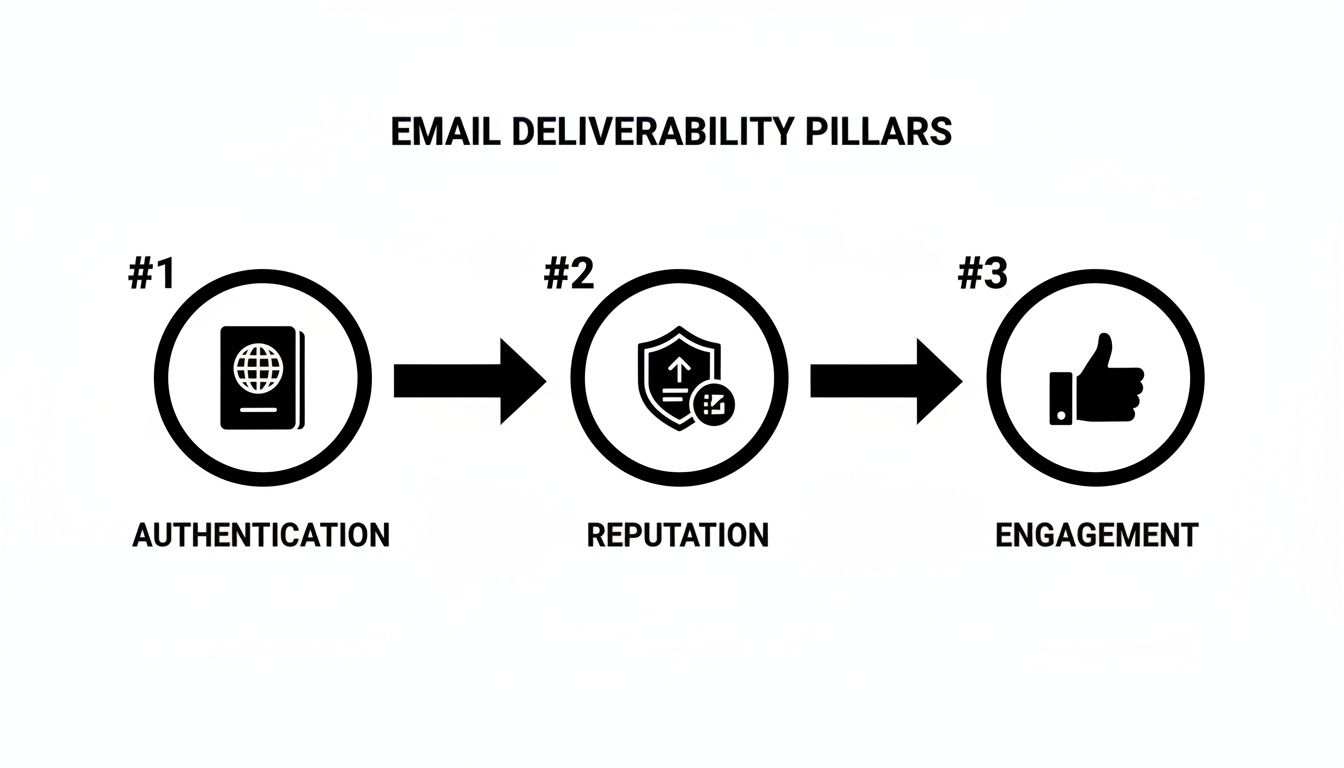
These three pillars - authentication, reputation, and engagement - are the foundation of any healthy email program, and a consultant will systematically tackle each one.
Developing A Strategic Action Plan
Once the audit is done and the problems are identified, the consultant doesn’t just hand you a generic list of “best practices.” That’s not helpful. Instead, they build a strategic roadmap - a clear, prioritized action plan tailored specifically to the issues they uncovered.
This roadmap lays out the exact steps needed to fix what’s broken and improve what’s already working. It gives you a clear path forward, ensuring you focus your efforts on the changes that will make the biggest impact first.
Implementing Fixes And Monitoring Performance
With a solid plan in hand, the real work begins. This is the hands-on phase where the consultant (or your team, with their guidance) starts implementing the fixes.
Here’s what that typically involves:
-
Nailing the Technical Setup: This means correctly configuring authentication protocols like SPF, DKIM, and DMARC. These are non-negotiable for proving you are who you say you are. Getting this right is critical, as we detail in our guide on step-by-step instructions for a proper technical setup.
-
Optimizing Sending Infrastructure: The consultant makes sure your domains and IPs are properly warmed up and configured to handle your email volume without raising red flags.
-
Performing List Hygiene: This is a fancy term for cleaning your email lists. It means getting rid of invalid, inactive, or risky addresses that are actively tanking your sender reputation.
Finally, the work shifts to ongoing monitoring. The consultant keeps a close eye on key metrics like inbox placement rates, bounces, and audience engagement to make sure the fixes are actually working. This data-driven approach is what methodically restores your email program to peak health and, just as importantly, keeps it there.
How To Choose The Right Email Delivery Consultant
Picking the right expert is probably the single most important decision you’ll make in your journey to fix your inbox placement. It’s a make-or-break moment. The wrong partner can burn through months of your time and budget with nothing to show for it, while the right one can become a genuine revenue driver for your business.
A real email delivery consulting partnership is so much more than a sales pitch. You need someone who feels like an extension of your own team - someone who’s just as invested in your success as you are.
So, how do you find that person? It comes down to vetting candidates across three distinct - but equally critical - areas. This simple framework will help you cut through the fluff and find an expert whose incentives are perfectly aligned with your growth.
Technical Expertise Is Non-Negotiable
First things first, your consultant must have deep technical knowledge. This isn’t optional. They need to be fluent in the language of mailbox providers like Google and Microsoft, easily navigating the tricky world of DNS records, authentication protocols like SPF and DKIM, and the constantly shifting algorithms that decide whether you land in the inbox or the spam folder.
This goes way beyond surface-level familiarity. Challenge them. Ask them to walk you through how they’d diagnose a reputation nosedive or their exact process for warming up a new sending domain. A true pro will give you clear, confident answers. A novice will hide behind vague buzzwords. They should sound less like a marketer and more like an engineer who just happens to be great at explaining things.
Strategic Business Acumen
But here’s the catch: technical skills alone are not enough. A truly great consultant knows how to connect deliverability fixes to real, tangible business outcomes. They get that the goal isn’t just a prettier “inbox placement rate” on a dashboard.
It’s about booking more meetings, generating more qualified leads, and building a healthier sales pipeline.
They should be asking you about your business model, your customer acquisition costs, and your typical sales cycle. This business-first approach is what separates a mere technician from a true strategist. They focus on delivering actual ROI, not just vanity metrics. For more on what makes a great growth partner, check out our guide on finding a top lead generation agency.
The right consultant doesn’t just fix your email problems; they build a system that fuels your growth. Their success should be measured by your success - period.
A Performance-Driven Mindset
Finally, look for a performance-driven mindset. How do they actually measure success? Do they provide clear, no-nonsense reporting that directly ties their work to your most important KPIs?
A consultant who is genuinely confident in their ability to get results will be totally transparent about their process and how they track progress. They won’t shy away from accountability.
To help you stay organized during your search, use this simple checklist to evaluate and compare potential email delivery consulting partners. It forces you to look beyond the sales pitch and focus on what really matters.
Consultant Evaluation Checklist
| Evaluation Criteria | Consultant A | Consultant B | What to Look For |
|---|---|---|---|
| Technical Depth | |||
| Can they explain complex topics in plain English? Do they sound confident? | |||
| Business Acumen | |||
| Do they ask about your revenue goals? Can they connect their work to your bottom line? | |||
| Performance Focus | |||
| How do they measure success? Do their reports align with your business KPIs? | |||
| Communication Style | |||
| Are they proactive and transparent, or do you have to chase them for updates? |
Using a structured evaluation like this ensures you find a partner who not only has the technical chops to get the job done but also brings the strategic foresight to turn your email program into a powerful engine for business growth.
Measuring The Real ROI Of Improved Deliverability
So, how do you actually justify the investment in email delivery consulting? It’s simple: you prove its value by focusing on cold, hard business results, not just a bunch of technical stats. It’s all about connecting the dots between better inbox placement and a healthier bottom line.

While email famously delivers a jaw-dropping return, that entire potential evaporates the second your message hits the spam folder. An incredible ROI is still zero if the email is never seen.
This means we have to completely change how we measure success. Metrics we used to rely on, like open rates, are basically useless now thanks to privacy updates. The real focus needs to be on actions that signal genuine interest and actually move the needle for your business.
From Vanity Metrics To Pipeline Growth
The true return on your deliverability investment isn’t found in a pretty open-rate report. It’s measured in the tangible actions that fill your sales pipeline. Once a consultant fixes your inbox placement, you should see a real lift in these key areas:
-
Higher Reply Rates: More positive replies mean your message is actually starting valuable conversations.
-
Increased Click-Through Rates (CTR): More clicks on your call-to-action links - like a demo booking page - are a dead giveaway of interest.
-
More Qualified Leads: This is the big one. Better deliverability puts your message in front of more of the right people, which directly leads to more qualified meetings on the calendar.
Email still crushes it on ROI, generating an average of $36 - $42 for every $1 spent. But how we track that success has changed. Solid metrics like click-through rates and revenue per recipient have taken over from open rates because they’re reliable and tie directly to business growth.
A Practical ROI Scenario
Let’s break this down with a simple, realistic example. Imagine your sales team sends 10,000 outreach emails a month, but a nasty deliverability problem is sending 20% of them straight to spam.
That’s 2,000 missed opportunities every single month. Your message, your offer, and your brand never even get a chance with those prospects.
Now, you bring in a deliverability consultant. Through a combination of technical fixes and reputation management, they improve your inbox placement by just 10%. Suddenly, an extra 1,000 emails are landing in the primary inbox each month.
If your baseline reply rate is 2%, that 10% improvement doesn’t just look good on a report - it translates into 20 new conversations with potential buyers. If you book meetings with 25% of those replies, you’ve just added 5 new, qualified sales meetings to your pipeline that month alone.
Over a year, that’s 60 additional meetings you would have completely missed out on. When you focus on the right numbers, you can clearly see that expert deliverability guidance isn’t an IT cost - it’s a powerful and predictable revenue driver. To get a better handle on tracking this, you should learn more about the email marketing KPIs that actually drive business growth.
Navigating The New Rules Of Inbox Placement
The world of email deliverability has changed, and there’s no going back. If you’re still using the old “send and hope” approach, you’re already behind. Mailbox providers like Gmail and Outlook now play by a very different set of rules - ones where your sender reputation and list quality are everything.
Think of your sender reputation like your credit score. It takes a ton of good behavior to build it up, but just one or two bad moves can send it plummeting. And once it’s damaged, it’s a long, painful process to fix.
The New Reality Of Reputation Management
In this new environment, sender reputation and list quality have become the decisive factors that determine whether your emails ever get seen. The big Internet Service Providers (ISPs) use sophisticated systems that judge you almost entirely on how your recipients react. They’re looking at your complaint rates, bounces, engagement, and how many inactive addresses are on your list.
This isn’t just a minor shift. If you get blacklisted or hit with high spam complaints, you’re not looking at a quick fix. Rebuilding that trust can take weeks or even months of painstaking work. You can get more insights on these deliverability trends and challenges from the folks at ExpertSender.
Proactive management isn’t just a “nice to have” anymore; it’s a must. Ignoring these new rules is like trying to drive across the country with a map from 1995. You’re going to get lost.
Your sender reputation is now your most valuable asset in email outreach. Once damaged, the path to recovery is slow and costly, making expert guidance from an email delivery consulting professional more critical than ever.
The High Cost Of Poor List Hygiene
One of the fastest ways to absolutely wreck your reputation is with a messy email list. Every time you send to an invalid, old, or unengaged contact, you’re sending a massive red flag to the mailbox providers. It tells them you aren’t listening to your audience, which is a cardinal sin in their world.
It’s shocking how many businesses still don’t bother with basic list verification, even with the risks being so clear. This one oversight is a direct line to high bounce rates and spam complaints - two of the most damaging marks against your sender score. It kicks off a nasty downward spiral:
-
You send your campaign to a poor-quality list.
-
Your bounce and complaint rates shoot through the roof.
-
Mailbox providers see these negative signals and tank your reputation.
-
Your future emails start landing straight in the spam folder.
Hiring a consultant who gets how to navigate these new rules isn’t a luxury anymore. For any business that’s serious about growth, it’s a necessity to make sure your message is actually getting heard.
Common Questions About Email Delivery Consulting
Even after mapping everything out, it’s natural to have a few lingering questions about email delivery consulting. Let’s clear up some of the most common ones.
What Is The Main Goal Of A Consultant?
At its core, the goal is straightforward: make sure your emails land in the inbox, not the spam folder. That’s it.
They get this done by digging into your technical setup, managing your sender reputation, and fine-tuning your entire email strategy to play by the rules of mailbox providers like Gmail and Outlook.
Think of them as a specialist doctor for your email program. They diagnose why your messages are getting filtered or blocked, then prescribe and implement the cure to ensure they get seen. A great consultant always ties their work back to real business results, like getting more replies and booking more meetings.
The core role of an email delivery consultant is to maximize your inbox placement rate. This single metric unlocks the true ROI of your entire email marketing and outreach efforts.
How Quickly Can I Expect To See Results?
This really depends on the starting point. If the problems are minor technical glitches, you could see improvements in just a few days.
However, if your sender reputation has taken a serious hit, rebuilding that trust with the big email providers is more of a marathon than a sprint. It often takes several weeks, sometimes even a couple of months, of perfectly executed sending to get back in their good graces.
To get a better handle on the specific strategies and technical must-haves for landing in the inbox, it’s worth exploring these essential email deliverability best practices.
Ready to stop guessing and start booking qualified meetings? Fypion Marketing operates on a pay-per-meeting model, so our success is your success. Book your free consultation today and see how our performance-driven approach can fill your sales pipeline.