
Lead Generation Blueprint: Build a Predictable B2B Pipeline

Let’s be honest, without leads, your business is dead in the water. Lead generation is the engine of any B2B company that wants predictable, sustainable growth. It’s the process of finding people who could be great customers and turning them into prospects who are actually interested in talking to your sales team.
It’s the first, most crucial step in building a real business relationship.
What B2B Lead Generation Really Means in 2026

Think of your business as a high-performance engine. B2B lead generation is the fuel injection system. The goal isn’t just to pump in as much low-grade fuel as possible; it’s about delivering a precise, high-octane mixture to generate maximum power and speed.
Without a steady stream of qualified leads, your sales team sits around waiting for the phone to ring, and your growth chart flatlines. A solid lead generation strategy keeps your pipeline full of potential customers who are a good fit and are genuinely curious about what you’re selling.
Inbound vs. Outbound Strategies
At the end of the day, all lead generation falls into two main camps: inbound and outbound. Understanding how they work - and how they work together - is the key to building a revenue machine that runs smoothly.
-
Inbound Lead Generation: This is the magnetic approach. You create helpful, valuable content and experiences that naturally pull your ideal customers toward you. Think of it as setting up an amazing storefront that people are excited to walk into on their own.
-
Outbound Lead Generation: This is the more direct, hands-on method. It involves proactively reaching out to potential customers who fit your ideal profile but might not even know you exist yet. This is like a salesperson making targeted visits to businesses they know can benefit from what they offer.
To get a real handle on the current landscape, it’s worth reviewing the core B2B Lead Generation Best Practices. This context will help you decide on the right mix of tactics for your specific goals.
For a quick comparison, here’s how the two approaches stack up against each other.
Inbound vs Outbound Lead Generation At a Glance
| Attribute | Inbound Lead Generation | Outbound Lead Generation |
|---|---|---|
| Core Method | Attract customers with valuable content (blogs, SEO, social media) | Proactively reach out to potential customers (cold email, calls, LinkedIn) |
| Customer Intent | High - they are actively seeking a solution and find you | Low to None - they are not actively looking for you |
| Pace | Slower, long-term asset building | Faster, can generate conversations and meetings quickly |
| Cost | Can have a lower cost-per-lead over time | Can have a higher initial cost but is highly scalable and predictable |
| Targeting | Broader - you attract anyone who finds your content | Highly targeted - you choose exactly who to contact |
| Best For | Building brand authority, generating a consistent flow of warm leads | Penetrating specific accounts, reaching high-value targets, rapid market testing |
Both inbound and outbound have their place in a well-rounded strategy. You don’t have to pick just one.
While many marketers sing the praises of inbound, and for good reason - SEO leads have a close rate of 14.6% compared to just 1.7% for outbound - the reality is a bit more nuanced.
A truly effective lead generation engine isn’t about choosing one strategy over the other. It’s about building a balanced system where inbound efforts warm up the market and outbound tactics engage high-value targets with surgical precision.
The Role of the Sales Funnel
The sales funnel is just a simple way of visualizing the journey a person takes from a complete stranger to a paying customer. Leads come in at the Top of the Funnel (ToFu) as prospects, get nurtured in the Middle (MoFu) as they learn more, and hopefully come out the Bottom (BoFu) as sales-ready opportunities.
Your entire lead generation program should be built to guide people through this journey. To see how this fits into the bigger picture, check out our guide on marketing for B2B companies.
In this guide, we’ll walk you through how to build your own scalable pipeline, focusing heavily on powerful channels like cold email and LinkedIn. We’ll cover everything from qualifying leads to tracking your success, giving you a practical roadmap for real growth.
Choosing Your High-Impact Lead Generation Channels

Okay, so you know the difference between attracting leads and actively hunting them down. The next logical question is, where do you actually find them? The answer is choosing the right channels - the digital watering holes where your ideal customers hang out.
Think of it like fishing. You wouldn’t cast a net in a puddle. You go where the fish are. In B2B, while you could dabble in everything from paid ads to content, real, scalable success usually comes from mastering just a couple of key channels.
For direct, repeatable outreach, two channels consistently blow the rest out of the water: cold email and LinkedIn. These aren’t just items on a checklist; they are the absolute powerhouses of modern B2B lead generation. They give you a direct line to decision-makers, something broader, more passive strategies just can’t replicate.
The Undisputed King of B2B Social Media: LinkedIn
When it comes to the B2B world, LinkedIn isn’t just another social network; it’s the entire stadium. It’s the default hub where executives, managers, and specialists gather to talk shop, share insights, and - most importantly for us - be open to business conversations.
This concentration of decision-makers makes it an incredible resource. You can pinpoint prospects by job title, company size, industry, or even recent company news, letting you build a laser-focused list. The platform’s professional vibe also means people expect to connect and discuss business, which lowers the barrier for your first message.
In fact, LinkedIn is the undisputed champ here. It drives 80% of all B2B social media leads and is a staggering 277% more effective than platforms like Facebook or X for generating them. It’s not optional; it’s a core part of any serious B2B playbook.
The Enduring Power of Precision Cold Email
People have been predicting the death of cold email for years, yet it remains one of the most powerful and scalable channels out there. Why? It’s direct, it’s personal, and it lands right where every professional spends their day: their inbox. No algorithms, no noisy feeds - just your message, waiting for their attention.
The secret isn’t to spray and pray. That’s what gives cold email a bad name. The modern approach is all about precision and relevance. This means:
-
Hyper-Targeted Lists: Building lists of prospects who are a perfect fit for your Ideal Customer Profile (ICP), not just anyone with a pulse.
-
Deep Personalization: Writing messages that show you’ve done your homework, referencing their specific role, company, or a recent achievement.
-
Value-First Approach: Offering a genuine insight or a solution to a problem you know they have, instead of just begging for a meeting.
When you do it right, cold email isn’t spam. It’s a strategic, one-to-one conversation starter that respects the other person’s time. If you’re weighing your options, understanding the nuances is key. Our guide comparing cold calls vs. cold emails breaks down which might be a better fit for your team.
The Multi-Touch Strategy That Wins
The most sophisticated teams don’t just pick one channel. They weave them together into a seamless multi-touch sequence. Here’s what that looks like in the real world for, say, a SaaS company selling project management software to engineering firms:
-
LinkedIn Touchpoint: The sequence starts with a LinkedIn connection request to a Head of Engineering. The note isn’t generic; it mentions a shared connection or a new project their company just announced.
-
Email Touchpoint 1: A couple of days later, a cold email lands in their inbox. It references the LinkedIn connection, brings up a common challenge for engineering teams (like managing complex project timelines), and briefly hints at a solution.
-
LinkedIn Engagement: Over the next week, the salesperson might like or comment on one of the prospect’s posts. It’s a low-key way to stay on their radar without being annoying.
-
Email Touchpoint 2: The next email doesn’t just ask for their time. It gives them something valuable, like a short case study showing how a similar engineering firm cut project delays by 25%.
-
The Ask: Only now, at the end of the sequence, comes the clear, low-friction ask: “Are you open to a 15-minute chat next week to see if this could help your team, too?”
This multi-channel approach builds familiarity and trust over time. You stop being a random stranger in their inbox and become a persistent, helpful resource, which dramatically boosts your chances of booking that all-important first meeting.
How to Qualify and Score Leads Effectively
Getting a flood of new contacts feels great, but it’s only half the job. Most of those contacts will never become customers. This is where you need to get smart with qualification and scoring - the processes that separate the window shoppers from the serious buyers.
Think of it like this: lead qualification is the bouncer at an exclusive club. Their only job is to make sure the right people get in, saving your sales team from wasting time on conversations that go nowhere. Lead scoring is the club’s internal VIP system, telling you which guests deserve your immediate attention.
The First Filter: Lead Qualification Frameworks
Before you start scoring anyone, you have to qualify them. This is a quick check to see if a lead even meets your most basic criteria. It answers one simple question: “Is this person a potential fit for what we sell?”
One of the oldest and most effective frameworks for this is BANT. It’s your bouncer, checking every lead against four core pillars:
-
Budget: Can their company actually afford your solution?
-
Authority: Is your contact a decision-maker, an influencer, or just someone who can point you to the right person?
-
Need: Do they have a real problem that your product or service solves?
-
Timeline: Are they looking to buy soon, or just browsing for next year’s budget?
If a lead doesn’t check at least a few of these boxes, they aren’t ready for a sales call. They might be a good fit for a long-term email nurture sequence, but they shouldn’t be taking up a salesperson’s time right now.
The Second Filter: The Power of Lead Scoring
Once a lead passes that first bouncer, lead scoring takes over. This is where you assign points to leads based on who they are (demographics) and what they do (their behavior). The higher the score, the more “sales-ready” they are.
Lead scoring turns a messy list of contacts into an organized, prioritized queue. It automatically shows your sales team who to talk to first, based on the signals a prospect has already given you.
The whole system runs on simple “if-then” logic. For example, if a lead visits your pricing page, they get +15 points. If they download a case study, maybe +10 points. If they happen to be a Director at a 500-person company in your target industry, that could be another +20 points.
We’ve built out a complete guide on this, and you can learn more about setting up a powerful system by mastering B2B lead scoring for sales effectiveness.
Building a Simple Lead Scoring Model
You don’t need a PhD in data science to build a scoring model. A powerful system can be built by focusing on just two types of data:
1. Firmographic/Demographic Score (The “Fit”)
This score is all about explicit data - things you know for a fact about the person or their company. It tells you how well they match your Ideal Customer Profile (ICP).
-
Job Title: C-Level/VP (+20), Director (+15), Manager (+10)
-
Company Size: 50-200 employees (+15), 201-1000 employees (+10)
-
Industry: Matches your target industry (+20)
2. Behavioral Score (The “Intent”)
This score is based on implicit data - the actions a lead takes on your website or with your emails. It tells you how interested they are.
-
High-Intent Actions: Requested a demo (+30), visited the pricing page (+15)
-
Medium-Intent Actions: Downloaded a case study (+10), attended a webinar (+10)
-
Low-Intent Actions: Opened an email (+1), visited a blog post (+2)
Add these two scores together, and you get a total score for every lead. Once a lead hits a threshold you’ve set (say, 100 points), they’re automatically flagged as a Sales Qualified Lead (SQL) and sent straight to your sales team for follow-up. This data-driven approach ensures your team is always focused on the hottest opportunities first.
Building Your Lead Generation Engine Step by Step
Theory is great, but it doesn’t book meetings. Turning that knowledge into a working lead generation program is what actually drives revenue. This is your playbook for building a B2B outreach engine from scratch - a guide designed to get you from a blank slate to a calendar full of qualified appointments.
Think of this five-step process as the core framework for any outbound campaign that works. Follow it, and you’ll build a system that’s not just effective, but also measurable and ready to scale.
Step 1: Define Your Ideal Customer Profile
Before you write a single word or build any list, you have to know exactly who you’re talking to. This is your Ideal Customer Profile (ICP). It’s a hyper-specific description of the fictional company that gets the most value from what you sell.
An ICP isn’t just “tech companies.” It’s “Series B FinTech startups in North America with 50-200 employees who just hired a new Head of Sales.” The more granular you get, the more your entire strategy will hit the mark.
Key things to define for your ICP include:
-
Industry/Vertical: What specific market are they in?
-
Company Size: How many employees? What’s their annual revenue?
-
Geography: Where are their offices located?
-
Technographics: What software or tools do they already use?
-
Pain Points: What specific business problems keep them up at night that you can solve?
Step 2: Build a High-Quality Target List
Once your ICP is set in stone, it’s time to find the real companies and people who fit that description. This isn’t about quantity; it’s all about quality. A clean, accurate list of 200 perfect-fit prospects will crush a generic list of 10,000 every single time.
You can pull this data from places like LinkedIn Sales Navigator or use specialized B2B data providers. The goal is simple: get a clean list of target companies and the right decision-makers, complete with their names, titles, and verified email addresses. Your list is the foundation of the entire campaign.
A huge mistake we see all the time is companies buying cheap, outdated lists. This just leads to high bounce rates, a torched domain reputation, and a ton of wasted effort. Investing in good data is one of the best moves you can make.
As you build your process, keeping up with proven lead generation best practices is crucial. It’s how you make sure you aren’t wasting time on tactics that stopped working years ago.
Step 3: Craft Outreach Messages That Actually Get Replies
Now for the fun part: writing messages that people actually read and respond to. Great outreach is a mix of personalization, relevance, and a clear call-to-action. Generic, “me-me-me” emails are deleted on sight.
Your messaging should follow a simple flow:
-
The Hook: Kick things off with a personalized first line. Show you did your homework. Mention a recent company funding round, a post they shared on LinkedIn, or a new product launch.
-
The Problem: Briefly touch on a common pain point relevant to their job and industry. It should be a problem you know they’re probably dealing with.
-
The Solution: Hint at your solution without launching into a big sales pitch. Keep it short and focused on the outcome, not a laundry list of features.
-
The Call-to-Action (CTA): End with a clear, low-friction question. Instead of asking for a demo, try something softer like, “Open to exploring how this might apply to your team?”
Your entire strategy lives or dies by your messaging. You can have the perfect list, but if your copy is bad, your campaign will go nowhere.
The chart below shows how you can turn these initial touches into real, qualified opportunities for your sales team.
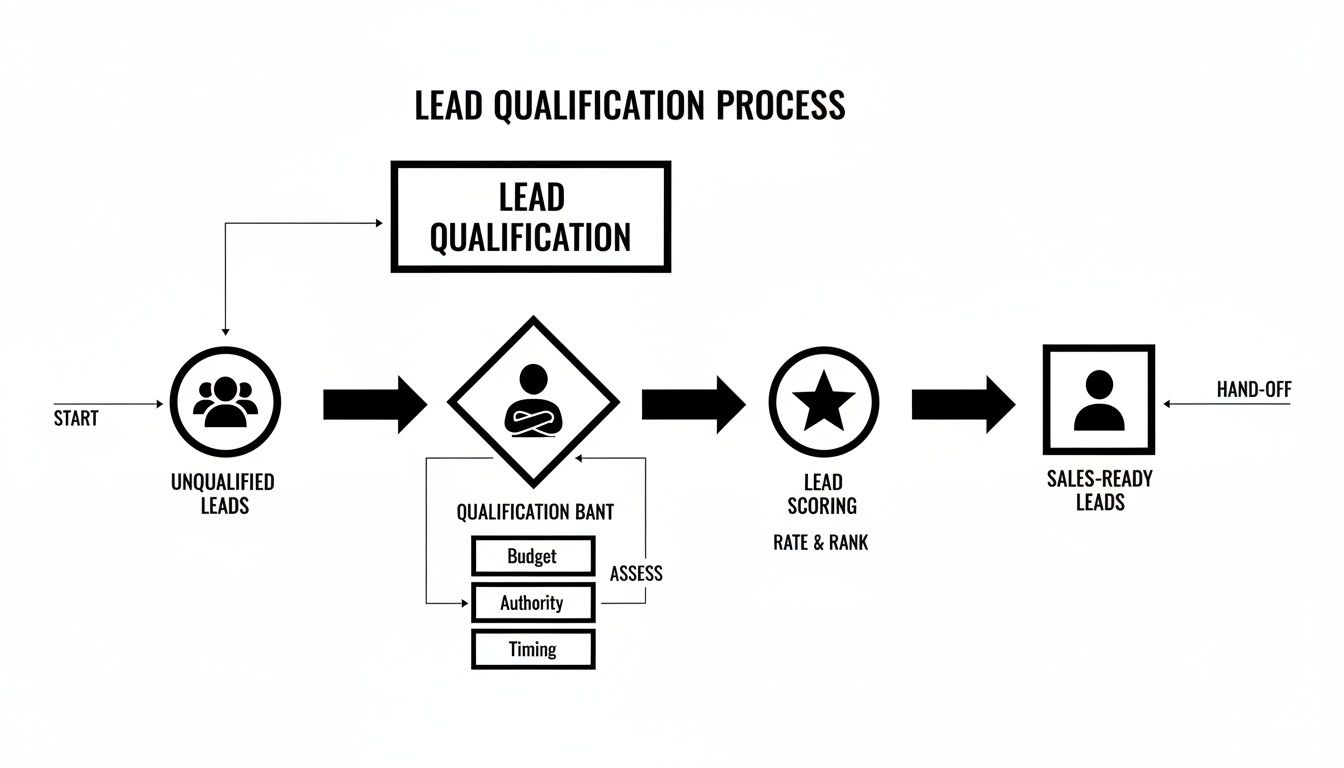
This process maps out how raw contacts are filtered through criteria like BANT and scoring to become leads your sales team will actually want to talk to.
Step 4: Launch Your Campaigns with the Right Tech
With your list and copy ready, you need the right technical setup to launch without getting flagged as spam. This is about more than just hitting “send” from your Gmail account.
Here’s the essential checklist for any cold email campaign:
-
Separate Sending Domains: Never, ever send cold outreach from your main company domain. Buy one or two similar domains (e.g., if you’re , get or ).
-
Email Warm-Up: Before you launch, use an email warm-up tool. This gradually builds a good sending reputation for your new domains over 2-3 weeks. It’s a non-negotiable step.
-
Sending Automation: Use a dedicated cold email platform to automate your follow-ups and track opens, replies, and clicks.
This technical foundation protects your primary domain and gives your messages the best shot at landing in the inbox. For a deeper dive, check out our guide on building a sales pipeline to boost revenue.
Step 5: Monitor and Optimize Performance
Lead generation isn’t a “set it and forget it” task. Once your campaigns are live, you have to be constantly watching the numbers and making adjustments based on data.
Keep a close eye on these key metrics:
-
Open Rate: Are people even opening your emails? If your open rate is below 40%, you might have a problem with your subject lines or deliverability.
-
Reply Rate: Are you getting responses? This is the metric that matters most. A solid reply rate for cold email is usually in the 3-7% range.
-
Positive Reply Rate: Of those replies, how many are actually interested? This tells you if your message is hitting home with the right people.
Use A/B testing to try out different subject lines, messaging angles, and calls-to-action. Tiny tweaks can lead to huge improvements, turning a decent lead generation engine into a pipeline-filling machine.
How to Accelerate Your Pipeline with a Pay-Per-Meeting Partner
Building a lead generation machine from scratch is a huge undertaking. It’s a grind that demands time, a very specific skillset, and a serious budget. But what if you could skip past the painful learning curve and the high costs of hiring and training your own team?
This is where a performance-based partner comes in. Imagine paying only for booked meetings. That’s the whole idea behind the pay-per-meeting agency model. Instead of getting locked into pricey monthly retainers, you work with a specialist firm that only gets paid when they put a qualified meeting on your sales team’s calendar.
The Performance-Based Advantage
The old-school agency model has a fundamental problem: their goals aren’t always aligned with yours. You pay a flat retainer whether they deliver one meeting or a hundred. The pay-per-meeting model completely flips that script, creating a real partnership where the agency’s success is tied directly to your own.
This model is a powerful shortcut to growing your pipeline for a few simple reasons:
-
Zero Upfront Risk: With no retainers or setup fees, your financial risk is practically nil. You only pay when a real, pre-qualified opportunity lands in your lap.
-
Instant Expertise: You get immediate access to a team that lives and breathes cold outreach. They already have the tech, the data sources, and the campaign experience to get things moving fast.
-
Serious Cost-Efficiency: Hiring an in-house team means dealing with salaries, benefits, and expensive software licenses. A pay-per-meeting partner rolls all of that into a simple, predictable cost for each meeting you get.
-
Pure Focus: This model frees up your sales reps from the grind of prospecting. They can dedicate 100% of their time and energy to what they do best: running great discovery calls and closing deals.
This performance-based approach is a pipeline accelerator. It lets you predictably scale your sales conversations without the operational headache of building the entire lead gen function from the ground up.
How the Pay-Per-Meeting Process Works
Working with a pay-per-meeting agency like Fypion Marketing is a refreshingly simple process built for speed. The entire system is designed to take the heavy lifting of lead generation off your plate so you can focus on revenue.
Here’s what a typical engagement looks like, step-by-step:
-
Strategy and ICP Deep-Dive: We start by getting into the weeds of your business. We’ll work with you to nail down your Ideal Customer Profile (ICP) and really understand the specific pains your solution solves.
-
Market & Message Research: Our team digs into your target market to find the messaging angles and value props that will actually connect with your ideal buyers. No generic fluff.
-
Technical Setup & List Building: We handle all the behind-the-scenes tech stuff - from setting up and warming up new domains to building a high-quality, targeted list of contacts who match your ICP.
-
Campaign Launch & Management: We launch personalized outreach campaigns and manage them obsessively. This means handling every reply, nurturing prospects, and booking meetings directly onto your sales team’s calendars.
-
Qualification & Hand-off: Every single meeting is checked against your qualification criteria (like BANT). Only genuinely qualified, sales-ready leads ever get passed to your team.
This end-to-end service is like having a dedicated appointment setting team that runs purely on performance. For any business with a proven product-market fit, it’s one of the fastest ways to build a predictable and scalable sales pipeline.
To dig deeper into this model, check out our practical guide to appointment setting outsourcing, which breaks the process down even further. This isn’t just about outsourcing a task; it’s a strategic partnership that turns lead generation from a cost center into a reliable engine for growth.
Common Lead Generation Mistakes to Avoid
Even with the best intentions, a lot of lead generation strategies fizzle out because they stumble into a few common, and totally avoidable, traps.
If you can learn to spot these pitfalls early on, you’ll save yourself a ton of time, budget, and frustration. It’s all about building a solid program from day one, instead of trying to patch up a leaky foundation later.
Relying on Bad or Outdated Data
Want to know the fastest way to kill a campaign before it even starts? Use bad data. It’s a guaranteed path to high bounce rates, a torched sender reputation, and zero meetings booked.
You’re just sending emails into the void, reaching people who left their jobs six months ago or addresses that don’t even exist.
Think of your data as the fuel for your outreach engine. Using low-quality, unverified data is like pouring sludge into a Ferrari’s gas tank - you’re not going to get very far, and you’ll cause some serious damage along the way.
The fix is straightforward but non-negotiable: invest in high-quality data. Whether you’re building lists in-house or working with a provider, you have to make sure every contact is verified and scrubbed regularly.
Trust me, a clean list of 100 accurate contacts is worth infinitely more than a junk list of 1,000.
Sending Generic, One-Size-Fits-All Outreach
Decision-makers get hammered with dozens of cold emails every single day. If your message is generic, it’s going straight to the trash folder. It’s that simple.
Any email that starts with “Dear Sir/Madam” or clearly shows you haven’t done a shred of research is dead on arrival. Personalization isn’t some nice-to-have bonus anymore; it’s the absolute bare minimum.
To get this right, you need to go way beyond plugging in a tag. Your outreach has to show you’ve actually done your homework.
-
Reference a company trigger: Did they just get a new round of funding, launch a product, or publish an interesting article? Mention it.
-
Connect with their role: Show you understand the specific challenges they face. For example, “As a VP of Sales, I imagine keeping the pipeline consistent is a huge focus for you…”
-
Mention something personal (not creepy): If you saw they commented on a LinkedIn post you both follow, it’s a great, natural way to open the conversation.
This isn’t about being clever; it’s about showing you respect their time. That small bit of effort is what separates you from the noise and dramatically boosts your chances of getting a reply.
Frequently Asked Questions About B2B Lead Generation
Even with the best game plan, you’re going to have questions. Let’s tackle some of the most common ones that come up when you start building out your lead generation pipeline.
How Long Does It Take to See Results?
This is the big one, and the honest answer is: it depends entirely on your strategy.
If you’re running a sharp outbound campaign, like highly targeted cold email, you can start seeing your first qualified meetings land on the calendar within 2-4 weeks of hitting “send.” The feedback is almost instant, which means you can tweak your approach on the fly.
On the other hand, inbound strategies like SEO and content marketing are a marathon, not a sprint. You’re building a long-term asset. It usually takes a good 6-12 months of consistent effort before you see a predictable stream of leads coming in organically.
What Is a Realistic Budget for a Lead Generation Program?
Your budget can swing wildly. If you decide to build an in-house team, you’re not just paying salaries and benefits. You’re also on the hook for expensive software licenses that can pile up fast.
Thinking about paid ads on a platform like LinkedIn? You’ll need a hefty ad spend just to compete - we’re talking thousands, or even tens of thousands, a month - and that’s before you even pay someone to manage the campaigns.
This is where a performance-based model really shines. It makes your budget completely predictable. You skip the massive upfront costs and simply pay a fixed fee for each qualified meeting that gets booked. It ties your spending directly to actual results.
Suddenly, lead generation isn’t a fixed overhead cost. It becomes a variable expense that grows right alongside your success.
How Do I Measure the ROI of My Lead Generation Efforts?
To get a real sense of your return on investment (ROI), you have to look past vanity metrics like the total number of leads. The real story is told by the numbers that connect your marketing spend directly to revenue.
You need to be tracking these KPIs:
-
Cost Per Lead (CPL): The simple cost to get a new contact into your system.
-
Cost Per Acquisition (CPA): The total cost to turn a prospect into a paying customer.
-
Customer Lifetime Value (LTV): The total revenue you can expect from a single customer over your entire relationship.
The core ROI formula is ((Revenue from New Customers - Campaign Cost) / Campaign Cost) x 100. This only works if you have tracking in place from the very first touchpoint all the way to a closed deal. That’s how you know which channels are actually making you money.
Ready to skip the learning curve and fill your pipeline with qualified meetings? At Fypion Marketing, we specialize in performance-based lead generation. You only pay for results. Book a free consultation today to see how we can accelerate your growth.