
A Practical Guide to Appointment Setting Outsourcing
Outsourcing your appointment setting is a massive strategic lever for B2B companies that want to grow fast without the headache and overhead of building an in-house sales team. At its core, it’s about hiring a specialized agency to run your prospecting and book qualified meetings. This lets your closers do what they do best: close.
What you’re really doing is flipping a huge fixed cost - salaries, benefits, software - into a flexible, performance-based investment.
The Strategic Shift from In-House to Outsourced Teams

For years, the go-to playbook for scaling sales was simple: hire a team of in-house Sales Development Representatives (SDRs). But more and more B2B leaders are waking up to the hidden costs and operational drag of this old model. Let’s be honest, it’s a grind - a constant, resource-draining cycle of recruiting, training, managing, and all too often, replacing people.
The raw truth is that building an effective SDR team from scratch is a heavy lift with a painfully long ramp-up time. Even when you find good people, it can take months for them to hit their stride. All the while, you’re burning cash on salaries, benefits, and software licenses with little to show for it.
Navigating the Hurdles of an Internal SDR Team
And the headaches don’t stop once they’re onboarded. SDR roles are notorious for high turnover, which throws you right back into the expensive, time-consuming hiring loop. This constant churn kills your pipeline consistency and pulls your sales leaders away from high-impact work.
This is exactly why so many companies are re-evaluating. The economics behind appointment setting outsourcing are just too compelling to ignore. In high-cost markets like the US, the investment to hire, train, and retain in-house SDRs is massive, often taking months to see any real return.
The pressure is on to hit aggressive sales goals with tighter budgets and more scrutiny on every new hire. This is the new reality, and it’s forcing a strategic pivot to outsourcing as a smarter, more cost-effective way to scale. You can find a great breakdown of this economic shift in this detailed analysis on Boom Sourcing.
By outsourcing, you’re not just delegating a task; you’re acquiring a fully operational growth engine. It’s about leveraging external expertise to bypass internal bottlenecks and achieve faster, more predictable results.
Comparing In-House vs Outsourced SDR Teams
When you put the two models side-by-side, the financial and operational differences become crystal clear. Here’s a quick breakdown of what you’re really looking at when deciding whether to build or buy your appointment setting function.
| Factor | In-House Team | Outsourced Partner |
|---|---|---|
| Startup Cost | High (recruiting fees, salaries, benefits, equipment, software licenses) | Low (setup fee, then performance-based retainer) |
| Time to Productivity | 3-6 months per SDR for full ramp-up | Immediate (team is already trained and operational) |
| Expertise | Developed over time, dependent on hiring and training quality | Specialized, pre-existing expertise in your target market |
| Tech Stack | You bear the full cost and implementation of all tools (e.g., Salesforce, Outreach, data providers) | Included in the service; access to a best-in-class, fully managed tech stack |
| Management Overhead | Significant time investment from sales leadership for coaching and management | Minimal; managed by the partner’s leadership team |
| Flexibility & Scalability | Rigid; scaling up or down is slow and expensive | Highly flexible; easily scale activity up or down based on campaign needs |
| Turnover Risk | High; you absorb the full cost of churn and re-hiring | Zero; partner is responsible for talent retention and replacement |
The table makes it obvious: while an in-house team offers more direct control, it comes at a steep price in terms of cost, time, and risk. Outsourcing, on the other hand, delivers speed, expertise, and cost-efficiency right out of the gate.
The Outsourcing Advantage: Speed and Specialization
Partnering with a specialized agency is a completely different ballgame. These firms aren’t generalists; they live and breathe one thing: generating qualified sales appointments. They bring immediate firepower that’s nearly impossible for a new in-house team to match.
-
Instant Access to Talent: You get a team of trained pros who are already experts at prospecting. There’s no learning curve. They hit the ground running.
-
Proven Methodologies: They come to the table with battle-tested outreach strategies, optimized messaging, and multi-channel cadences that are already proven to work.
-
Advanced Tech Stack: You get the benefit of their entire sales tech stack - data enrichment tools, automation platforms, dialers - without the six-figure price tag or implementation nightmare.
This move effectively transforms a massive fixed overhead into a variable, performance-based expense. Instead of paying salaries whether you get meetings or not, you pay for what actually matters: qualified appointments landing on your sales team’s calendar. This is a fundamental part of how outsourced lead generation drives B2B growth.
Ultimately, outsourcing your appointment setting frees up your best salespeople to focus 100% on their real job - closing deals - while a dedicated partner keeps their pipeline packed.
How to Choose the Right Outsourcing Partner
Picking a partner for your appointment setting outsourcing is easily the most important call you’ll make in this whole process. Get it right, and you’ve got a seamless extension of your sales team, filling your pipeline with genuinely qualified meetings. But a bad partner? They’ll burn through your budget, trash your brand’s reputation with sloppy outreach, and leave you with a calendar full of duds.
The goal isn’t just to hire a vendor. You’re looking for a strategic ally who is genuinely invested in seeing you grow. That means you need to look past the slick sales pitch and website testimonials.
Evaluate Their Industry Experience and Specialization
Generic outreach is dead. Your very first filter should be industry expertise. Does the agency actually get the language, pain points, and buyer motivations in your world? A team that’s a rockstar at booking meetings for SaaS companies might completely bomb if your target buyers are in heavy manufacturing.
You need to see tangible proof of their experience.
-
Relevant Case Studies: Don’t let them get away with just showing you a slide of logos. Ask for detailed case studies from companies that look like yours - similar size, same industry, and a comparable target audience.
-
Client References: This is non-negotiable. You need to talk to their current or past clients. Ask them about the quality of the appointments, how proactive the team was, and what happened when things inevitably went wrong.
-
Team Background: Who’s really going to be running your campaigns? Find out about the actual experience of the account managers and the SDRs who will be representing your brand.
This is where you can get some unfiltered truth from review platforms. For instance, digging into a company’s profile on a site like Clutch can give you a raw, behind-the-scenes look.
This kind of third-party validation cuts through the marketing fluff. It shows you a high overall rating, sure, but more importantly, you see verified reviews, their focus areas, and even client budget details. It paints a much more complete picture of their track record.
Scrutinize Their Process and Technology
A top-tier partner runs on a transparent, data-driven process. They should have no problem walking you through their entire methodology, from A to Z. This is your chance to really gauge their operational maturity and see if their way of working gels with your own.
Here are some key questions to drill down on:
-
Lead Qualification Framework: What exactly do they consider a “qualified” appointment? Do they stick to a recognized framework like BANT (Budget, Authority, Need, Timeline) or MEDDIC? If their answer is vague, that’s a massive red flag.
-
Tech Stack: What tools are they using for list building, email automation, and CRM integration? You need to make sure their tech plays nice with yours and that they have solid data enrichment capabilities.
-
Data Sourcing and Compliance: Where are they getting their contact data? How do they keep it accurate and compliant with rules like GDPR or CCPA? Protecting your brand starts with responsible data practices.
A partner’s refusal to discuss their process in detail is a clear signal. Either they don’t have a sophisticated system, or they’re trying to hide something. True experts are proud of their methodology and are more than happy to show you under the hood.
Understand the Pricing Model and Alignment
Finally, you have to dissect their pricing structure. How a partner charges tells you a lot about their confidence and whether their incentives are truly aligned with yours. The two most common models in appointment setting outsourcing create completely different dynamics.
Comparison of Common Pricing Models
| Model | How It Works | Pros | Cons |
|---|---|---|---|
| Monthly Retainer | You pay a fixed fee each month for a set amount of activity (e.g., SDR hours, emails sent). | Predictable monthly cost. | High Risk. You pay regardless of results. No guarantee of meetings. |
| Pay-Per-Meeting | You only pay a set fee for each qualified appointment that is booked and actually shows up. | Low Risk. Directly tied to performance. Aligns partner success with your success. | Cost per meeting can seem higher, but you’re paying for outcomes, not effort. |
For businesses that want to de-risk their investment, the pay-per-meeting model is almost always the way to go. It forces the agency to have skin in the game. They only make money when you get qualified meetings on your calendar - which is the entire reason you’re hiring them in the first place. This performance-based approach is the foundation of any modern, effective partnership.
By taking a structured approach to vetting, you can get past the superficial sales pitch and find a partner who truly has the expertise, process, and business model to drive real results. Understanding the nitty-gritty of their operations, especially when it comes to outsourcing inside sales, will give you the confidence to make a choice that actually accelerates your growth.
Setting Your Outsourced Team Up for Success
Picking a partner is just the starting line. The real work - the stuff that actually determines if your appointment setting outsourcing pays off - happens during onboarding. If you rush this part, you’re pretty much guaranteeing a mess of misaligned expectations, low-quality meetings, and a budget that vanishes with nothing to show for it.
You have to think of your new partner as a genuine extension of your sales team. They need the same tools, the same institutional knowledge, and the same clarity your in-house reps get. Those first few weeks are everything. They set the foundation and ensure every single email and call they make is a perfect reflection of your brand.
Building Your Ideal Customer Profile Together
The absolute bedrock of any good outbound campaign is a razor-sharp Ideal Customer Profile (ICP). This isn’t a document you just lob over in an email and hope they get it. It needs to be a living, breathing profile you build side-by-side with your new team.
Remember, your partner brings a fresh set of eyes. They can often spot patterns or opportunities your internal folks might have missed. Take the time to walk them through your best customers. Don’t just talk about firmographics like company size or industry; explain why they’re such a great fit.
Get into the weeds on what defines a perfect-fit account:
-
What technographic signals tell you a company is feeling the pain you solve?
-
Are there behavioral triggers, like a recent funding round or hiring for a specific role?
-
What are the deep-seated pain points that your product solves better than anyone else on the market?
This deep-dive session ensures your outsourced SDRs aren’t just hitting up the right companies. It arms them with the context to engage the right people with messaging that actually resonates from day one.
Think of a well-defined ICP as the campaign’s North Star. When your outsourced team knows exactly who to target and why, they can focus 100% of their effort on prospects who are actually likely to convert. This dramatically boosts the quality of the appointments they set.
This process of vetting, assessing, and finally aligning with a partner is crucial for making sure they can actually execute on that ICP.
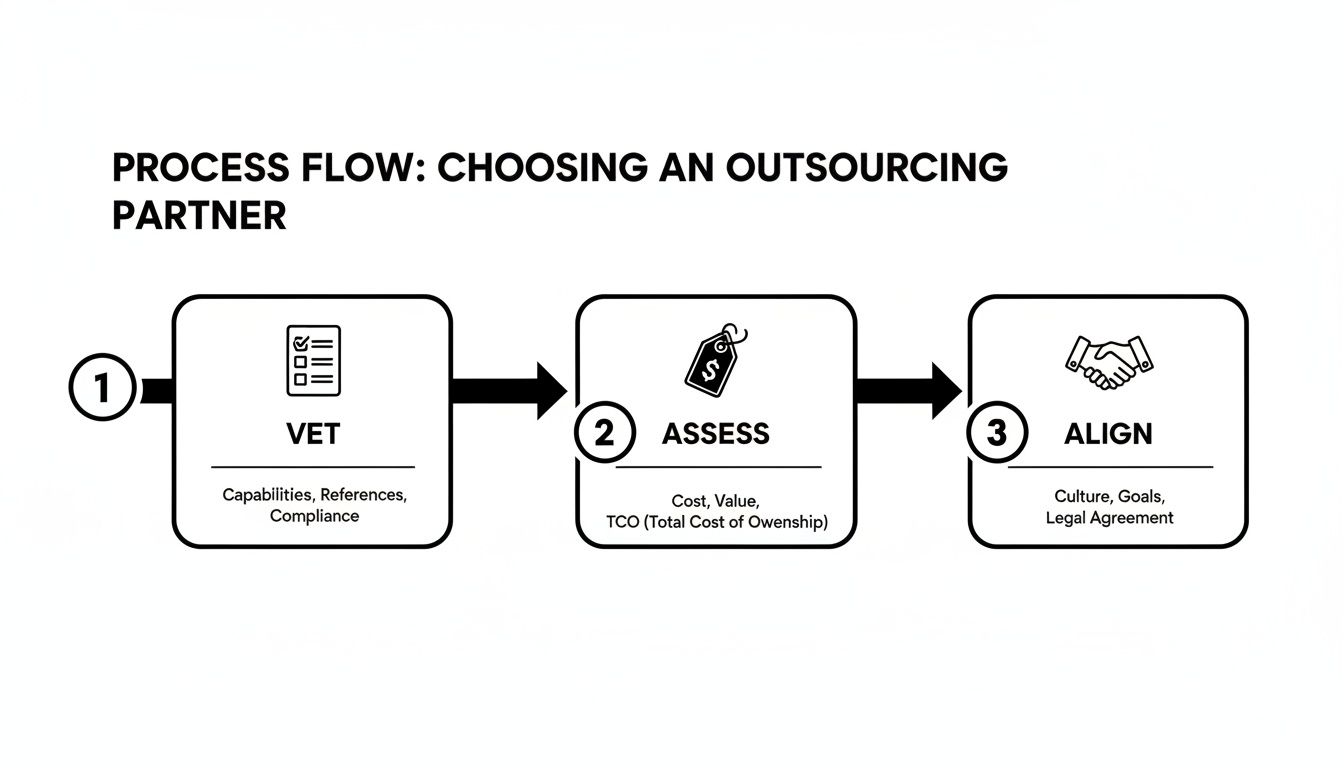
The key takeaway here is that alignment isn’t an afterthought. It’s the critical final step that turns a vendor relationship into a true partnership.
Arming Your Team with Critical Assets
Once you’ve locked down the “who,” you have to give them the “what” and the “how.” They need access to the same playbook and resources your own team uses to talk about your product, the market, and your unique value. This isn’t optional - it’s essential if you want them to sound authentic.
Your onboarding toolkit should be comprehensive. Make sure it includes:
-
Product Demos: Don’t just tell them about the product; show them. Give them access to recorded demos or, even better, a sandbox environment to click around in.
-
Competitor Battle Cards: Give them the cheat codes. Clearly outline your key differentiators and how to pivot when a prospect brings up a competitor.
-
Brand Voice & Tone Guidelines: You need their emails and calls to sound like they’re coming from your company, not a generic call center.
-
Case Studies & Testimonials: Arm them with proof. Give them the success stories that show the real-world value you bring to the table.
Beyond just sharing files, you also have to understand how to effectively delegate for remote appointment setting. It’s about empowering your new team with the context and autonomy to use these assets in a smart way.
Defining Success and Communication Rhythms
Last but not least, you have to agree on what a “win” looks like. The single most common point of failure in outsourcing is a fuzzy definition of a “qualified appointment.”
You need to sit down together and create a clear, written definition of a Sales Qualified Appointment (SQA). This document should spell out the exact criteria a prospect must meet for the meeting to count. Is it based on company size? Budget? A specific expressed need? Nail this down to remove all ambiguity and ensure you’re only paying for meetings that have a real shot at moving down your pipeline.
With that in place, set up a non-negotiable communication cadence.
-
Weekly Check-ins: A standing meeting to review metrics, share feedback from the sales team on booked appointments, and make strategic tweaks.
-
Shared Slack Channel: A must-have for real-time questions, quick updates, and celebrating wins.
-
Transparent Reporting: You need access to a dashboard that tracks the important stuff: appointments booked, show rates, and, most importantly, conversion to a qualified opportunity.
This kind of structure is vital for any distributed team, and you can dive deeper into how to manage a remote sales team in our guide. A tight feedback loop is what allows your partner to constantly refine their approach based on what’s actually working, turning a decent campaign into a great one.
Modern Outreach Strategies That Actually Work

Let’s be honest: the old-school, brute-force cold calling playbook is dead. In a world where every decision-maker’s inbox is overflowing, just cranking up the volume of calls and emails won’t get you anywhere. The best appointment setting outsourcing partners figured this out a long time ago.
They know that getting a meeting with a busy executive takes more than just a good script. It requires a smarter, more coordinated attack.
This is where a real multi-channel outreach strategy comes into play. Instead of betting everything on a single touchpoint, top-tier services weave together personalized emails, savvy LinkedIn engagement, and genuinely intelligent cold calls. Each channel has a job to do, all working in concert to build familiarity and deliver value before you ever ask for their time.
The Power of an Integrated Cadence
A modern outreach cadence isn’t just a random series of pings; it’s a carefully choreographed sequence of interactions. Think of it as warming up a prospect, educating them bit by bit, so when the “ask” for a meeting finally comes, it feels like a natural next step, not a jarring interruption. This multi-pronged strategy isn’t a “nice-to-have” anymore - it’s the only way to cut through the noise.
The numbers back this up. Companies that use three or more channels in their outreach see engagement rates up to 287% higher than those sticking to a single channel. That stat alone makes any email-only or call-only strategy look ancient. It’s why the best providers build their entire service around these integrated flows, meeting prospects where they’re actually listening.
Here’s what a simple but effective multi-channel sequence could look like:
-
Day 1: A highly personalized email that references a specific company trigger, like a new funding round or a key executive hire.
-
Day 2: A LinkedIn connection request to the same person, but with a short, non-salesy note that adds context.
-
Day 4: A follow-up email that doesn’t just say “bumping this up,” but offers something valuable - a relevant case study or a link to a helpful blog post.
-
Day 6: A smart cold call. The goal isn’t to pitch, but to reference the earlier email and simply open a conversation.
This approach flips the script entirely. Outreach goes from being a cold interruption to a series of helpful, professional touchpoints.
Personalization at Scale
Here’s the secret sauce that makes it all work: genuine personalization. Your outsourcing partner shouldn’t be blasting out generic templates. If they are, you’ve hired the wrong one. They need to be digging in, using data and research to make every message feel like it was written just for that one person.
For example, instead of a boring, generic subject line, they’ll use something they found on the prospect’s LinkedIn or in a recent company press release. It’s a small detail, but it instantly shows they’ve done their homework and makes your brand stand out. If you want to go deeper on this, we’ve got a whole guide on how to master cold email personalization to boost responses.
The goal of modern outreach isn’t just to get a response; it’s to start a meaningful conversation. A skilled partner knows how to use each channel to build rapport and establish credibility, making the prospect want to take the meeting.
Data-Driven Optimization
Finally, a truly sophisticated appointment setting outsourcing partner doesn’t just launch a campaign and hope for the best. They operate like scientists in a lab - constantly testing, measuring, and tweaking their approach based on what the data is telling them.
They treat every single element as a variable to be optimized.
This means they’re running tests on things like:
-
A/B Testing Subject Lines: Do questions work better than statements? Which phrases kill open rates?
-
Analyzing Call Times: Pinpointing the exact windows when prospects are most likely to actually pick up the phone.
-
Refining Messaging: Ditching value props that fall flat and doubling down on the ones that get great responses.
This constant feedback loop ensures your campaign doesn’t just run; it gets better over time. You don’t just get more appointments; you get higher-quality ones. As outreach gets more advanced, it’s also interesting to see how companies are using tech like AI Voice Agents to Book Appointments to support these efforts. This obsession with data-driven improvement is what separates an outsourced vendor from a true growth partner.
Measuring the True ROI of Your Partnership
Once your outsourced appointment setting partner gets things rolling, it’s easy to get caught up in vanity metrics. Things like email open rates and click-throughs feel good, but they don’t pay the bills.
To really know if your investment is paying off, you have to dig deeper. It’s all about tracking the key performance indicators (KPIs) that directly impact your bottom line. This means looking past the surface-level data and connecting your partner’s activity to real, tangible sales pipeline growth. That’s the only way to hold them accountable and prove the partnership is actually working.
Going Beyond Basic Activity Metrics
A great partner will track everything they do, but your job is to focus on the outcomes. A high volume of calls or emails means absolutely nothing if it doesn’t lead to qualified conversations with potential buyers. The first move is to shift your focus from “effort” metrics to “results” metrics.
Here are the bottom-line KPIs that actually tell the story:
-
Cost Per Appointment (CPA): This is your most direct measure of efficiency. Simply divide your total monthly spend by the number of qualified appointments held. A low CPA is a great sign your partner is turning your investment into sales conversations without wasted motion.
-
Show Rate: This one’s simple: how many of the appointments they book actually happen? A low show rate (anything dipping below 75%) can signal problems with how leads are being qualified or a clunky handoff process between their team and yours.
-
Appointment-to-Opportunity Conversion Rate: This is the ultimate quality check. It answers the most important question: “How many of these meetings is my sales team accepting as legitimate, pipeline-worthy opportunities?” If this number is low, it’s a red flag that your definition of a qualified appointment isn’t aligned with your partner’s.
Tracking these numbers gives you a clear, honest picture of performance. It turns your weekly check-ins from subjective chats into data-driven strategy sessions.
Calculating the True Cost and Return
When you’re thinking about the ROI of appointment setting outsourcing, you have to compare it to the real cost of doing it in-house. It’s not as simple as one salary vs. one monthly retainer.
Industry data shows that outsourced SDR programs can build a pipeline 60% faster than internal teams because they completely skip the long hiring and training ramp-up. And while the average salary for an in-house SDR might look like $120,000 a year, that number never includes the big-ticket items like tech stack costs, benefits, and management overhead, which inflate the true cost significantly. You can learn more about the real ROI of SDR outsourcing and how it drives growth.
This context is everything. Outsourcing isn’t just about saving a few bucks; it’s about getting faster, more predictable pipeline growth for a much more transparent price.
Your goal isn’t just to get meetings; it’s to generate profitable revenue. By tracking how many appointments convert to opportunities and eventually to closed-won deals, you can calculate the true return on investment and prove the program’s financial impact.
Building a Performance Dashboard
To keep all this straight, you need a simple performance dashboard. This doesn’t have to be some complex BI tool - a shared spreadsheet or a basic report in your CRM works perfectly. This dashboard becomes your single source of truth for weekly check-ins.
Here’s what your dashboard should track, updated weekly or monthly:
| Metric | Target | Actual | Notes / Key Takeaways |
|---|---|---|---|
| Appointments Booked | 20 | 22 | Strong initial volume this month. |
| Show Rate | >80% | 77% | Three no-shows; need to tighten confirmation process. |
| Appointments Held | 16 | 17 | On track with overall goals. |
| Opportunity Conversion Rate | >50% | 59% | Excellent quality - sales team is very happy with these meetings. |
| Cost Per Appointment | <$400 | $363 | Hitting efficiency targets. |
| Pipeline Generated | $100k | $125k | Exceeding pipeline goals. |
This kind of clear, data-driven approach takes all the emotion and guesswork out of managing your partner. It makes it easy to have productive conversations about what’s working and what needs a little tweak.
For a deeper look at these calculations, check out our practical guide on how to calculate marketing ROI. By measuring what matters, you’ll turn your outsourcing relationship from a simple service into a strategic engine for growth.
Common Questions About Outsourcing Appointment Setting
Even with a solid game plan, diving into an appointment setting outsourcing partnership can feel like a leap of faith. I’ve found that most business leaders circle back to the same core concerns about cost, quality, and how quickly they’ll see a return.
Getting straight answers to these questions is the only way to feel confident enough to pull the trigger. So, let’s tackle the most common ones I hear.
How Much Does Appointment Setting Outsourcing Typically Cost?
This is the big one, and the answer is… it depends. The cost of outsourcing is all over the map, and it really comes down to the pricing model the agency uses.
The old-school approach is a flat monthly retainer, which can run you anywhere from $3,000 to over $10,000. The major hang-up here is you’re paying for effort, not outcomes. All the financial risk is sitting squarely on your shoulders.
A much smarter, modern approach is a performance-based model like “pay-per-meeting.” It’s become the gold standard for a reason. You only pay for qualified appointments that actually meet the criteria you set. This model completely aligns the agency’s goals with yours - if you don’t win, they don’t get paid.
Costs here can range from $150 to over $1,000 per meeting, depending on how complex your industry is and how high up the food chain you need to go to find your decision-maker.
Will an Outsourced Team Understand Our Niche Product?
This is a totally valid concern, especially if you’re selling something technical or highly specialized. The short answer is yes, but only if you partner with a top-tier agency. The best providers don’t just blast out generic templates; they become students of your business.
Their process should be a deep immersion, not a quick once-over. This means:
-
Digging into your product docs and technical specs.
-
Picking apart your best customer case studies to see where the real value is.
-
Listening to recorded sales calls to get a feel for your brand voice and key talking points.
A great partner doesn’t feel like a vendor; they become a true extension of your team. This deep onboarding is non-negotiable. It’s what ensures every email and call is authentic, informed, and actually resonates with your market. They should sound like they know your product from day one.
What Is the Difference Between a Lead and a Qualified Appointment?
Getting this distinction right is everything. It’s the entire reason performance-based appointment setting outsourcing works so well and is critical for tracking real ROI.
A “lead” is just raw data. It might be a name, an email, and a company, but you have no idea if they fit your Ideal Customer Profile (ICP) or have any interest whatsoever. Buying lead lists is easy, but it’s a fast track to burning out your sales team on dead ends.
A “qualified appointment” is a different beast entirely. It’s a confirmed meeting on your sales rep’s calendar with someone who has been properly vetted against your specific criteria. This could be their job title, company size, a specific challenge they’re facing, or even a directly expressed interest.
When you partner with a service that charges per appointment, you’re paying for real sales opportunities, not just a spreadsheet of names. Your sales team’s efficiency skyrockets because they’re spending their time having meaningful conversations with people who are actually a good fit.
How Quickly Can We Expect to See Results?
One of the biggest wins with outsourcing is the speed. Building an in-house SDR team from scratch is a long, expensive process. It often takes a new rep 3-6 months to get fully ramped up and start consistently booking qualified meetings.
An experienced outsourced partner can shrink that timeline down significantly. The process usually looks something like this:
-
Onboarding & Setup (2-4 weeks): This is where they nail down your ICP, absorb your materials, and build the campaign strategy.
-
Campaign Launch: Right after setup, the outreach machine starts running.
-
First Appointments Booked (within the first 30 days): You should see the first qualified meetings hitting your team’s calendars within a month of launch.
From there, it’s all about momentum. A skilled partner will use the data from those initial sends to constantly tweak and optimize the campaign, refining the messaging and targeting to drive better and better results over time. You get a much faster and more predictable pipeline.
Ready to fill your pipeline with qualified meetings without the risk of retainers? Fypion Marketing operates on a purely performance-based model - you only pay for results. Schedule your free consultation today at https://www.fypionmarketing.com and discover how we can accelerate your growth.