
Leads and Conversions: A B2B Guide to Pipeline Growth
Your dashboard looks healthy. Traffic is up, forms are coming in, LinkedIn engagement looks respectable, and the ad team can point to a steady flow of clicks. Then sales opens the calendar and sees too much whitespace.
That gap is where most B2B pipeline problems live. Activity is happening, but revenue isn’t following. For SaaS and tech companies, the issue usually isn’t a total lack of demand. It’s that the system turning interest into sales conversations is either poorly defined, poorly measured, or built around the wrong incentives.
A lot of teams still optimize for what’s easiest to report. More leads. More opens. More downloads. More “top of funnel.” But pipeline doesn’t care how busy marketing looked this month. It cares whether the right buyers moved into real conversations with enough intent to buy.
From Busy Traffic to Real Revenue
A common B2B scenario looks like this. Marketing delivers a steady stream of website visits, paid campaigns are live, and content is publishing on schedule. Yet the sales team says lead quality is inconsistent, follow-up happens unevenly, and too many “leads” never become serious opportunities.
That usually means the company is tracking motion instead of progress. A click isn’t pipeline. A form fill isn’t sales-ready demand. Even a reply isn’t valuable if it comes from the wrong company, the wrong role, or the wrong buying window.
The fix starts with changing the unit of measurement. Instead of asking, “How many leads did we get?” ask, “How many qualified conversations did we create?” That one shift changes how you judge channels, campaigns, and agencies.
A useful primer on improving conversion mechanics is this guide on how to increase sales conversion rate, especially if your team needs a practical reset on where friction usually enters the process. For a B2B-specific view of how those stages should connect, this guide to high-converting B2B sales funnels is a good reference point.
What revenue-focused teams do differently
They define success closer to revenue. That often means measuring:
-
Qualified meetings booked: Not just raw inquiries.
-
Stage-to-stage movement: Who progressed, not who merely appeared.
-
Sales acceptance: Whether reps want the lead.
-
Conversion by source: Which channels produce opportunities, not just traffic.
Practical rule: If a metric can rise while revenue quality falls, it can’t be your main KPI.
This matters even more in outbound. Cold email can produce valuable pipeline, but only if the campaign is built around fit, timing, and qualification. If it’s built around volume alone, it creates admin work for sales and false confidence for marketing.
Understanding the Crucial Difference Between Leads and Conversions
A lot of wasted budget starts with a vocabulary problem. Teams use lead and conversion like they mean the same thing. They don’t.
A lead is a person or company that has shown some level of interest. A conversion is a defined action that moves that person meaningfully forward. Sometimes that conversion is a form submission. Sometimes it’s a booked meeting. Sometimes it’s a sales-qualified handoff. If you don’t define the action, the metric becomes useless.
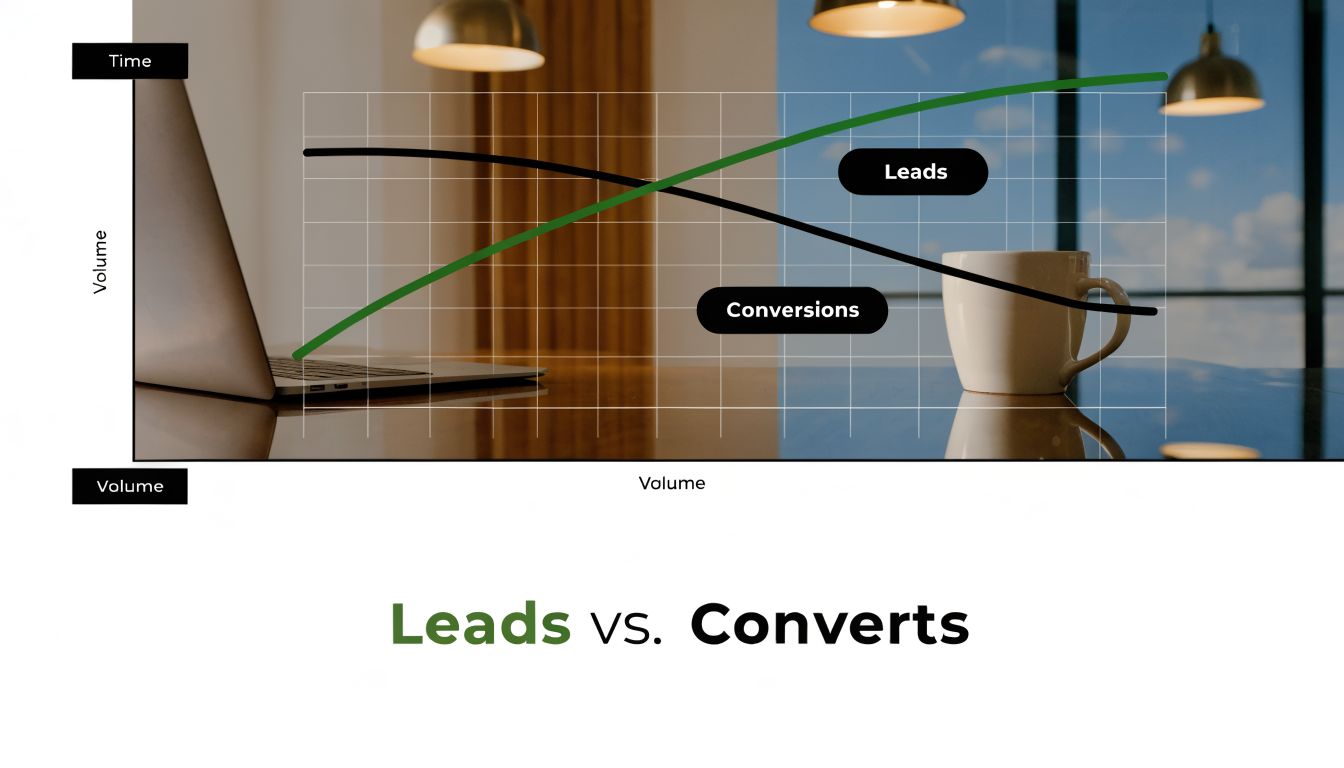
Using a fishing analogy, a lead is a nibble. A conversion is the fish landed in the boat. If your team celebrates every nibble as if it were a landed catch, forecasting gets distorted fast.
Why this distinction affects pipeline quality
When companies treat every inbound contact or outbound reply as equal, sales ends up sorting through noise. Reps spend time on accounts with no budget, no urgency, no authority, or no fit. Marketing then reports “lead volume” while sales reports “nothing useful.”
That’s why the handoff criteria matter. The gap between a marketing-qualified lead and a sales-qualified lead is where many funnels break. If your definitions are vague, nobody owns the outcome. Marketing says the lead engaged. Sales says the lead wasn’t real.
If your team needs a cleaner operational distinction, this breakdown of marketing qualified lead vs sales qualified lead is useful because it forces the qualification conversation into concrete terms. It also helps to align on a plain-language definition of a lead before building reports. This explainer on what is a lead in business is a practical place to start.
A simple way to define conversions properly
Use layered conversions instead of one catch-all label.
| Funnel moment | What it really means |
|---|---|
| Lead | A contact entered the system |
| Marketing conversion | The person took a trackable action that signals interest |
| Sales conversion | The account met qualification criteria and warranted rep time |
| Revenue conversion | The opportunity became a customer |
Treating all leads equally is like putting every website visitor straight onto a sales rep’s calendar. It creates motion, not efficiency.
A strong pipeline depends on agreed definitions. Without them, teams argue over lead quality because they never agreed on what “quality” meant in the first place.
Mapping Your B2B Conversion Funnel and Key KPIs
A funnel map matters most when volume starts to hide waste.
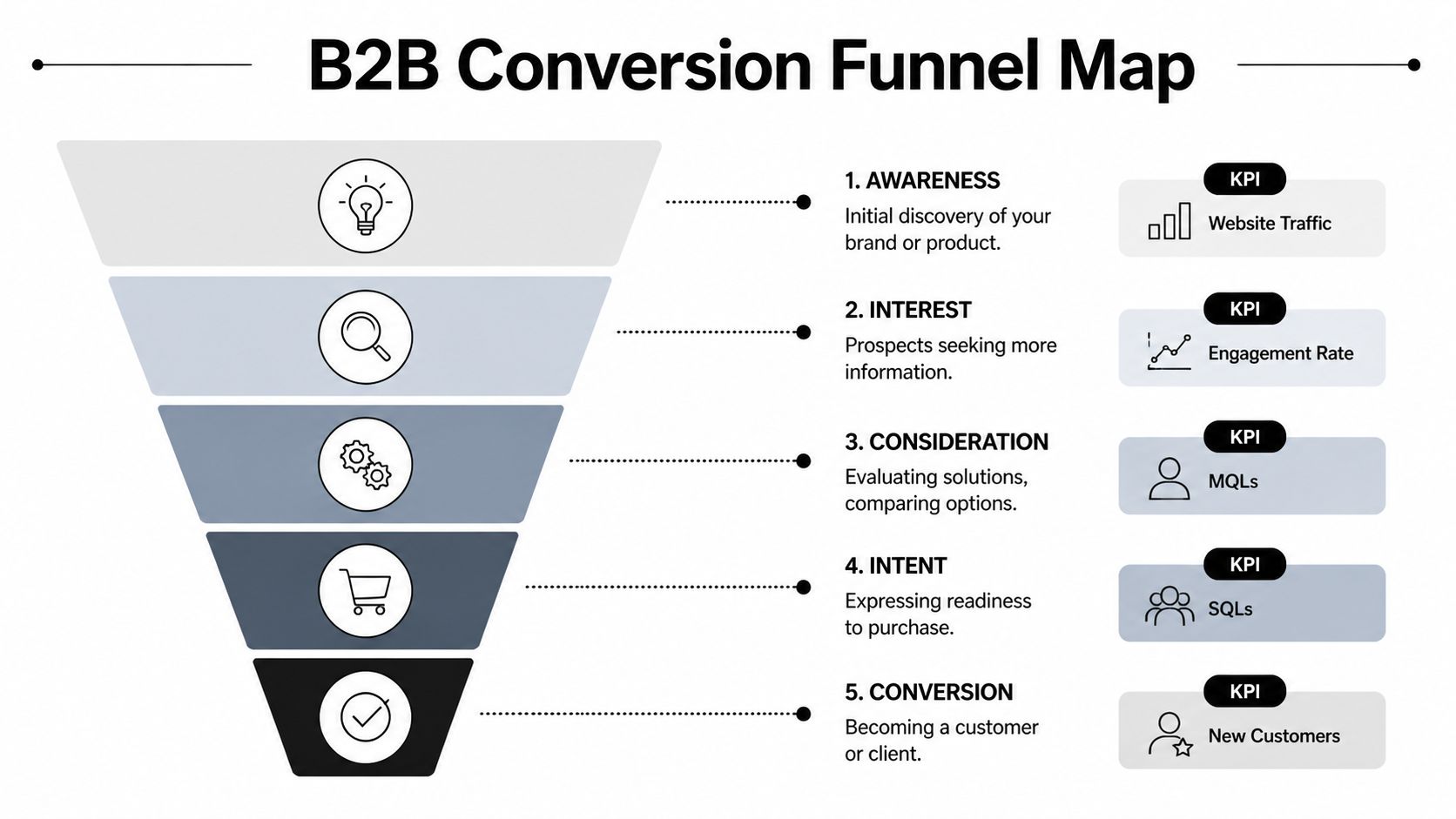
I see this in SaaS teams all the time. Marketing reports hundreds of leads. Sales says very few are worth a call. The pipeline looks active, but calendar slots stay empty. A working funnel fixes that by showing where intent turns into pipeline and where it dies.
For B2B companies using outbound, especially cold email, the funnel should also reflect incentive design. If an agency gets paid on lead count, it will optimize for replies, downloads, and low-friction conversions. If it gets paid per qualified meeting, it has to care about targeting, messaging, deliverability, and show rates. That shift solves a common lead quality versus quantity problem because the KPI tied to payment is closer to revenue.
The funnel stages that actually matter
Track the stages your team can act on. For many B2B programs, that means this:
| Stage | What happens here | KPI to watch |
|---|---|---|
| Visitor | Someone lands on your site or content asset | Visitor-to-lead rate |
| Lead | A contact enters the funnel through form fill, reply, signup, or list match | Lead volume by source |
| MQL | The lead shows enough relevance or engagement for marketing to prioritize | Lead-to-MQL rate |
| SQL | Sales agrees the account is worth direct follow-up | MQL-to-SQL rate |
| Booked meeting or customer | The buyer commits to a conversation or purchase step | SQL-to-meeting or lead-to-customer rate |
The labels can change. The handoffs cannot.
According to Power Digital’s B2B marketing statistics, median B2B conversion rates are modest, and outbound channels such as cold email usually convert at a lower top-line rate than inbound. That does not make outbound weaker. It means outbound starts earlier in the buying cycle and asks your team to create demand instead of waiting for it.
That distinction matters if you sell to a narrow ICP. A cold email program aimed at 500 target accounts may produce fewer total conversions than organic traffic, but the meetings can be far more valuable because they come from the right companies. In a pay-per-meeting model, that trade-off becomes visible fast. Bad lists, vague offers, and weak qualification rules stop getting rewarded.
How to read the KPIs without fooling yourself
Do not judge a channel by one conversion number.
A cold email campaign with a lower lead-to-customer rate can still outperform paid search if it consistently books meetings with enterprise accounts your inbound engine never reaches. The right comparison is source quality, sales acceptance, meeting rate, pipeline created, and closed revenue. If you need a clearer operating model for stage design, this B2B marketing funnel guide is a useful reference.
Attribution also affects how you read funnel performance. A buyer might first find your brand through search, read a case study a week later, then reply to an outbound email after an internal trigger event. Last-touch reporting will over-credit the email or the final ad click. Teams that need more accurate channel reporting should review this guide to marketing attribution.
KPIs that keep teams honest
A short KPI list is usually enough:
-
Lead volume by source: Shows where raw opportunity enters the funnel.
-
Sales acceptance rate: Shows whether leads deserve rep attention.
-
SQL-to-meeting rate: Shows whether targeting, outreach, and timing are working.
-
Meeting-to-opportunity rate: Shows whether booked calls are real buying conversations.
-
Lead-to-customer rate by source: Shows which channels produce revenue.
For outbound teams, I would add one more operating metric. Track qualified meetings per 1,000 contacts reached. It forces discipline. A campaign can generate replies and still fail if those replies do not become real sales conversations.
That is why performance-based outreach models work when they are set up well. They tie effort to a business outcome the sales team respects, instead of paying for activity that looks busy in a dashboard.
How to Find and Fix Common Conversion Bottlenecks
A funnel can look healthy on a dashboard and still miss pipeline targets. Traffic is up. Lead volume is up. Sales still says the quarter feels thin because the breakdown lies in one handoff, one response lag, or one weak outreach step that turns interest into dead air.

The fix starts with stage-by-stage inspection. More top-of-funnel volume does not rescue a middle-funnel bottleneck. It usually hides it for a few weeks and makes sales complain louder later.
Start with the handoff, not the headline metric
Total leads are a lagging comfort metric. Stage conversion shows where revenue gets lost.
Review the funnel in order:
-
Are visitors becoming leads at a reasonable rate?
-
Are leads becoming MQLs because they showed real buying intent, or because the scoring model is too generous?
-
Are MQLs turning into SQLs quickly enough to justify rep attention?
-
Are SQLs booking meetings?
For many B2B teams, the biggest bottleneck is the gap between qualification and action. Convince & Convert’s lead conversion statistics highlight how fast response time affects conversion, and they also show a sharp drop from MQL to SQL in many funnels. That pattern matches what shows up in SaaS pipeline reviews. Teams often assume they have a lead generation problem when they really have a lead handling problem.
That distinction matters even more in outbound.
Cold email can produce replies, form fills, and “interested” signals that look promising in a weekly report. If those contacts do not convert into qualified meetings, the campaign is buying activity, not pipeline. Performance-based models such as pay-per-meeting force the issue. They align the vendor, SDR team, and sales leader around meeting quality instead of raw lead count, which is the cleanest way to resolve the quality versus quantity tension.
What to inspect when conversion stalls
If your visitor-to-lead rate is weak, inspect the first impression:
-
Offer mismatch: The page promise does not match the buyer’s problem or urgency.
-
Form friction: You ask for details the buyer has not earned trust to share yet.
-
Message clarity: The buyer cannot tell who the product is for, what it replaces, or why it matters now.
If your MQL-to-SQL rate is weak, inspect the operating model:
-
Slow follow-up: Interest cools before sales makes contact.
-
Loose qualification: Marketing passes names that fit a persona but lack timing, pain, or authority.
-
Poor routing: Good leads sit in queues or reach the wrong rep.
If your SQL-to-meeting rate is weak, inspect sales readiness and outreach quality:
-
Weak outbound messaging: The email asks for time before it earns attention.
-
Bad account selection: Reps pursue companies that match firmographics but have no active reason to buy.
-
Low meeting intent: The lead accepted a conversation in theory, not in practice.
The funnel usually breaks at the first stage with unclear ownership.
That is why I push teams to audit handoffs before rewriting copy or buying more traffic. Marketing should define what qualifies a lead. Sales should own response speed and meeting conversion. Operations should own routing logic, alerts, and visibility. Shared responsibility sounds collaborative, but in practice it often means nobody fixes the leak.
One trade-off is worth stating plainly. Tighter qualification lowers reported lead volume. It also improves rep focus, meeting quality, and forecast trust. For SaaS companies running outbound, that trade is usually profitable. A smaller pool of accounts with stronger intent will outperform a larger pile of names that never reach a real conversation.
For teams building that review cadence into weekly execution, these sales pipeline management best practices help turn conversion data into clear ownership and faster fixes.
Actionable Strategies to Increase Lead Volume and Conversion Rate
Monday morning, the dashboard looks fine. Lead count is up, reply volume is healthy, and sales still says pipeline quality is weak. That usually means the system is rewarding activity instead of sales-ready conversations.
Lead volume and conversion rate improve together only when the campaign is built around qualified meetings. If one team is paid for list size, another for replies, and sales is left to clean up the result, quality drops fast. Performance-based models fix part of that problem by aligning everyone to the same outcome. In outbound, pay-per-meeting is the clearest example. It pushes targeting, copy, qualification, and follow-up toward one standard: would sales want this conversation?

Increase lead volume with tighter outbound targeting
Cold email works when it behaves like account selection with messaging attached, not bulk distribution. More names do not solve weak fit. They just hide it for a few weeks.
For SaaS and tech companies, the best gains usually come from narrowing the list before sending a single email. Start with segments that share a real buying reason, then write to that reason. A VP of Revenue at a Series B company scaling SDR headcount has different pressure than a CTO replacing internal tooling. Putting both in the same sequence usually hurts reply rate and meeting quality.
Use filters that reflect buying conditions:
-
Company fit: Industry, size, business model, and operational complexity
-
Role fit: The person closest to the problem and able to sponsor change
-
Timing signals: Hiring, expansion, funding, tech stack changes, or leadership shifts
-
Pain fit: A specific bottleneck your offer can address without a long explanation
This is also where commercial structure matters. If an agency gets paid on send volume or raw leads, it has a reason to widen targeting. If it gets paid on qualified meetings, it has a reason to be stricter. That trade-off is healthy. Lower volume at the top often produces more pipeline in the middle.
Teams building outbound around booked conversations can see how that model works in practice through this guide to SDR-led demand generation with outbound cold email. Fypion Marketing uses that meeting-first approach, which changes how campaigns are scoped, how reply quality is judged, and how quickly weak segments get cut.
Improve conversion by optimizing micro-steps
Conversion problems rarely start at the final form or booking page. They start earlier, in small breaks between one action and the next.
Directive’s B2B conversion rate optimization guide breaks this down through micro-conversion analysis. The practical takeaway is simple. Small lifts across several steps usually beat one major change at the end of the funnel. If more prospects click from email to page, more start the form, and more finish scheduling, the total gain compounds.
That changes what teams should test. Instead of asking whether the funnel converts, ask where interest loses momentum.
Good optimization targets
-
Email to landing page: Subject line relevance, opening line match, CTA framing
-
Landing page to form start: Headline clarity, offer specificity, proof placement
-
Form start to form completion: Number of fields, required inputs, scheduling friction
-
Lead to meeting: Response speed, rep handoff, calendar availability, follow-up quality
One sentence can change the result. “Book a demo” often underperforms “compare your current process against peers” because the second ask feels easier and more relevant to an early-stage buyer.
Use A/B testing with discipline. Test one variable tied to one leak. Random design tweaks waste cycles and create false confidence. In outbound-led funnels, message-to-offer match usually matters more than visual polish.
Here’s a practical explainer worth watching before you rework conversion paths:
Build nurturing for leads that aren’t ready yet
A prospect can be qualified and still not be ready this quarter. Treating every positive signal as meeting intent creates bad pipeline math and frustrated reps.
The Insight Collective’s lead generation KPI analysis found that many leads are generated before they are ready to buy, and that sales and marketing alignment remains a common barrier to conversion. That matches what shows up in outbound programs. A reply is not the same as purchase timing. “Send details” and “we should talk next month” need different handling.
Good nurturing protects future pipeline without flooding calendars.
What nurturing should look like in practice
-
Separate curiosity from intent Route soft interest into follow-up, not directly into AE calendars.
-
Score engagement by behavior Reply quality, repeat engagement, and timing matter more than opens.
-
Match follow-up to role and problem A finance lead and an ops lead should not get the same next touch.
-
Promote leads only when the next conversation is likely to happen This keeps meeting rates cleaner and rep time better used.
The core point is simple. More leads help only when the system is selective about what becomes a sales conversation. That is why performance-based outreach models work well for B2B outbound. They force a harder question earlier: is this just a response, or is it a real meeting opportunity?
Implementing a Data-Driven B2B Growth Playbook
Your dashboard says marketing delivered 400 leads. Sales says only 12 were worth a call. The pipeline review turns into a credit fight instead of a diagnosis. That is what a weak growth system looks like.
A data-driven playbook fixes that by making every team answer the same question. Which work creates qualified meetings that can turn into revenue?
Use attribution to reduce reporting bias
Attribution matters because each function sees only part of the journey. Paid media may create the first visit. Content may build trust over time. Outbound may start the first real conversation. Sales may convert the account after weeks of follow-up.
A simple model keeps the discussion grounded:
| Attribution model | What it emphasizes | Main limitation |
|---|---|---|
| First-touch | Original source of awareness | Misses the influence of later touches |
| Last-touch | Final action before conversion | Gives too much credit to the last click or reply |
| Multi-touch | Contribution across the journey | Depends on cleaner tracking and tighter CRM discipline |
For SaaS and tech companies with longer sales cycles, multi-touch is usually the better operating view. It is less tidy than single-source reporting, but it matches how B2B buying happens.
Pay for the outcome you want
Compensation shapes behavior faster than any dashboard. If an agency is paid on lead volume, it will find ways to produce more names. If it is paid on qualified meetings, it has to care about targeting, message-market fit, reply handling, and calendar acceptance.
That trade-off matters because lead quantity and lead quality usually pull in opposite directions. A list can be broadened to drive more replies, but meeting quality often drops. Qualification can be tightened to improve close rates, but volume slows. Performance-based models force that tension into the open and make it manageable.
According to this analysis of the digital lead trap in B2B, firms lose 20-30% of revenue to poor lead-to-order conversion. The same analysis argues that pay-per-meeting pricing aligns incentives with pipeline quality and that faster follow-up materially improves conversion odds. For outbound teams running cold email, that is the right pressure. Replies are easy to count. Meetings that sales accepts are harder to fake.
Build the operating model around meeting quality
A growth playbook holds up under pressure when these rules are clear:
-
One definition of qualified Marketing, SDRs, and AEs agree on firmographic fit, buying signals, and disqualifiers.
-
Response handling by intent level Positive replies are triaged. A direct meeting request goes one way. Light interest or vague curiosity goes into nurture.
-
Channel-specific scorecards Inbound should not be judged by the same benchmarks as cold outbound. One captures demand. The other creates it.
-
Meeting-level accountability Track show rate, acceptance rate, pipeline per meeting, and close rate by source.
-
Closed-loop feedback from sales Reps should mark meetings as right fit, wrong fit, too early, or no real pain. That feedback should change targeting and copy within weeks, not quarters.
A lot of outbound programs break at this point: they stop at reply rate and call the campaign a success. In practice, cold email only works as a scalable channel when the team owns the full path from targeting to booked meeting to sales acceptance. That is the logic behind SDR-led outbound cold email demand generation, especially in a pay-per-meeting model where poor qualification becomes expensive for the provider, not just the client.
One more point matters. Speed and selectivity have to work together. Fast follow-up on bad-fit replies wastes rep time. Slow follow-up on strong-fit replies wastes pipeline. The right system does both well.
If your company has plenty of leads and too few real opportunities, the issue is usually not effort. It is commercial alignment, funnel definitions, and weak feedback loops. Fix those three, and lead generation starts acting like revenue creation instead of report building.
Fypion Marketing offers a performance-based B2B cold email model built around booked conversations that match agreed criteria. It is a practical fit for SaaS and tech teams that need more pipeline without paying for lead volume sales will not use.