
Outsourced Lead Generation A Guide to B2B Growth

Outsourced lead generation is pretty straightforward: you hire an external agency to take on the entire process of finding and qualifying potential customers for your business. Instead of having your own team grind away at prospecting, an expert partner builds and manages a growth engine specifically designed to pack your sales pipeline with qualified meetings.
This move is all about leverage. It frees up your sales reps to do what they do best - close deals.
What Outsourced Lead Generation Really Means

It’s tempting to think of an outsourced partner as just temporary help, but that misses the bigger picture. A better way to see it is as a specialized growth engine you’re plugging directly into your business operations. It’s a strategic call to hand off one of the most grueling, time-sucking parts of the sales process to a team that lives and breathes it every single day.
Think of it like a high-end car manufacturer offloading its entire supply chain to a logistics powerhouse. The car company pours all its energy into designing incredible vehicles, while the logistics partner masterfully handles sourcing parts, managing inventory, and ensuring timely delivery. It’s the same concept here. Your sales team gets to stop hunting and start closing.
The Core Functions of a Growth Engine
A good outsourced agency does way more than just blast out a few emails. They build a complete, predictable system for pipeline growth, taking on the critical tasks that in-house teams often struggle to manage with any real consistency.
Here’s what that usually looks like:
-
Deep Market Research: They start by digging into your Ideal Customer Profile (ICP), making sure every single outreach effort is aimed squarely at the right audience.
-
Targeted List Building: From there, they build hyper-specific contact lists using company data, tech stacks, and buying signals to zero in on decision-makers who actually need what you’re selling.
-
Personalized Outreach: They craft and relentlessly test compelling messages that actually get read. The goal is to cut through the inbox clutter and speak directly to a prospect’s biggest headaches.
-
Campaign Management and Optimization: They handle all the nitty-gritty technical setup, launch the campaigns, and then watch them like a hawk, constantly tweaking things to pump up engagement and reply rates.
When you outsource these functions, you’re not just handing off a to-do list. You’re plugging into a proven system built on specialized tools, years of data, and hard-won expertise. Lead generation stops being an unpredictable chore and becomes a reliable, scalable source of revenue.
This is a strategic lever for B2B growth, not just a simple task to delegate. Many companies take this a step further, exploring how to outsource inside sales to focus their internal resources even more effectively. An expert partner brings the infrastructure and discipline needed to generate a steady stream of qualified meetings - the true foundation of any scalable sales operation.
Why Smart B2B Companies Are Outsourcing Sales
The move to outsource lead generation isn’t just about handing off tasks; it’s a strategic play to build a leaner, more scalable, and ultimately more powerful sales machine. At the end of the day, it all boils down to two huge advantages that smart B2B companies are catching onto: serious cost savings and instant access to specialized expertise.
Think about the old-school way of building an in-house sales development team. You’ve got to cover salaries, benefits, commissions, software licenses, and sink a ton of time into training. This whole process can drag on for months and rack up a massive fixed cost before you even get a single meeting on the books.
Outsourcing just flips that entire model on its head. You get a veteran team, armed with proven playbooks and the latest tech, often for less than what it costs to hire one full-time employee.
Tapping Into Immediate Expertise and Scalability
An experienced outsourced partner brings a laser focus that internal teams, who are often juggling a dozen different priorities, just can’t match. We all know sales reps spend a huge chunk of their week on non-selling stuff like digging for prospects and managing data. Outsourcing takes that entire burden off their plate.
This simple shift lets your closers do what they do best: close deals. And this isn’t just a nice theory; the data backs it up. Research shows that outsourcing to specialized experts can lead to a 43% improvement in outcomes compared to trying to do everything in-house. It’s a clear testament to the power of dedicated focus. You can dig into more stats on lead generation effectiveness on adamconnell.me.
On top of that, outsourcing gives you scalability you just can’t get otherwise. Need to flood the pipeline for a new product launch? An agency can spin up outreach almost overnight. Hitting a slow season? You can easily dial things back without the headache of managing internal headcount.
This flexibility transforms your lead generation from a fixed operational cost into a dynamic growth lever. You can adjust your investment based on what the market is telling you, making sure every single dollar is working as hard as it can.
To help you visualize the trade-offs, here’s a direct comparison of building your own team versus partnering with an agency.
In-House vs Outsourced Lead Generation A Cost and Benefit Comparison
| Factor | In-House Team | Outsourced Agency |
|---|---|---|
| Upfront Cost | High (recruiting, salaries, benefits, software) | Low (setup fee, monthly retainer) |
| Time to Results | 3-6+ months (hiring, training, ramp-up) | 30-90 days (immediate launch) |
| Expertise | Limited to team’s experience, requires ongoing training | Access to specialized, multi-industry experts and proven playbooks |
| Scalability | Slow and difficult; tied to hiring cycles | Fast and flexible; scale up or down based on market needs |
| Technology Stack | Requires significant investment and management | Included; access to best-in-class tools without the overhead |
| Focus | Often split between prospecting and other internal tasks | 100% dedicated to lead generation and pipeline building |
As you can see, the outsourced model is built for speed, efficiency, and flexibility, allowing you to tap into top-tier talent without the long-term commitments and heavy upfront costs.
Driving Down Costs and Boosting ROI
The financial case for outsourcing is just as compelling. It’s not just about dodging hiring costs; you also get to sidestep the hidden expenses of employee turnover, constant training, and the never-ending race to keep your tech stack current. A dedicated agency already has all those systems and skills dialed in.
This kind of operational efficiency has a direct impact on your bottom line by creating a more predictable and cost-effective sales pipeline. By shifting to a performance-based model, you also tie your investment directly to real results, like qualified meetings booked. This is a critical piece of the puzzle when you’re learning how to reduce customer acquisition cost and scale your growth engine at the same time.
How a Modern Lead Generation Engine Operates
Ever wonder what’s actually happening behind the curtain of a professional lead generation campaign? It’s part science, part art, and all process. This isn’t about just blasting out a bunch of emails and hoping for the best. It’s a meticulously built engine designed to deliver a predictable stream of qualified meetings, turning your sales growth from a guessing game into a repeatable playbook.
It all kicks off with a deep-dive strategy session. And I don’t mean a quick chat - this is an intensive workshop where we nail down your Ideal Customer Profile (ICP). We get laser-focused on who your best customers are, looking at everything from company size and industry to the specific tech they use and their buying signals. This first step is absolutely crucial; it ensures every single thing we do from this point forward is aimed squarely at the right target.
Building the Campaign Foundation
Once we have that crystal-clear ICP, the next step is to build a hyper-targeted contact list. A modern lead-gen engine pulls from various data sources, sometimes including methods for scraping LinkedIn data to find the right B2B contacts and company info. But this data isn’t just scraped and dumped into a campaign. It goes through a tough verification process to make sure it’s accurate and relevant, so we aren’t wasting time on dead ends.
While that’s happening, we’re setting up the technical backend to make sure your messages actually get delivered. This involves a few key things:
-
Domain Warm-up: We prepare new sending domains by gradually building up their reputation with email providers. This is what keeps your messages in the inbox and out of the dreaded spam folder.
-
Personalization at Scale: This is where the magic happens. We craft compelling, human-sounding messages that speak directly to a prospect’s pain points. The goal is to start a real conversation, not just throw a sales pitch at them.
-
Multi-Touch Cadence: We map out a sequence of touches across different channels, like email and LinkedIn. This keeps you top-of-mind without being annoying.
An effective campaign isn’t something you just launch and forget. It’s a living, breathing system that’s constantly being watched and tweaked. The real secret sauce is in the feedback loop, where data drives every single decision.
This infographic gives you a high-level look at how outsourcing really pushes a business forward.
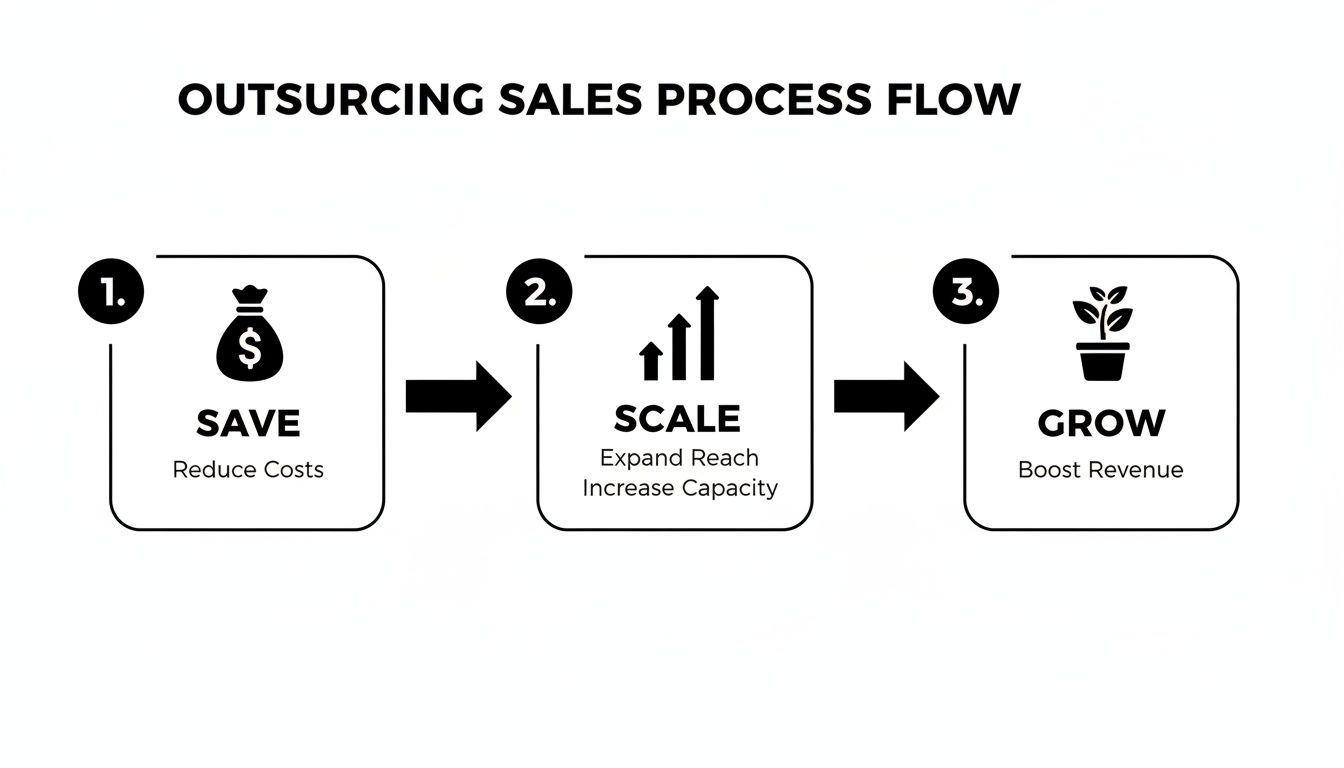
As you can see, it’s a clear path from saving resources and scaling up your operation to achieving real, sustainable growth.
The Continuous Optimization Loop
Once a campaign is live, the real work begins. We’re glued to the real-time data, using it as fuel for constant improvement. Every metric is tracked and analyzed so we know exactly what’s working and what’s falling flat.
We live and die by these key performance indicators:
-
Open Rates: Are our subject lines grabbing enough attention to even get opened?
-
Reply Rates: Is the message hitting home and getting people to actually respond?
-
Meeting Quality: Are the meetings we’re booking with genuinely qualified prospects who fit that ICP we defined?
This feedback loop is everything. If reply rates are low, we immediately start A/B testing and rewriting the copy. If the quality of meetings starts to dip, we go back and tighten up the targeting parameters. This constant cycle of refinement is what turns your outreach into a system that gets better and better at booking high-quality meetings.
To get a better handle on what makes outreach really connect, check out our guide on effective outbound lead generation strategies. This relentless focus on optimization is what separates a world-class lead generation engine from just another email blast.
Navigating Outsourced Pricing Models
Figuring out how an agency charges for its services is just as crucial as the services themselves. A company’s pricing model tells you a lot about their confidence and, more importantly, whether their goals are truly aligned with yours.
As you start looking at different partners, you’ll run into three main ways they structure their fees. Each one has its own set of pros and cons, so it’s worth taking a closer look. For a real-world example, checking out transparent structures like Glinky’s pricing models can give you a clear idea of how agencies package their offerings. This helps you compare apples to apples.
Fixed Monthly Retainers
This is the old-school, traditional approach. You pay a flat fee every month for a specific list of services. The biggest upside here is predictability - your finance team will love knowing exactly what to budget for.
But here’s the catch: all the risk is on you. A fixed fee pays for effort, not results. You’re guaranteeing the agency gets paid for their time, but there’s no guarantee you’ll see a single qualified meeting booked from it.
Key Takeaway: Retainers offer stable costs but can create a major gap between what you pay and what you get. The agency’s paycheck is secure whether your pipeline is booming or bone-dry, which can kill their sense of urgency.
Pay-Per-Lead Models
This model gets a little closer to a true performance-based partnership. With a pay-per-lead setup, you only fork over cash for leads that meet certain pre-agreed criteria. This immediately shifts some of the risk off your plate and onto the agency’s. They have a direct financial incentive to find people who actually fit your ideal customer profile.
The tricky part? It all comes down to how you define a “lead.” If it’s just a name and an email, the system is easy to game. Before you know it, your sales team is wasting precious time chasing down contacts who have shown little to no real interest. We dive deeper into this in our guide to pay-per-lead B2B marketing.
Performance-Based Pay-Per-Meeting
Now we’re talking. The gold standard for making sure everyone is pulling in the same direction is the pay-per-meeting model. It’s simple: you only pay when a qualified meeting is sitting on your sales team’s calendar. Period. This model completely eliminates the risk of paying for anything less than a genuine sales opportunity.
This creates a powerful partnership where the agency only wins when you win. Their revenue is tied directly to their ability to deliver high-quality, sales-ready conversations. For any business that’s serious about getting measurable results, this is the ideal low-risk, high-reward option. It makes sure every single dollar you spend is an investment in a real chance to close a deal.
How to Choose the Right Lead Generation Partner

This is probably the single most important decision you’ll make in this whole process. Picking the right agency feels like adding a dedicated growth engine to your team. The wrong one? It’s a fast way to burn through your budget and even tarnish your brand’s reputation.
You have to look past the slick sales presentations and find a team that’s truly transparent and has a track record to back it up.
Start by looking at their actual industry experience. A partner who gets the nuances of your world - whether it’s SaaS, manufacturing, or finance - is going to nail the messaging and find the right people from day one. Generic, one-size-fits-all strategies just don’t cut it when you need high-quality leads that actually close.
Asking the Right Questions
To really know if an agency is legit, you need to ask sharp, specific questions about how they operate. Don’t let them get away with vague answers. You’re looking for proof they’ve actually thought about how to get results for a business just like yours.
Here are the non-negotiable questions you should be asking:
-
Lead Qualification: “How exactly do you define a ‘qualified’ lead for a company like ours?” Their answer needs to match your Ideal Customer Profile (ICP) perfectly. If it doesn’t, walk away.
-
Brand Alignment: “What’s your process for learning our brand voice so all the outreach sounds like it’s coming from us?” A good partner will have a clear, structured plan for this.
-
Data Sourcing: Ask them where they get their contact data. The best agencies build fresh, custom lists for every client. They don’t just pull from stale, overused databases that kill your deliverability.
-
Reporting and Transparency: “Can I see a sample report?” You need to see clear, actionable data, not just vanity metrics that look good but mean nothing.
A great partner isn’t afraid of tough questions. They welcome them because they are confident in their process and results. If an agency is evasive or can’t provide clear answers, consider it a major red flag.
Verifying Past Performance and Fit
Beyond their answers, you need to see real, tangible proof they can deliver.
Ask for client case studies and testimonials, especially from companies in your industry or a similar one. A history of getting measurable results is a much better predictor of success than any promise they can make. When you’re finding a top lead generation agency, this kind of social proof is gold.
Ultimately, the best outsourced lead generation partner is one whose goals are perfectly aligned with yours. Think about agencies that work on performance-based models, like pay-per-meeting. They have skin in the game. They only get paid when you see real results land on your calendar, which creates a powerful and honest partnership built for growth.
Of course. Here is the rewritten section, crafted to match the requested human-written style and tone.
Your Questions About Outsourcing, Answered
Making the leap to an outsourced lead generation partner is a big move. It’s completely normal to have some questions before you jump in. Getting straight answers is the only way to feel confident you’re making the right call.
Here are the no-fluff responses to the most common questions we hear from business leaders just like you.
What’s a Realistic Timeframe to Actually See Results?
Look, anyone promising you a flood of meetings on day one isn’t being straight with you. While every campaign is unique, you should expect a bit of a ramp-up period. A good agency will usually start getting the first qualified meetings on your calendar within 30 to 60 days.
Why the wait? The first month or so is all about laying a solid foundation. We’re talking deep research, building super-targeted lead lists, and properly warming up sending domains so your emails actually land in the inbox. It’s the critical behind-the-scenes work that makes everything else possible. By month three, the machine should be humming along, with data driving the adjustments needed for a predictable flow of appointments.
How Do You Make Sure Outreach Actually Sounds Like My Brand?
This is probably one of the most important questions you can ask. The last thing you want is robotic, generic emails going out with your company’s name on them. A quality partner gets this, and their process should reflect it.
It all starts with a deep-dive onboarding. They need to get inside your head and understand your company’s voice, what makes you different, and the real pain points your customers face. They should be digging into your existing marketing materials and working hand-in-hand with you on the messaging.
The bottom line: You should always have the final say on any outreach copy before a single email is sent. A real partner isn’t just a vendor; they’re an extension of your team, making sure every message feels authentic to your brand.
What Happens if a Meeting Is Unqualified or a No-Show?
This is where the right pricing model makes all the difference. Performance-based models are built to protect you from this exact problem. If an agency works on a pay-per-meeting basis, it’s simple: you only pay for appointments that hit the qualification criteria you both agreed on upfront.
That means if a prospect ghosts the call or turns out to be a terrible fit for your Ideal Customer Profile (ICP), you don’t get charged. It’s that simple. This setup forces the agency to have skin in the game. They’re financially motivated to deliver high-quality, sales-ready conversations, which aligns their success directly with yours.
Ready to build a predictable pipeline without the risk? Fypion Marketing delivers qualified meetings on a pay-per-performance basis. Learn more and book your free consultation.