
Discover how to calculate roi marketing: A Practical ROI Guide

Calculating marketing ROI isn’t some dark art - it all boils down to a single, powerful formula: (Net Profit / Marketing Cost) x 100. This simple equation is your north star, showing you the profitability of your campaigns by directly comparing what you made to what you spent. Getting this right is the first real step toward making smart, data-backed decisions that actually move the needle.
Mastering the Core Marketing ROI Formula

Before you can confidently tell your boss, “here’s our return,” you need a rock-solid grasp of the basic formula. It’s the foundation for pretty much every other marketing metric you’ll ever use. When you truly understand each part of the equation, your calculations become accurate and - more importantly - defensible.
This is how you shift marketing’s perception from a “cost center” to a proven revenue engine. It’s not just about crunching numbers; it’s about telling a compelling story to your stakeholders. When you can clearly show how a $10,000 investment turned into $50,000 in profit, you’re in a much better position to ask for a bigger budget next quarter.
Breaking Down the Formula
At its core, the calculation is refreshingly simple. You take the profit generated by your campaign, subtract what you spent on marketing, and then divide that result by the marketing cost again. Multiply it by 100, and boom - you have a percentage that tells you exactly how you performed.
A positive ROI means you made money. A 300% ROI, for example, tells you that for every dollar you put in, you got three dollars back in pure profit. It’s a fantastic result. A negative ROI, of course, means the campaign lost money.
The gold standard formula is: [(Revenue Generated - Marketing Cost) / Marketing Cost] x 100. This version is what most pros use because it paints the clearest picture. For B2B marketers, this clarity is everything. Shockingly, only 36% feel they can accurately measure their ROI, but the ones who can are 1.5 times more likely to get their budgets increased.
To help you get the inputs right, here’s a quick breakdown of what each component really means.
Marketing ROI Formula Components Explained
| Component | Definition | Example |
|---|---|---|
| Revenue Generated | The total sales or income directly attributable to the marketing campaign. | A $50,000 increase in sales traced back to your email campaign. |
| Marketing Cost | All expenses incurred to create and run the campaign. | $10,000 spent on ad platforms, content creators, and software. |
| Net Profit | The revenue generated by the campaign minus the cost of goods sold (COGS). | $50,000 (Revenue) - $15,000 (COGS) = $35,000 Net Profit. |
Using these components correctly is the difference between a fuzzy estimate and a number you can take to the bank.
What Goes into the Calculation
The accuracy of your ROI lives and dies by the data you feed into it. Net Profit isn’t just your total sales; it’s the revenue you can directly attribute to your marketing efforts, minus the cost of producing what you sold (COGS).
Likewise, Marketing Cost has to be all-encompassing. A common rookie mistake is to only count ad spend. That’s just not the whole picture. To get it right, you absolutely must include:
-
Software and tools: Subscription costs for your marketing automation, analytics, and design platforms.
-
Creative production: Fees you paid to freelancers, agencies, or content creators.
-
Team salaries: A prorated portion of the salaries for the people who worked on the campaign.
Getting granular with these expenses is closely tied to your efforts to reduce customer acquisition cost, as both require a meticulous accounting of every dollar spent. When you include every single relevant expense, you’re not just getting a number - you’re getting an honest, reliable picture of your marketing’s true financial impact.
Gathering the Right Data for an Accurate ROI

The marketing ROI formula is straightforward, but it has a massive weakness: it’s completely at the mercy of your data quality.
Garbage in, garbage out. A single forgotten expense or a misattributed sale can throw your entire calculation into chaos, pointing your strategy in the wrong direction. Getting this right means you have to get into the nitty-gritty of tracking every single dollar.
Your calculation needs to capture not just the obvious costs but also the sneaky ones that love to slip through the cracks. This is where most marketers stumble, ending up with an inflated ROI that looks great on paper but doesn’t reflect reality.
Identifying Every Single Marketing Cost
To get a true picture of your investment, you need to hunt down every single expenditure tied to a campaign. This goes way beyond just your ad spend.
Start by listing every tool and subscription your team touches. That $150/month email platform or a $500/month analytics tool might seem minor, but over a year, those costs balloon.
And don’t forget the human element. If three of your team members spent 20% of their time on a campaign for one month, a slice of their salaries absolutely has to be included in the cost.
Other costs you can’t afford to miss include:
-
Creative Production: Fees for designers, copywriters, or video editors.
-
Agency or Freelancer Fees: Any money paid to external partners who helped out.
-
One-off Software Purchases: Any tools you bought specifically for the initiative.
To really nail this down, it helps to understand general and administrative expenses and how they fit into the bigger financial picture. This gives you a framework for categorizing costs correctly so nothing gets missed.
Pinpointing Revenue and Attributing Sales
Tracking your costs is only half the battle; tying revenue back to your efforts is just as crucial. You need a rock-solid way to connect a specific sale to a specific marketing action. This is where attribution becomes your best friend.
A simple and incredibly effective method is using UTM parameters in all your campaign links. These little bits of code tell your analytics platform exactly where a user came from, letting you trace a purchase all the way back to a specific email, social media post, or ad.
Pro Tip: For high-stakes campaigns, I always recommend creating dedicated landing pages with unique forms. This creates a closed loop. Any lead or sale that comes through that page is automatically attributed to the correct campaign, completely eliminating the guesswork.
If you’re in B2B, you know the sales cycles can be painfully long. Waiting for the final sale to calculate ROI just isn’t practical. The workaround? Assign a monetary value to your intermediate goals.
For example, if you know that 1 in 10 qualified meetings eventually converts into a $20,000 deal, then each booked meeting is worth $2,000. This approach lets you prove value and calculate an interim ROI long before any contracts get signed. Tracking these essential email marketing KPIs gives you a much clearer, more immediate pulse on your campaign’s performance.
Calculating ROI for Different Marketing Channels
Trying to slap a single, one-size-fits-all ROI model across your entire marketing plan is a classic mistake. It just doesn’t work. Every channel has its own financial DNA; what tells you the story for a quick-win email campaign won’t accurately capture the slow-burn value of SEO.
To really get what’s going on, you have to calculate ROI in a way that respects each channel’s unique rhythm. This is how you make smart budget decisions. It gives you the clarity to double down on what’s actually working, pull back on what isn’t, and shift your resources where they’ll have the biggest impact. Without this level of detail, you’re just guessing.
High-Return vs. Long-Term Investments
Not all marketing channels are built the same, especially when it comes to how fast you see a return. They pretty much fall into two camps: the sprinters and the marathon runners.
-
Email Marketing: This one is famous for delivering fast, high returns. It’s direct, it’s personal, and you’re talking to an audience you already own.
-
Pay-Per-Click (PPC) Advertising: PPC can get leads and sales in the door almost immediately. You can often see the ROI within days or weeks.
-
Search Engine Optimization (SEO): Definitely a long-term play. Results build slowly over months, but the payoff can be massive and sustainable once it kicks in.
-
Content Marketing: Much like SEO, content builds your authority and brings in organic traffic over time. This makes calculating an immediate ROI tricky, but it’s crucial for proving its long-term value.
Understanding this difference is key. It stops you from unfairly comparing a brand-new SEO initiative to a mature email list that’s been nurtured for years. Each one needs its own timeline and its own set of expectations.
When it comes to pure numbers, email marketing is an absolute powerhouse. It boasts an average return of $42 for every single $1 spent. That performance leaves most other channels in the dust, with SEO coming in second at a still-impressive $22.24 per dollar.
A Practical B2B Email Campaign Example
Alright, let’s get our hands dirty and run the numbers on a hypothetical cold email campaign. Imagine your goal is to book qualified meetings for your sales team, and you’ve assigned a specific dollar value to each meeting.
Campaign Costs:
-
Email Outreach Software: $500
-
List Building & Verification: $1,500
-
Copywriting & Management: $3,000
-
Total Marketing Cost: $5,000
Campaign Results:
-
Booked Qualified Meetings: 50
-
Value Per Meeting (based on your average close rate and deal size): $400
-
Total Revenue Generated: (50 meetings x $400/meeting) = $20,000
Now, we just plug those numbers into our simple ROI formula:
Boom. This campaign delivered a 300% ROI. A clear win.
This is the kind of data that transforms your outreach from a hopeful shot in the dark into a predictable revenue engine. For agencies, knowing how to prove this kind of value is everything; having solid marketing automation for agencies helps structure these reports so clients see exactly what they’re paying for.
If you want to build a system like this yourself, our guide on a modern B2B email marketing strategy that converts walks you through the entire process. Once you have these focused calculations, you can scale your investment with confidence.
Typical ROI Benchmarks by Marketing Channel
To give you a better sense of what to expect, here’s a quick look at the average ROI for some of the most popular marketing channels. Use this as a guide to set realistic expectations and think about where your budget might be best spent.
| Marketing Channel | Average ROI (Return per $1 Spent) | Key Considerations |
|---|---|---|
| Email Marketing | $36 - $42 | Relies on a quality list. Highly effective for nurturing and retention. |
| SEO | $22.24 | A long-term investment. Results are compounding and sustainable. |
| PPC Advertising | $2 - $8 | Fast results and highly scalable, but can be expensive and competitive. |
| Content Marketing | $5 - $20 | Builds brand authority and organic traffic. ROI is often indirect and builds over time. |
| Social Media Marketing | $2 - $10 | Varies widely by platform. Excellent for brand awareness and community building. |
| Affiliate Marketing | $10 - $15 | Performance-based model minimizes risk, but requires strong partner relationships. |
Keep in mind, these are just averages. Your actual results will depend on your industry, your strategy, and how well you execute. The real power comes from tracking your own numbers and optimizing from there.
Moving Beyond Basic ROI with Advanced Metrics
Relying on a single, campaign-level ROI number is a bit like driving while only looking in the rearview mirror. Sure, it tells you where you’ve been, but it gives you zero clue about what’s coming up ahead.
If you really want to understand your marketing’s health and build a true growth engine, you have to dig deeper. It’s the difference between good marketing and great marketing - moving beyond the immediate win to see the total value you’re creating over time.
This perspective is an absolute game-changer for businesses with long sales cycles or subscription models. For them, the first sale isn’t the finish line; it’s just the start of the relationship.
Understanding Customer Lifetime Value
One of the most powerful tools you can have in your arsenal is Customer Lifetime Value (CLV). This metric isn’t about the last purchase; it’s about predicting the total profit you’ll make from a customer over their entire relationship with your company.
Think about it. A customer might come in from a campaign with a so-so initial ROI. But what if they stick around for five years? Their total value could be massive. Calculating CLV helps you justify putting money into strategies that build loyalty and retention, not just quick, flashy wins.
The real magic happens when you pair CLV with your Customer Acquisition Cost (CAC). The CLV-to-CAC ratio is one of the best predictors of your business’s long-term health. A solid ratio - the industry benchmark is often 3:1 or higher - means you’re getting at least three dollars back for every dollar you spend to get a new customer.
This chart shows a simple snapshot of immediate returns, which is a great starting point for seeing the bigger picture.
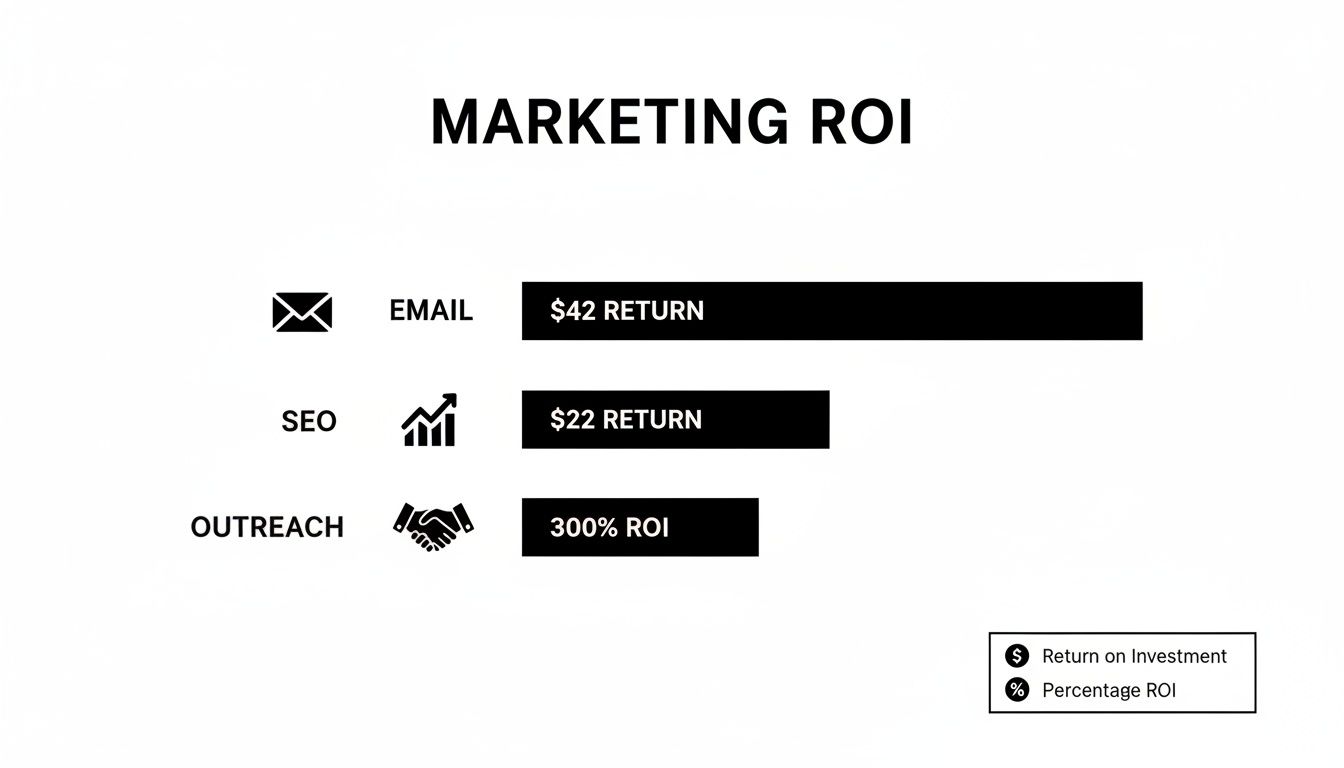
While a channel like email shows a fantastic immediate return, something like SEO builds compounding value that a single snapshot can’t possibly capture. We see this all the time. B2B content and SEO, for example, deliver incredible long-term ROI. In fact, data shows SEO can produce a 748% ROI for B2B companies, with some seeing ratios as high as 22:1. Measure that impact over three years, and ROI in some tech sectors can climb to a staggering 1,486%. You can discover more insights about these marketing ROI statistics on Firework.com.
The Importance of Multi-Touch Attribution
Another concept you have to get right is multi-touch attribution. The old-school “last-click” model - where 100% of the credit goes to whatever the person clicked right before converting - is dangerously outdated.
Let’s be real. B2B buyers don’t just see one ad and pull out their company card. They read a blog post, see a few social updates, maybe attend a webinar, and exchange a half-dozen emails before they even think about talking to sales.
Multi-touch attribution models try to spread the credit across all of those different touchpoints. This gives you a much more realistic picture of how your channels are actually working together. You start seeing the value in those top-of-funnel activities that build trust and awareness, even if they don’t lead to a direct sale.
By understanding that complete journey, you can finally make smarter decisions and stop undervaluing critical parts of your marketing mix. To go even deeper on this, check out our guide on mastering lead gen KPIs for business growth.
Common Mistakes to Avoid When Calculating ROI

Calculating your marketing ROI is the moment of truth. But I’ve seen too many marketers fall into common traps that turn a clear picture into a blurry, misleading mess.
Get this wrong, and you could end up killing a great campaign or, even worse, pouring more money into a failing one. Let’s walk through the big mistakes I see all the time so you can sidestep them completely.
Forgetting the ‘Soft’ Costs
This is probably the most frequent error. Marketers get laser-focused on the obvious line items - ad spend, agency retainers, contractor invoices - and call it a day. The problem? That’s not your true investment.
Doing this gives you an inflated ROI that looks great on paper but doesn’t reflect reality. To get an honest number, you have to account for the “soft” costs that made the campaign possible.
-
Prorated Team Salaries: If your content manager spent 25% of their time last month on a specific campaign, then 25% of their monthly salary belongs in your cost calculation.
-
Software Subscriptions: Think about your marketing stack. A portion of your HubSpot, Ahrefs, or Canva subscription fees should be allocated to the campaigns that rely on them.
-
Overhead Costs: For a truly granular view, some companies even factor in a sliver of office rent or utilities.
Ignoring these is like calculating the profit from a bake sale but forgetting you had to buy the oven. You’re missing a massive piece of the investment.
Misattributing Sales with Flawed Tracking
Another huge landmine is fuzzy attribution. If you can’t confidently connect a sale back to a specific marketing touchpoint, you’re just guessing.
This usually happens when teams default to a “last-click” attribution model. This outdated approach gives 100% of the credit to whatever the customer clicked right before they bought. It completely ignores the blog post they read two weeks ago, the webinar they attended last month, or the social ad that first introduced them to your brand. For any business with a considered purchase, last-click is a recipe for bad decisions.
Pro Tip: You need to move to a multi-touch attribution model. It spreads the credit across the entire customer journey, giving you a far more realistic view of what’s actually working. This way, you won’t accidentally slash the budget for a top-of-funnel campaign that’s quietly teeing up all your conversions.
Judging Long-Term Strategies on Short-Term Results
This one drives me nuts. You can’t judge a marathon runner by their first 100-yard dash. Yet, I see marketers trying to measure the ROI of a massive SEO or content marketing push after just 30 days.
It’s a guaranteed way to make a brilliant strategy look like a failure. These channels are built to deliver compounding value over months, even years.
Expecting an immediate return is just setting yourself up for disappointment. Instead, you need to align your measurement window with the strategy’s timeline. This is where concepts like pay-for-performance marketing become so powerful, as they align agency incentives with those longer-term business outcomes.
For these marathon strategies, focus on leading indicators in the early days - things like keyword ranking improvements, organic traffic growth, or new lead sign-ups. Save the final revenue-based ROI calculation for a timeframe that actually gives the strategy a chance to work.
Got Questions About Marketing ROI? We’ve Got Answers.
Even after you’ve nailed down the formulas, real-world questions always come up. Let’s tackle some of the most common ones that pop up when you’re in the trenches trying to calculate marketing ROI.
What Is a Good Marketing ROI, Really?
Everyone wants that one magic number, but the honest answer is: it depends.
That said, a common benchmark you’ll hear tossed around is a 5:1 ratio. This works out to a 400% ROI and means you’re making five dollars for every one dollar you spend. If you’re hitting a 10:1 ratio (900% ROI), you’re in pretty elite company.
But context is king. A SaaS business with high margins might be perfectly happy with a 3:1 ratio, especially if their Customer Lifetime Value (CLV) is massive. On the flip side, a low-margin e-commerce shop probably needs a much higher return right out of the gate just to keep the lights on.
The best yardstick is always your own past performance. Aim for steady, consistent improvement over chasing an arbitrary industry number.
How Soon Can I Actually Measure ROI for a New Campaign?
Patience is a virtue here, and it all comes down to your sales cycle. I’ve seen so many teams pull the plug on a great strategy simply because they tried to measure its impact way too early.
Here’s a practical way to think about it:
-
Short Sales Cycles: If you’re running PPC ads that lead directly to a sale, you can usually get a good read within a few weeks. The feedback loop is fast.
-
Long Sales Cycles: For plays like content marketing or SEO in the B2B world, the path from a first blog post view to a signed contract can take months.
For those long-haul strategies, you need to look at leading indicators first. Are you getting more qualified leads? Are demo requests up? Is your sales pipeline growing? These early signs tell you if you’re on the right track. Wait until a full sales cycle has passed - often 90 to 180 days for complex B2B deals - before you calculate the final revenue ROI.
How Do I Calculate ROI When I Can’t Track Direct Revenue?
This is a classic problem, especially for top-of-funnel campaigns where the goal is brand awareness, not an immediate credit card swipe. When you can’t draw a straight line to a sale, you have to get creative with proxies for value.
The trick is to assign a dollar value to a specific, high-intent action.
Dig into your historical data. Let’s say you know that 1 out of every 20 qualified leads eventually becomes a customer, and your average customer value is $10,000. Simple math tells us that each qualified lead is worth $500 to your business.
Now, you can calculate your ROI based on the value of the leads you generated, not just the immediate revenue. This approach is absolutely essential for proving the worth of campaigns that build your pipeline for future growth.
At Fypion Marketing, we specialize in turning outreach into measurable results. By focusing on a pay-per-meeting model, we remove the guesswork from your lead generation ROI, ensuring you only pay for qualified opportunities. See how we can build a predictable sales pipeline for your business.