
Sales Outsourcing Service for B2B Tech Growth
You’ve got a product that closes when the right buyer shows up. The problem is that the right buyer isn’t showing up often enough.
Most B2B teams hit this wall the same way. The founder is still helping shape outbound. The sales director is reviewing sequences, fixing CRM hygiene, and trying to keep AEs focused on closing instead of prospecting. Hiring more SDRs sounds like the obvious answer until you price the ramp time, management load, tooling, and the risk of getting stuck with activity that looks busy but doesn’t turn into pipeline.
That’s where a sales outsourcing service becomes useful. Not as a shortcut. Not as a cheap labor play. As an operating model for teams that need qualified meetings without building every moving part themselves.
The Growth Plateau Every B2B Founder Faces
A familiar pattern shows up once a SaaS company gets early traction. Referrals slow down. Founder-led outreach stops scaling. Paid acquisition gets expensive. The product is good enough to sell, but the pipeline isn’t steady enough to forecast with confidence.

At that stage, teams often try one of three fixes. They ask AEs to prospect more, they hire one SDR and hope that person can do everything, or they buy software and assume the stack will solve a process problem. None of those moves work for long if the underlying issue is operational capacity.
The market has already moved in that direction. Globally, 33% of companies outsource marketing and sales processes, and 43% of tech firms plan to increase outsourcing spend in 2025 according to Activated Scale’s sales outsourcing market analysis. That doesn’t mean outsourcing is always the right call. It means many teams now treat external execution as a normal part of revenue operations, not an exception.
What the plateau actually looks like
It usually isn’t dramatic. It looks like this:
-
Closers doing SDR work because calendars aren’t full enough.
-
Inconsistent outbound volume because list building, copywriting, deliverability, and follow-up all compete for attention.
-
Long hiring cycles that delay pipeline more than they fix it.
-
Weak experimentation because nobody owns testing across messaging, targeting, and channel mix.
If that sounds familiar, you don’t need more theory. You need a repeatable system.
A strong outbound motion often combines human judgment with workflow support. If you’re evaluating tools before outsourcing, this breakdown of AI for sales prospecting is useful because it shows where automation helps and where it still needs operator oversight. For a broader look at how B2B teams structure top-of-funnel execution, this guide to lead generation for tech companies is also worth reviewing.
The plateau rarely comes from a bad product. It usually comes from an outbound engine that was never built to run consistently.
What Exactly Is a Sales Outsourcing Service
Your AE is closing deals at 20 percent, but half the week disappears into prospecting, list cleanup, and chasing no-show meetings. You do not have a rep problem. You have a coverage problem. A sales outsourcing service exists to cover that gap with an operating system, not just extra hands.
A sales outsourcing service is an external team that owns part or all of your sales development work with its own reps, managers, processes, tools, and reporting cadence. In practice, that can mean booking meetings, running outbound campaigns, qualifying inbound leads, or supporting a full top-of-funnel motion.
The distinction that matters is operational. Buying one contractor gives you labor. Buying a managed service gives you labor plus process control, supervision, QA, tooling, and accountability. That is why so many outsourcing deals disappoint. The buyer expected headcount. What they needed was a system with clear ownership and defined handoffs.
What a real service includes
A credible provider usually brings these pieces together:
-
Targeting and account selection so outreach stays focused on the right segments and buyer roles
-
Outbound execution across email, phone, LinkedIn, or a narrower channel mix that fits your market
-
Data operations including list building, enrichment, verification, and cleanup
-
Tool administration such as sequencing setup, inbox rotation, domain management, and CRM sync
-
Management oversight with QA, coaching, reporting, and iteration based on results
That package is what separates a managed sales outsourcing service from a freelancer, staffing agency, or list vendor.
It also changes how you should evaluate the offer. Ask who owns deliverability. Ask who writes and revises copy. Ask how quickly bad data gets removed, how meetings are qualified, and what happens after a prospect replies. If those answers are vague, the provider is selling activity, not pipeline.
What it is not
A sales outsourcing service does not fix weak positioning, an unclear ICP, or a product nobody wants. It also should not operate in a vacuum.
The best outsourced teams act like an extension of revenue operations. They book meetings, but they also surface objection trends, reply patterns, targeting gaps, and handoff issues your internal team can use. That feedback loop is where a good engagement starts to compound.
Contract structure matters here. If you are buying pay-per-meeting, define what counts as a qualified meeting before the first campaign goes live. Include title filters, company size, geography, problem fit, disqualification reasons, reschedule rules, and no-show treatment in writing. Without that detail, you will spend the first month arguing over whether the vendor delivered what you bought.
Practical rule: If a partner talks about volume before qualification criteria, CRM visibility, and handoff rules, keep looking.
For teams comparing narrower lead gen support against a managed outbound program, this guide to outsourced lead generation for B2B growth is a useful reference.
Key Types of Sales Outsourcing and When to Use Them
Not every company needs the same kind of outsourced support. The mistake is buying the largest package when the bottleneck is narrower.

The right model depends on where your sales process is already strong and where it’s breaking. If your closers convert well but nobody fills their calendars, you don’t need a full outsourced sales team. If you’re entering a new market with no outbound process at all, you probably do.
Full-cycle sales outsourcing
This model covers most or all of the sales process. Prospecting, qualification, outreach, appointment setting, and sometimes closing support all sit with the provider.
Use it when:
-
You have product-market fit but no mature outbound function
-
You’re entering a new region or segment
-
Internal leadership doesn’t have time to build and coach the function from scratch
This is the heaviest lift operationally because it requires the deepest alignment on messaging, qualification, CRM process, and follow-up ownership. It can work well for early-stage or transition-stage companies, but only if the provider is disciplined about documentation and handoffs.
Lead generation services
This model focuses on top-of-funnel sourcing and outreach. The provider identifies prospects, builds lists, enriches data, and drives first-touch engagement. Your internal team usually handles qualification and closing from there.
This is a better fit when your internal sales team is capable but underfed. It’s also useful when marketing is producing interest, but not enough named accounts and outbound activity to support growth targets.
A lot of B2B teams start here because it solves a clear problem without changing the entire sales org. If you want a clean explanation of the SDR function inside that motion, this overview of what a sales development representative does is a practical reference.
Outsourced SDRs and appointment setting
This is the most common option for SaaS and B2B tech. The provider runs outbound and books meetings for your AEs or founders.
The strongest versions of this model use coordinated sequencing. According to Outbound Sales Pro’s breakdown of sales outsourcing execution, advanced multi-channel setups that combine email warming, LinkedIn outreach, and concurrent dialing can generate 2x to 3x more live conversations than single-channel programs when they’re calibrated correctly. That only works when targeting, personalization, and routing are handled properly. Sending more touches through more channels without discipline just creates more noise.
A useful way to evaluate this model is to ask what happens after the meeting is booked. If the answer is vague, quality usually is too.
Here’s a quick look at how many teams think about the channel mix before choosing an appointment-setting partner:
Channel sales development
This model supports partner-led growth. Instead of booking meetings directly with end buyers, the outsourced team recruits, activates, or supports resellers, affiliates, agencies, or distribution partners.
Use it when your product sells well through an ecosystem and you need help creating partner pipeline rather than direct outbound pipeline. It’s less common for earlier SaaS teams, but useful for mature companies with established channel strategy.
A simple way to choose
| Model | Best used when | Main risk |
|---|---|---|
| Full-cycle outsourcing | You need broad sales coverage fast | Too much external ownership without enough internal process |
| Lead generation | Your team can sell, but needs more qualified top-of-funnel activity | Leads arrive without enough qualification discipline |
| Outsourced SDR and appointment setting | AEs are good closers but their calendars are thin | Meeting volume gets prioritized over meeting quality |
| Channel sales development | Growth depends on partners, not direct sales alone | Partner recruitment happens without partner activation |
If your internal team already closes well, start with the smallest outsourced model that fixes pipeline flow. Don’t outsource complexity you don’t need.
Decoding Sales Outsourcing Pricing Models
Pricing tells you how risk is divided. It also tells you what behavior the provider is likely to optimize for.
A cheap monthly fee can become expensive if the meetings are weak. A performance model can look attractive until you realize nobody agreed on what a qualified meeting means. Before comparing providers, compare incentives.
Retainer-based pricing
This is the traditional structure. You pay a monthly fee for access to a team, a process, or a defined scope of activity.
Retainers work best when you want strategic involvement, flexible scope, and close collaboration over time. They’re common when the provider is doing more than appointment setting, such as message development, segmentation work, infrastructure setup, and ongoing experimentation.
The downside is obvious. You take on more upfront risk. If performance drifts, you’re still paying.
Performance-based pricing
In this model, payment is tied to outcomes. The most common versions are pay-per-lead and pay-per-meeting.
This structure is attractive to B2B tech teams because it reduces fixed spend and sharpens accountability. But it only works if the outcome is defined tightly. A booked meeting is not automatically a useful meeting. You need agreement on buyer role, company fit, need state, attendance standards, and handoff rules.
One example in this category is Fypion Marketing, which runs cold email outreach on a pay-per-meeting basis with pre-agreed qualification criteria rather than an upfront retainer. That structure isn’t always the best choice, but it is clearer for companies that want to limit spend on unproven outbound motion.
Hybrid and revenue-share models
Hybrid models blend a base fee with performance upside. Revenue-share models go further and tie compensation to downstream results.
These can align incentives well when the sales cycle is long and the provider contributes meaningfully beyond booking meetings. They can also become messy fast. Attribution disputes are common when multiple channels and internal teams influence the same deal.
The more a pricing model depends on later-stage revenue, the more precise your attribution rules need to be.
Sales Outsourcing Pricing Model Comparison
| Model | Structure | Buyer Risk | Best For |
|---|---|---|---|
| Retainer | Fixed monthly fee for team and scope | Higher upfront risk if output lags | Teams that want strategic flexibility and broader support |
| Performance-based | Payment tied to leads or meetings | Lower upfront risk, higher need for tight definitions | SaaS and tech teams that want clear outcome accountability |
| Hybrid or revenue share | Base fee plus performance component, or share of closed revenue | Medium to high complexity around attribution | Companies with mature tracking and longer partnership horizons |
What to ask before signing
Use these questions to pressure-test any quote:
-
What exactly triggers payment and who verifies that the trigger was met?
-
What happens to no-shows or bad-fit meetings and is there a replacement policy?
-
Which work is included in the fee, such as data, copy, infrastructure, reporting, and optimization?
-
Who owns the assets including domains, sequences, copy, contact data, and CRM records?
If you want a broader look at how outcome-based pricing works beyond sales outsourcing alone, this piece on pay-for-performance marketing gives useful context.
How to Vet and Select the Right Sales Partner
Most buyers ask the wrong first question. They ask, “How many meetings can you book?” The better question is, “How do you decide whether a meeting was worth booking in the first place?”
That single shift changes the whole evaluation process.

According to TTEC’s discussion of sales outsourcing contracts and success-based models, while most providers are paid on success, many contracts lack enforceable performance benchmarks or clawback clauses. That’s the contract gap buyers ignore until they start getting meetings that technically count but don’t help the pipeline.
Start with operational fit
A provider can be skilled and still be wrong for your business. Vet the fit before you vet the pitch.
Look for alignment across these areas:
-
Market familiarity. They don’t need to specialize only in your niche, but they should understand your sales motion, average buyer sophistication, and common objections.
-
Channel competence. If they sell themselves as multi-channel, ask which channels they operate well and who owns each one.
-
Sales process maturity. Providers should be comfortable working inside qualification frameworks such as BANT or MEDDIC if your team already uses them.
-
Reporting discipline. If reporting lives in slide decks instead of your CRM, expect blind spots.
Inspect the engine, not the homepage
Ask to see how they work. Not polished screenshots. The actual operating rhythm.
Request specifics on:
-
Data sourcing and enrichment How do they identify target accounts, validate contacts, and remove bad data before launch?
-
Sequence design How many touches, over which channels, with what logic for replies, routing, and follow-up?
-
CRM integration Do they log objections, competitor mentions, next steps, and booking context directly into Salesforce or HubSpot?
-
Optimization cadence What gets reviewed weekly, what gets tested, and who makes the changes?
The strongest providers can answer those questions without hiding behind jargon. Leads at Scale’s guide to outsourced sales operations notes that enterprise-grade programs rely on real-time CRM updates, data enrichment workflows, automated routing, and weekly or bi-weekly reporting dashboards to improve pipeline velocity and maintain accountability. That’s the level of operational detail you want.
The contract terms that matter
Many deals go soft here. If the contract is vague, everything gets re-litigated later.
Your agreement should define:
-
Qualified meeting criteria Company type, buyer seniority, geography, industry fit, problem relevance, and any exclusion rules.
-
Acceptance and rejection window How long your team has to flag a meeting as invalid, and what evidence is required.
-
No-show and reschedule policy Whether those count, when they count, and who owns follow-up.
-
Replacement or clawback terms What the provider owes if a booked meeting fails agreed qualification standards.
-
Exit rights Notice period, offboarding obligations, data return, and access revocation.
Contract check: If “qualified meeting” can’t be tested objectively by two different people and produce the same answer, the definition is too loose.
Red flags buyers should take seriously
Some warning signs show up early if you know where to look:
-
They promise volume before discovery.
-
They won’t explain their data sources or verification process.
-
They avoid CRM-native reporting.
-
They push long lock-ins without clear service levels.
-
They use examples that sound impressive but don’t match your sales motion.
A credible partner won’t dodge trade-offs. They’ll tell you where your offer may be hard to sell, where targeting is too broad, and where internal handoffs could break the process.
For a practical benchmark on what to ask agencies in this category, review this guide on choosing a lead generation agency.
Integrating Your Partner and Measuring True ROI
A signed agreement doesn’t create pipeline. Integration does.
Outsourced programs either become productive extensions of your team or turn into a separate machine that throws meetings over the wall. The hidden cost isn’t just bad leads. It’s the time your internal team spends fixing handoffs, correcting messaging, chasing missing context, and arguing over ownership.
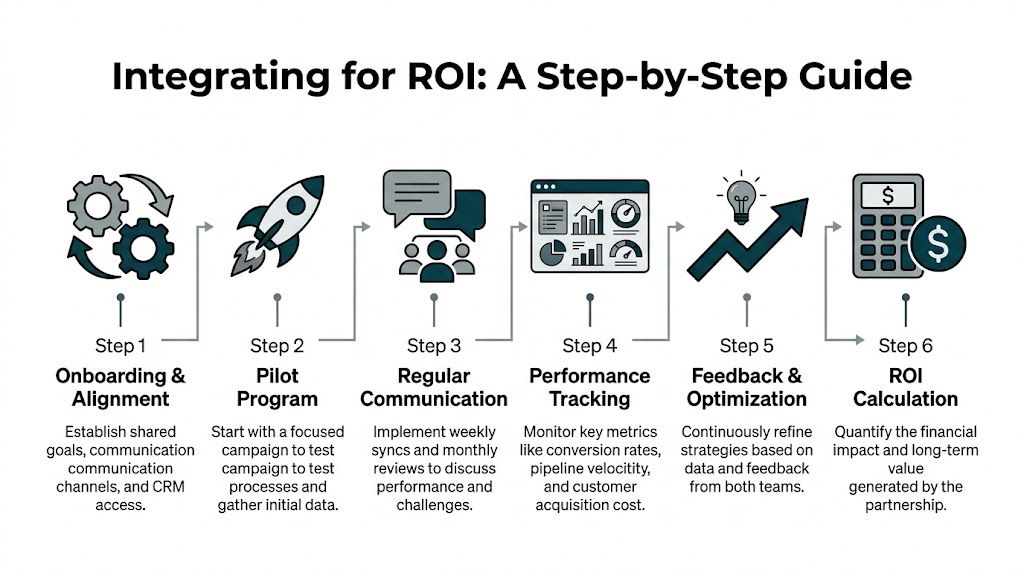
According to Konsyg’s discussion of sales outsourcing trade-offs, the operational and cultural costs of integrating external sales teams are significant, and success depends on smooth handoffs, shared data, and aligned messaging. That tracks with what occurs in reality. When integration is loose, everyone blames everyone else.
The onboarding work that can’t be skipped
You need a short, structured setup period that covers more than ICP slides.
At minimum, align on:
-
Positioning and exclusions so the provider knows not just who to target, but who to avoid
-
Qualification rules for what counts as a valid meeting
-
Routing logic based on territory, segment, or account ownership
-
CRM fields and notes standards so AEs get useful context before the call
-
Feedback loop cadence with weekly review calls and a clear owner on each side
If a provider wants to “just get started” without this groundwork, they’re pushing risk back onto you.
How a modern workflow should run
A good outsourced motion usually looks like a connected system, not a stack of disconnected tasks.
For example:
-
Target accounts are selected based on ICP and role criteria.
-
Contact data is enriched and verified before anything goes live.
-
Email infrastructure is prepared and sending is paced carefully.
-
Outreach sequences run across channels with logic for replies and intent signals.
-
Interested prospects are routed to human reps for qualification and booking.
-
Meeting context is written into the CRM before the AE takes over.
-
Weekly reviews identify bottlenecks such as strong opens but weak replies, or booked calls with poor hold rates.
That workflow is stronger when the provider has technical discipline behind it. The earlier source on outsourced sales operations highlights the value of CRM synchronization, enrichment tools such as Clay and Unify, and dashboards that expose where conversion is getting stuck. Those details matter because they determine whether the outsourced team produces usable pipeline or just top-of-funnel activity.
Measure ROI beyond meeting count
Meetings booked is the easiest number to report and one of the least useful if viewed alone.
Track a fuller set of metrics:
-
Meeting hold rate Booked calls that take place.
-
Meeting-to-SQL rate Whether booked conversations pass your sales acceptance standard.
-
Opportunity conversion from outsourced meetings Whether the channel creates real pipeline, not just calendar activity.
-
Sales cycle velocity How quickly qualified opportunities move after first meeting.
-
Cost per sales accepted lead A stronger operating metric than raw cost per meeting.
A provider should be accountable for what they influence directly, but you should still measure downstream outcomes. Otherwise you’ll optimize for calendars instead of revenue.
The first signs of a healthy program
You don’t need to wait for closed revenue to know whether integration is working.
Healthy programs show a few early signals:
-
AEs trust the notes and context before calls.
-
Rejection reasons are specific, not emotional.
-
Messaging improves because objections are logged consistently.
-
Internal debate shifts from “Are these meetings bad?” to “Which segment is converting better?”
That’s when an outsourced sales outsourcing service stops being an external vendor and starts acting like part of your revenue engine.
Is a Sales Outsourcing Service Your Next Growth Engine
A common founder scenario looks like this. Demo quality is fine. Close rates are acceptable. The calendar still has gaps because outbound execution is inconsistent, under-managed, or stalled behind other priorities. That is the point where a sales outsourcing service can help.
The decision should come down to operating fit, not enthusiasm for outsourcing as a category. If your ICP is still shifting, your offer changes every few weeks, or your sales team rejects meetings without clear reasons, fix that first. An external team can extend your process. It cannot stabilize one that does not exist.
The part many teams miss is contract design. A weak agreement hides risk inside vague terms like “qualified lead” or “sales-ready meeting.” A usable agreement defines required firmographic filters, contact seniority, disqualification rules, show-rate expectations, replacement terms, CRM handoff requirements, and how quickly your team must accept or reject meetings. Pay-per-meeting models can work well for B2B tech because they force both sides to write those details down before launch. That discipline matters as much as the pricing model.
If you want a practical gut check, review your current outbound process against broader fundamentals for how to generate sales leads. Gaps usually show up fast once you compare targeting logic, channel mix, follow-up discipline, and lead handling standards.
My advice is simple. Run a contained pilot before signing a long contract. Choose one segment, one offer, one qualification standard, and one review cadence. If the partner can produce accepted meetings with clean handoff data and consistent show rates under those conditions, you have something worth expanding. If they avoid precision in the contract or rely on activity reports instead of outcome definitions, walk away.
If you want a sales outsourcing setup where cost is tied to booked, qualified meetings instead of upfront retainers, take a look at Fypion Marketing. They focus on B2B cold email outreach and use a pay-per-meeting model with pre-agreed qualification criteria, which is one practical option for SaaS and tech teams that want tighter risk control.