
Your Product Market Fit Validation Playbook for 2026

You’re probably in one of two situations right now. Your product has a handful of customers and encouraging feedback, but you can’t tell whether you’ve found real demand or just a few generous early adopters. Or you’re under pressure to scale pipeline, hire sales, and increase spend before the evidence is strong enough to support that move.
That’s where most B2B teams get product market fit validation wrong. They treat it like a vibe check. A few logos sign up, a prospect says the demo looked great, someone on the team says, “We’re getting traction,” and suddenly the company starts acting as if the market has already spoken.
It hasn’t.
In B2B SaaS, product market fit validation is a process of linking three things in sequence. First, what a specific buyer says in discovery. Second, what a real user does over time. Third, whether the account pays, stays, and expands without constant rescue from sales or customer success. If those three signals line up, you have something you can scale. If they don’t, more budget usually makes the problem worse.
Laying the Groundwork with a Testable Hypothesis
Teams often don’t start with a hypothesis. They start with an idea. That sounds harmless, but it creates bad validation work. An idea is broad enough to absorb almost any feedback. A hypothesis can be wrong, and that’s exactly what makes it useful.
A weak statement sounds like this: “Our CRM helps sales teams.” It’s too vague to test. Which sales teams? What problem? What specific outcome matters enough for them to change behavior, budget, and process?
A usable B2B hypothesis has three parts. A clear ideal customer profile, a defined painful problem, and a specific value proposition that should outperform the status quo.

Build around one buyer and one pain
Don’t start with “mid-market companies” or “SaaS teams.” That’s not an ICP. Start narrower. A stronger hypothesis names the account type, the user, and the buying context.
For example:
-
ICP: Remote B2B sales teams at SaaS companies with multi-step outbound workflows
-
Problem: Reps lose too much time updating fields, notes, and follow-up tasks manually
-
Value proposition: A workflow assistant that reduces admin burden and keeps CRM hygiene intact without forcing reps to change tools
That gives you something to test in interviews, messaging, onboarding, and pilots. It also tells you what kind of evidence matters. If your claim is about reducing manual work, then generic praise about your UI doesn’t validate the core promise.
One useful way to sharpen this thinking is to review how lightweight user interviews uncover buying friction. If you need a practical refresher, what is user research for indie hackers is a solid primer, even for B2B founders who are overcomplicating discovery.
Define the hypothesis so it can fail
A good PMF hypothesis should make your team slightly uncomfortable because it can be disproven quickly.
Use this format:
-
Who exactly is the buyer and user
-
What high-friction job are they trying to get done
-
Why your product should win against spreadsheets, internal process, or the incumbent tool
Here’s the standard I use with SaaS teams:
If the statement can survive almost any customer reaction, it isn’t a hypothesis. It’s positioning copy.
This is also where buyer persona work matters. Personas are often written after launch as a content exercise. That’s backwards. Personas are useful before validation because they force specificity in role, motive, friction, and buying trigger. A practical guide to creating buyer personas for better outreach can help tighten that part of the process.
Move in the right evidence order
The cleanest workflow starts with interviews, then moves to behavior, then economics. That sequence matters because you need to understand the job-to-be-done before you interpret usage patterns. Practical PMF guidance recommends moving from qualitative insight to behavioral evidence and then economic proof, with signs of strong fit including a flattening retention curve, a Sean Ellis score of 40%+ saying users would be “very disappointed,” and organic growth above 15% month-over-month for at least 3 months (practical PMF guidance).
That doesn’t mean you need every signal at once. It means your validation work should follow a logic chain. First prove you’re solving a sharp problem for a narrow segment. Then prove those users keep coming back. Then prove they’ll pay enough, long enough, for the business to scale.
Choosing Your Core Product-Market Fit Metrics
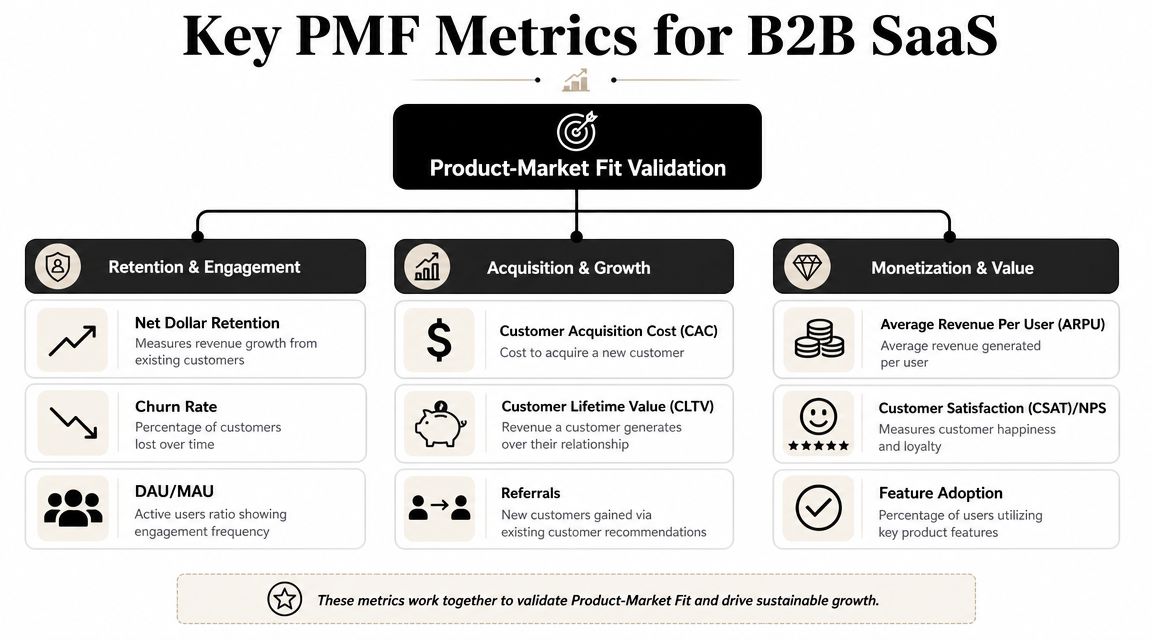
Once the hypothesis is clear, the next mistake is tracking too many metrics. Dashboards get crowded fast. PMF work gets cleaner when you separate signals into three buckets: what users say, what users do, and what users pay for.
Most early B2B teams overweight the first bucket because it’s easy to collect. They underweight the second because retention takes time, and they avoid the third because pricing conversations feel messy. Real product market fit validation needs all three.
What users say
The best known survey metric here is the Sean Ellis test. If at least 40% of surveyed users say they’d be “very disappointed” if your product disappeared, the product is often considered to have strong PMF. It’s a widely used benchmark, but it should be paired with retention instead of used alone. The same PMF benchmark set also points to monthly churn below 5% to 7% for SaaS and NPS above 50 as signs of unusually strong loyalty (Sean Ellis and loyalty benchmarks).
That gives you three useful “say” metrics:
-
Must-have sentiment: The Sean Ellis question tells you whether your product feels essential.
-
Advocacy: NPS helps you see whether satisfaction is strong enough to create referrals.
-
Problem intensity: Interview language tells you whether buyers describe the issue in operational terms or just nod politely.
A prospect saying “that’s interesting” is not validation. A buyer saying “we’ve tried to fix this three times already” is.
What users do
Behavior carries more weight than enthusiasm. In B2B SaaS, the strongest evidence usually shows up in activation patterns and retention.
Watch for:
-
Activation: Do new accounts reach the core value moment without heavy manual support?
-
Repeat usage: Are users returning because the workflow matters, not because your team keeps nudging them?
-
Cohort retention: Do later cohorts hold on to value, or do they decay after the first burst of curiosity?
Sign-ups and demo requests matter less than teams think. Those are front-end indicators. PMF lives in repeated behavior after onboarding.
If you’re aligning these metrics with revenue models, it helps to be precise about what recurring revenue means operationally. This overview of what is recurring revenue is useful for founders who still mix booked deals, contracted value, and retained revenue into one fuzzy number.
What users pay for
The final bucket is economic validation. You don’t need a perfect finance model to know whether the market is pulling your product. You do need honest answers to a few questions.
| Metric category | What it tells you | PMF use |
|---|---|---|
| Willingness to pay | Whether the problem is expensive enough to solve | Filters out nice-to-have products |
| Retention of paid accounts | Whether value survives after procurement and onboarding | Separates trials from durable demand |
| Expansion or organic pull | Whether the account sees enough value to deepen usage | Signals readiness for scale |
A useful rule in B2B is simple. If users love the demo but stall when pricing enters the conversation, you may have product interest without product market fit.
And if you’re building a KPI stack around this phase, keep lead metrics in context. Pipeline metrics help, but they don’t replace PMF signals. A practical list of lead generation KPIs for 2026 is useful once acquisition starts to matter more. It shouldn’t be your main compass before fit is proven.
Designing Effective Validation Experiments
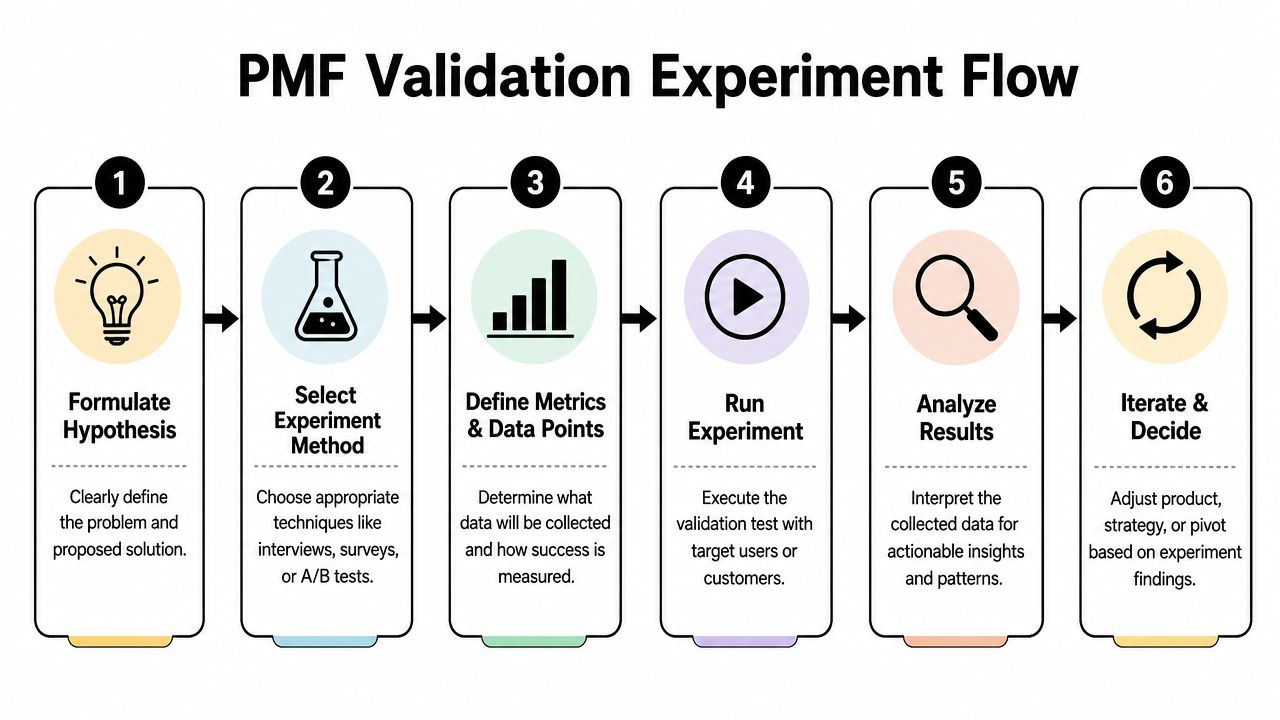
Most PMF work fails because the experiments are too loose. Teams talk to random prospects, ask vague questions, and treat any positive reaction as a green light. Good validation experiments are narrow, repeatable, and tied to one decision.
A structured approach matters in B2B because the signal comes slower. One research-backed industry source reports that startups using structured validation systems reach PMF 35% faster, and that B2B startups typically need about 14 months because of longer sales cycles and more complex buying committees. The same guidance notes that teams often wait for roughly 200 to 500 contacts per segment before trusting the signal, then look for retention curves that flatten into a stable plateau (structured validation and B2B timelines).
Structured customer interviews
This is the first experiment I’d run for a B2B SaaS product. The goal isn’t to hear feature requests. It’s to confirm that the problem is painful, current, and expensive enough to justify change.
Target people who already experience the workflow you want to improve. Avoid broad “market feedback” calls with advisors, friends, or loosely related operators.
Use questions like these:
-
Current workflow: “How do you handle this process today?”
-
Pain intensity: “Where does it break down most often?”
-
Cost of inaction: “What happens when this doesn’t get done well?”
-
Failed alternatives: “What have you already tried?”
-
Buying trigger: “What would need to happen for this to become a priority now?”
“Walk me through the last time this problem happened.”“What did it cost in time, delay, risk, or missed revenue?”“Who else cares about fixing it?”“If you solved this next quarter, what would improve internally?”“Why hasn’t the current workaround been good enough?”
Success signal: the buyer describes the pain without your prompting, names a failed workaround, and can explain why solving it matters now.
High-intent smoke tests
The second experiment tests message-to-market resonance before heavy product work. Build a simple landing page or outreach angle around one hypothesis and drive qualified traffic or outbound interest to it.
What you’re testing is not vanity traffic. You’re testing whether a specific segment responds to a specific promise.
Good smoke test variables include:
-
Job title
-
Company size
-
Industry
-
Problem framing
-
Primary outcome
If you’re designing the top of this funnel, a practical reference on the B2B lead generation funnel can help you separate curiosity from genuine buying intent.
Success signal: prospects reply with context, ask follow-up questions, or request next steps because the problem framing matches something urgent on their side.
Paid pilot programs
Pilots are where many B2B teams finally get honest. Free pilots generate courtesy engagement. Paid pilots force the buyer to evaluate budget, internal ownership, and expected outcome.
A strong pilot needs:
-
A narrow use case: Don’t test the whole platform
-
A defined success event: Know what outcome matters to the account
-
A fixed timeframe: Long pilots lose urgency
-
A real stakeholder: Someone who owns the pain, not just a friendly champion
Success signal: the customer commits resources, brings in other stakeholders, and works through internal friction because the outcome matters.
Later in the process, if a company has already proven PMF and needs systematic outbound testing across segments, firms such as Fypion Marketing can support qualified-meeting generation through cold email. That’s useful after validation is clear, not as a substitute for it.
A useful perspective on experiment cadence:
Segment comparison tests
One of the fastest ways to waste time is averaging all feedback together. Compare segments directly instead.
Run the same offer or interview structure across multiple ICP slices and look for differences in urgency, response quality, and conversion into pilots or trials. In B2B, one narrow wedge often lights up before the broader market does.
Success signal: one segment consistently moves faster, asks sharper questions, and shows less need for explanation.
Analyzing Cohorts and Interpreting the Signals
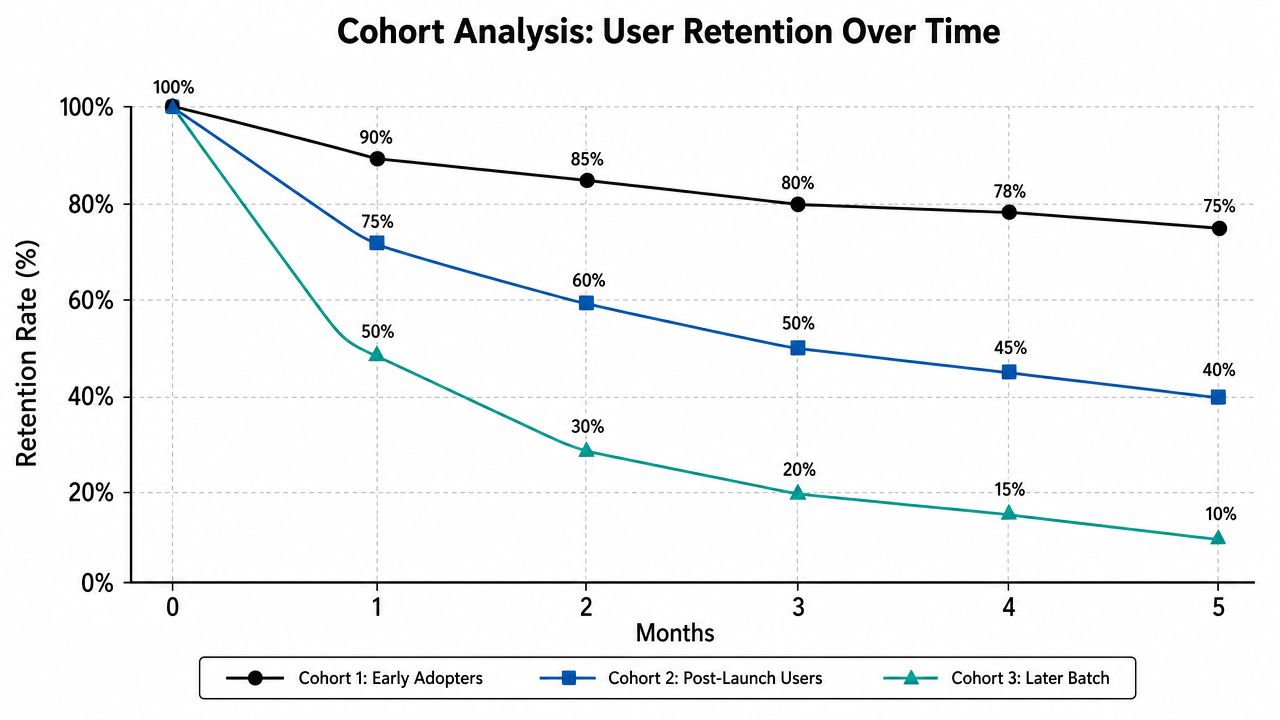
The most revealing artifact in product market fit validation is the cohort retention chart. It strips away launch excitement and tells you whether the product keeps delivering value after the first interaction.
You can think of most cohort curves in three patterns. A cliff, a plateau, or, less commonly, a smile. Each one tells a different story about usage quality and market readiness.
Read the shape before the volume
A cliff means users drop quickly and keep dropping. That usually points to one of three issues: weak onboarding, a shallow problem, or the wrong customer segment. Teams often try to solve this with more acquisition. That rarely works.
A plateau is what you want. It shows that after the natural drop-off, a meaningful group keeps using the product. That’s the footprint of durable value.
A smile curve is unusual but interesting. It suggests users may come back after an interval because the workflow is periodic, collaborative, or tied to a later-stage event. In B2B, that can happen with tools tied to reviews, audits, hiring cycles, or planning processes. It’s not automatically good or bad. You need to understand the use case.
Don’t ask whether retention is perfect. Ask whether it stabilizes for the right users.
Segment before you conclude
Average retention can hide your best market. One segment may retain well while the rest churn out. That doesn’t mean the product has broad PMF yet, but it often means you’ve found the wedge you should double down on.
Segment the cohorts by variables like:
-
Role: End user, manager, admin, executive sponsor
-
Company size: Small teams versus more complex organizations
-
Industry: Where the workflow pain is most acute
-
Acquisition path: Founder-led sales, outbound, partner referral, inbound demo
-
Use case: The specific job the customer adopted the product for
If one cohort plateaus while another falls off a cliff, don’t average them into a comforting story. Pick the stronger wedge and sharpen the product and messaging around it. A useful framework for that kind of narrowing is B2B customer segmentation as a growth blueprint.
Watch for the false positive
Early traction can mislead teams. A PMF timeline guide warns that premature scaling is a common mistake, because founders interpret initial traction as proof and expand too early. The same framework recommends testing 3 to 5 campaigns in parallel across job titles, company sizes, or industries, then waiting for 200 to 500 contacts per segment before deciding. The strongest market wedge is the one where prospects keep replying, booking calls, and asking to start (parallel campaign testing and premature scaling risk).
That advice lines up with what shows up in cohort analysis. The wrong response is often, “We got some traction, so the market is broad.” The right response is, “This specific group stays. Everyone else leaves. That’s our next focus.”
Making the Go or No-Go Decision
At some point, the team has to stop discussing PMF in abstract terms and make a decision. Scale. Keep validating. Or change direction.
That decision gets easier when you force the evidence into one view instead of arguing metric by metric. I prefer a simple matrix that combines qualitative, behavioral, and economic signals. No single metric should carry the whole verdict.
Product-Market Fit Decision Framework
| Signal Strength | Key Indicators | Recommended Action |
|---|---|---|
| Strong fit | Buyers describe the problem clearly and unprompted, users show durable retention, paid accounts continue using the product, referrals or organic pull appear, and survey sentiment supports must-have status | Scale deliberately. Add acquisition channels, formalize sales process, and invest in repeatable pipeline creation |
| Emerging fit | One segment responds strongly, some cohorts retain better than others, pilots convert but with friction, and qualitative feedback is consistent but not yet broad | Stay focused on the winning segment. Tighten onboarding, refine positioning, and run another validation cycle before major expansion |
| No fit | Feedback is polite but vague, retention drops without stabilizing, pricing stalls deals, and usage depends on heavy intervention from the team | Do not scale. Rework the ICP, problem definition, or core product promise before increasing spend |
What strong fit actually looks like
Strong PMF is not “customers like us.” It’s a combination of signals that reinforce each other. The buyer’s language matches your positioning. The user reaches value without needing constant rescue. The account keeps using the product after implementation friction fades. Commercial conversations feel like prioritization discussions, not persuasion battles.
That’s when scale starts making sense.
What weak fit usually looks like
Emerging PMF is the awkward middle. One vertical may love the product. Another may churn. A champion may push internally, but the broader buying group still hesitates. You can build a business from this stage, but only if you narrow aggressively.
Discipline matters most here. Teams often react to mixed signals by broadening the market. That tends to blur the one segment that was functioning.
If only one buyer type retains, that’s not a weakness. It’s direction.
What no fit looks like in practice
No PMF doesn’t always feel dramatic. Sometimes it looks like endless demos, warm feedback, custom requests, and no clean pattern of sustained use. The product gets compliments. It doesn’t get pulled into the customer’s operating rhythm.
That’s a no-go.
The right move is to revisit the hypothesis, not to demand more leads from marketing or more effort from sales.
Your Next Steps After Validation
Validation isn’t the finish line. It’s the point where your next move becomes obvious.
If the signal is strong, your job changes. You stop proving demand and start building a repeatable acquisition engine around a market that already wants what you sell. That means clearer positioning, tighter sales qualification, better segmentation, stronger outbound, and content or paid channels that amplify a message the market has already validated. If you’re preparing that transition, a practical launch planning resource like prepare for your product launch can help pressure-test operational readiness.
If the signal is emerging or weak, don’t call it scale. Call it iteration. Go back to the highest-intent accounts. Study where activation stalls, where stakeholders lose confidence, and where the value story gets muddy. Then run smaller, cleaner tests around the segment that showed the strongest pull.
For B2B startups, the difference between those two paths matters a lot. Scaling acquisition before fit is clear creates noisy pipelines, confused messaging, and churn that sales can’t fix. Scaling after fit is clearer because the market already gives you the language, the segment, and the offer to repeat.
That’s why product market fit validation matters so much. It doesn’t exist to produce a nice dashboard. It exists to answer one hard question with enough evidence to act on it: should this company pour fuel on growth, or keep refining the engine?
Once that answer is clear, the next phase gets much simpler. If you need support building demand after validation, this guide to lead generation for startups is a practical place to start.
If your SaaS company has clear product market fit and needs a repeatable way to turn that into qualified pipeline, Fypion Marketing offers B2B lead generation through a pay-per-qualified-meeting model. That setup can fit teams that want to scale outbound without taking on fixed retainers before meetings are booked.