
Top Tips: account based marketing best practices for B2B Growth
In a crowded B2B marketplace, generic marketing no longer cuts it. Today’s buyers are well-researched, immune to mass messaging, and expect a personalized experience. Trying to be everything to everyone results in being nothing to anyone, wasting resources and failing to capture high-value deals. This is where a focused strategy becomes essential for growth.
Account-Based Marketing (ABM) flips the traditional marketing funnel on its head. Instead of casting a wide, impersonal net hoping to catch leads, ABM identifies and targets a select group of high-potential accounts, treating each one as a unique market. It’s a concentrated effort that aligns your sales and marketing teams to deliver coordinated, relevant experiences that resonate with key decision-makers. The result is a more efficient go-to-market motion, higher-quality pipeline, and stronger customer relationships.
This guide moves beyond the basics to deliver a definitive roundup of the 10 account based marketing best practices that drive real results. You will learn how to:
-
Build and score a precise Target Account List (TAL).
-
Align sales and marketing teams with actionable playbooks.
-
Orchestrate multi-channel campaigns that engage entire buying committees.
-
Measure success with the right KPIs and attribution models.
We’re skipping the theory and providing a blueprint packed with actionable steps, practical examples, and proven templates. Whether you are building an ABM program from scratch or refining an existing one, these principles will equip you to close bigger deals, faster.
1. Define and Segment Your Target Account List (TAL)
The foundation of any successful Account Based Marketing (ABM) strategy is a meticulously curated Target Account List (TAL). Instead of casting a wide, inefficient net, this practice concentrates your resources on a specific set of high-value companies that perfectly match your Ideal Customer Profile (ICP). This focused approach ensures that every marketing dollar and sales hour is spent pursuing accounts with the highest probability of closing and generating significant revenue.
Building your TAL involves a deep analysis of firmographic data (like company size, industry, and revenue), technographic data (what technologies they currently use), and critical behavioral signals. For instance, Demandbase uses its own AI-powered platform to identify and prioritize accounts exhibiting strong buying intent, allowing its teams to engage prospects at the perfect moment.
How to Build a High-Impact TAL
-
Model Your Best Customers: Analyze the shared attributes of your most successful existing clients. Use this data as a blueprint to define your ICP and identify similar companies in the market. This reverse-engineering approach is a core principle of effective B2B customer segmentation. For a deeper dive, explore this complete guide to B2B customer segmentation.
-
Incorporate Intent Data: Use platforms like Bombora or 6sense to spot accounts actively researching solutions like yours. These “in-market” signals are powerful indicators of an immediate need, making these accounts prime targets.
-
Tier Your Accounts: Not all target accounts are equal. Segment your TAL into tiers (e.g., Tier 1, 2, 3) based on revenue potential, strategic value, and fit. This allows you to allocate resources proportionally, giving Tier 1 accounts a highly personalized, one-to-one treatment while applying a one-to-few or one-to-many approach for lower tiers.
-
Keep it Dynamic: A TAL is not a “set it and forget it” document. Market conditions change, and company priorities shift. Revisit and update your list quarterly to remove poor-fit accounts and add new, promising ones, keeping your ABM efforts sharp and relevant.
2. Personalize Messaging and Content at the Account Level
Once your Target Account List is defined, the next critical step in account based marketing best practices is to move beyond generic communication. ABM’s power lies in its ability to deliver messaging that resonates deeply with each target account’s unique context, challenges, and goals. This means replacing broad, templated outreach with content and copy meticulously crafted for a specific company, demonstrating genuine research and a clear understanding of their business needs.

This level of detail dramatically improves engagement. Instead of being perceived as spam, your message arrives as a relevant, timely solution. For example, Salesforce is known for its enterprise ABM campaigns that directly reference an account’s specific pain points and business context, making their value proposition immediately apparent. Similarly, data from LinkedIn shows that practitioners using its message personalization features saw a 40% increase in response rates, proving the direct impact of this approach.
How to Implement Account-Level Personalization
-
Conduct Account Intelligence: Before any outreach, research the account’s recent news, quarterly earnings reports, new product launches, or leadership changes. Tools like Owler or even simple Google Alerts can provide a steady stream of valuable triggers.
-
Reference Specific Pain Points: Analyze their industry, competitors, and public statements to identify likely business challenges. Frame your solution not as a list of features, but as a direct answer to a problem they are actively trying to solve. For a deeper look, you can master cold email personalization to boost responses.
-
Tailor the Value Proposition: Connect your product’s benefits directly to the target account’s strategic objectives. If a company announces a goal to improve operational efficiency, explain exactly how your solution helps achieve that specific outcome.
-
Scale with Smart Technology: Use ABM platforms like those from HubSpot, Outreach, or Salesloft to manage personalization at scale. These tools use dynamic content tokens to insert company names, job titles, and custom fields, but the real value comes from using custom snippets based on your research for deeper personalization.
3. Align Sales and Marketing Teams Around Account Targets
Account Based Marketing cannot succeed when sales and marketing operate in separate silos. This best practice centers on dismantling those walls and forging a single, unified revenue team. True alignment means both departments agree on which accounts to target, share the same goals for engaging them, and execute a coordinated strategy to turn them into customers. Without this partnership, ABM efforts become disjointed, messaging is inconsistent, and valuable opportunities are lost.
When sales and marketing work in lockstep, the entire buyer’s journey feels seamless. Marketing warms up an account with targeted ads and content, and sales follows up with a relevant, timely conversation, creating a powerful one-two punch. A cornerstone of successful ABM is achieving tight sales and marketing alignment around shared account targets, ensuring a unified approach throughout the customer journey. This synergy is proven to accelerate deals, as companies using Marketo have seen up to 40% faster sales cycles.
How to Create a Unified Revenue Team
-
Establish a Shared “Source of Truth”: Both teams must operate from the same data set. Use a centralized CRM like Salesforce that is accessible to everyone, providing a complete, 360-degree view of all account activity, from marketing engagement to sales conversations. This eliminates data silos and conflicting information.
-
Develop a Joint Service Level Agreement (SLA): Create a formal document outlining the specific responsibilities of each team. Define what constitutes a “marketing-qualified account” (MQA), detail the criteria for handoffs, and set clear expectations for the speed and quality of sales follow-up.
-
Implement Shared KPIs and Dashboards: Move beyond department-specific metrics. Build shared dashboards that track account progression, engagement scores, pipeline velocity, and win rates for the Target Account List. When both teams are measured by the same outcomes, their goals naturally converge.
-
Schedule Regular Alignment Meetings: Institute a recurring “ABM Sync” meeting with key stakeholders from sales, marketing, and leadership. Use this time to review account progress, share insights from the field, and collaboratively adjust tactics for underperforming accounts. This creates a crucial feedback loop.
4. Implement Multi-Channel, Multi-Touch Campaign Orchestration
Relying on a single channel like email is a common misstep in modern B2B outreach. The best account based marketing practices involve orchestrating coordinated campaigns across multiple channels to create a unified and persistent brand presence. This multi-touch approach surrounds decision-makers at target accounts with consistent messaging across email, LinkedIn, digital ads, phone calls, and even direct mail, meeting them wherever they are most active.
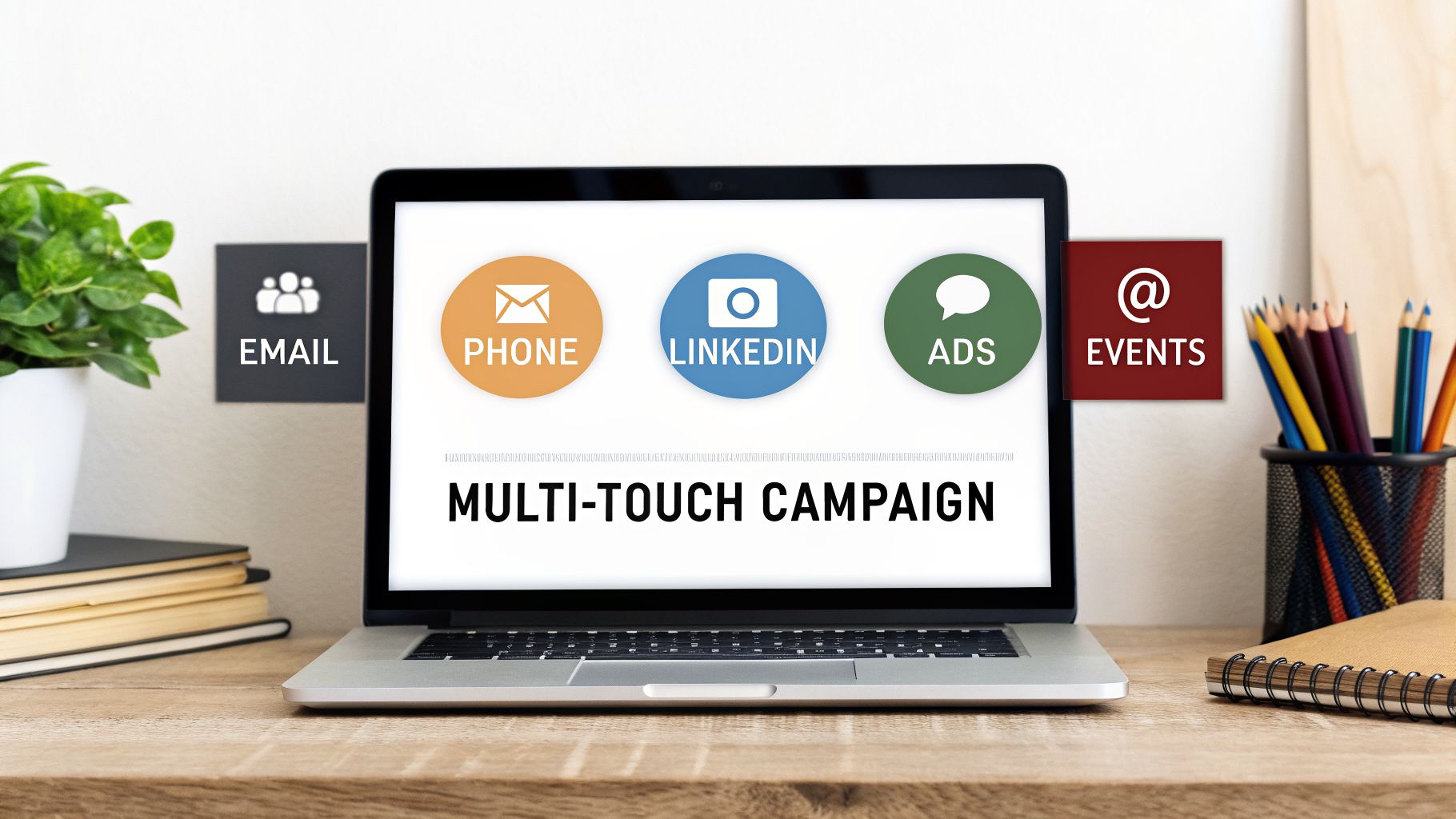
Effective orchestration ensures proper sequencing and frequency, preventing prospect fatigue while maintaining top-of-mind awareness. For example, Demandbase coordinates campaigns across email, LinkedIn ads, web personalization, and direct mail to create an immersive experience. Similarly, Salesforce synchronizes its email, LinkedIn, and targeted digital ad campaigns to engage key accounts from multiple angles. This integrated strategy significantly increases the probability of engagement and response.
How to Orchestrate Your ABM Campaigns
-
Start Small, Then Scale: Begin with 2-3 primary channels you can manage effectively, such as email and LinkedIn. Prove their combined effectiveness and establish a workflow before adding more complex channels like programmatic ads or direct mail.
-
Sequence Your Touchpoints: Space out interactions with 3-5 day intervals to stay on the radar without overwhelming your prospects. A well-timed sequence feels helpful, not intrusive. To effectively implement this, consider adopting a modern multi-channel content strategy to align your assets with your outreach cadence.
-
Be Multi-Threaded: Coordinate outreach between different team members. For instance, have an SDR send an email on day one, followed by a marketing manager sending a LinkedIn connection request on day four. This makes your company appear more engaged and human.
-
Maintain Message Consistency: Your value proposition must be clear and consistent across every channel. Whether a prospect sees a display ad, reads an email, or gets a phone call, the core message should be instantly recognizable.
-
Track Channel Performance: Analyze which channel combinations drive the highest engagement and conversion rates for your target accounts. Use this data to optimize your sequences and reallocate your budget to the most impactful activities. For more on this, discover how to boost results with cold outreach automation to streamline tracking.
5. Leverage Intent Data and Behavioral Signals
Executing an ABM strategy without intent data is like trying to navigate a city without a map. Intent data provides the “where” and “when” for your outreach, revealing which target accounts are actively researching solutions like yours and entering a buying window. This practice is a cornerstone of modern account based marketing best practices because it shifts your focus from cold, disruptive outreach to timely, relevant engagement.
By monitoring signals like keyword searches, content consumption across the web, and competitor comparisons, you can pinpoint accounts showing purchase intent. Platforms like 6sense are known for their ability to not only identify this activity but also predict when an account is most likely to buy. This data-driven approach ensures your sales and marketing teams engage prospects at the moment of highest interest, significantly increasing the probability of a positive response.
How to Activate Intent Data in Your ABM Strategy
-
Combine First-Party and Third-Party Data: Blend your own first-party data (website visits, email clicks, content downloads) with third-party intent data from providers like Bombora or Terminus. This creates a complete picture of an account’s interest, capturing both on-site engagement and off-site research activities.
-
Set Up Real-Time Alerts: Configure your ABM platform to send instant notifications to your sales team when a high-value target account exhibits a spike in intent. This “fastball” alert enables immediate and contextually relevant outreach, striking while the iron is hot.
-
Prioritize and Time Outreach: Use intent signals to sequence your outreach. Instead of contacting all accounts in a tier simultaneously, focus your initial efforts on those actively demonstrating buying behavior. This prioritizes resources for the most promising opportunities.
-
Inform Sales Conversations: Share specific intent insights with your sales development representatives (SDRs). Knowing that an account has been researching a specific competitor or feature allows your team to tailor their discovery questions and position your solution more effectively from the very first call.
6. Build Detailed Buying Committee Profiles and Map Decision-Makers
Enterprise deals are rarely closed by influencing a single person. True account based marketing best practices demand that you identify and engage the entire buying committee, a group of stakeholders who collectively guide the purchasing decision. Mapping this group ensures your message reaches everyone from the economic buyer who signs the check to the end-users who will adopt your solution, preventing crucial influencers from being overlooked.
Understanding each stakeholder’s unique motivations, pain points, and level of influence is critical. For example, a CFO (economic buyer) cares about ROI and total cost of ownership, while an IT Director (technical evaluator) is focused on integration, security, and implementation. Research from Salesforce shows that deals involving five or more engaged stakeholders close up to 50% faster, highlighting the direct revenue impact of comprehensive committee engagement.
How to Map Your Buying Committee
-
Identify Key Roles: Use tools like LinkedIn Sales Navigator and Apollo.io to pinpoint individuals in relevant roles. Interview your sales team to understand who typically holds sway in deals. Common roles include the Champion, Economic Buyer, Technical Buyer, and User Buyer.
-
Create Role-Specific Messaging: Develop value propositions tailored to each persona’s specific concerns. Your messaging for a VP of Sales should focus on revenue growth and team productivity, while your outreach to a Head of Operations should address efficiency and cost savings. If you need help structuring these profiles, our guide on how to create buyer personas provides a solid foundation.
-
Track Engagement by Persona: Use your CRM, like HubSpot or Salesforce, to monitor how each stakeholder interacts with your content and outreach. If you see high engagement from technical buyers but none from economic buyers, you’ve identified a bottleneck to address.
-
Coordinate Outreach Efforts: Assign different members of your sales and marketing team to build relationships with specific stakeholders. This prevents disorganized, overlapping communication and presents a united front, showing the target account that you are organized and professional.
7. Establish Clear Account-Based Metrics and Attribution Models
One of the most critical account based marketing best practices is shifting your measurement focus from individual leads to entire accounts. Traditional marketing often gets stuck on vanity metrics like cost-per-lead, which fails to capture the collective buying journey of a target account. An effective ABM strategy requires a new set of KPIs that measure account engagement, pipeline velocity, and direct revenue impact, providing a clear picture of your program’s true ROI.
This means tracking how marketing activities influence deal progression at the account level. For instance, HubSpot’s account-based reporting tools allow users to see exactly which marketing touchpoints contribute to revenue from specific target companies. This clarity is essential for optimizing campaigns and proving the value of ABM to company leadership. Without the right metrics, you are essentially flying blind, unable to distinguish effective tactics from wasted effort.
How to Implement Account-Based Measurement
-
Define Your Primary Success Metric: Before launching, decide on the ultimate goal. Is it total revenue from your TAL? The number of new enterprise logos acquired? Or pipeline created within target accounts? This North Star metric will guide your entire strategy and reporting framework.
-
Implement Multi-Touch Attribution: A single touchpoint rarely closes a complex B2B deal. Use a multi-touch attribution model (like a W-shaped or full-path model) to assign credit appropriately across the various marketing and sales interactions that guide an account from awareness to purchase.
-
Track Both Account and Portfolio Health: Monitor engagement metrics for individual accounts (e.g., website visits from key personas, content downloads) and also track aggregate metrics for your entire TAL portfolio. This dual view helps you spot both account-specific opportunities and broader campaign trends. For more insight on what to measure, review this guide to essential lead generation KPIs that apply to ABM.
-
Create Shared Dashboards: Build and maintain dashboards with platforms like HubSpot or Databox that are accessible to both sales and marketing. This transparency fosters alignment and ensures both teams are working from the same data to accelerate deals and measure success.
8. Develop High-Quality, Account-Specific Content and Resources
Generic, one-size-fits-all content has no place in a high-performing Account Based Marketing (ABM) strategy. This best practice centers on creating and deploying assets that speak directly to the specific challenges, industry context, and stakeholder roles within your target accounts. Instead of hoping a broad message resonates, you build credibility and demonstrate deep expertise by addressing their exact pain points with precision.
This targeted approach ensures your content acts as a valuable tool for the buying committee, not just another piece of marketing collateral. When a prospect from a target account receives a case study about their direct competitor or an ROI calculator pre-populated with their industry’s benchmarks, it immediately shows you’ve done your homework. For instance, Salesforce excels at this by creating dedicated industry solution pages and vertical-specific case studies, proving their platform’s value within a prospect’s unique operational environment.
How to Create Account-Specific Content
-
Start with Sales Intelligence: Your sales team is a goldmine of information. Interview them to identify the most common questions, objections, and business challenges they hear from prospects. Use this intel to build a content backlog that directly addresses these real-world concerns.
-
Tailor Existing Assets: You don’t always need to start from scratch. Take a general whitepaper and add an account-specific introduction, or insert a slide into a presentation deck that features the target company’s logo and relevant data points. This light personalization can have a significant impact.
-
Develop Role-Specific Angles: An executive summary for a CEO should focus on ROI and strategic advantage, while a technical guide for an IT Director should dive into implementation and security specs. Adapt the depth and focus of your content for each member of the buying committee.
-
Create Comparison Guides: Your prospects are evaluating you against competitors. Create fair, detailed comparison guides that transparently highlight your unique differentiators. This positions you as a helpful advisor and helps you control the competitive narrative. Marketo effectively uses this by producing guides that compare its features against other marketing automation platforms.
9. Implement Continuous Testing, Optimization, and Iteration
Account Based Marketing is not a “set it and forget it” initiative; its power is unlocked through a persistent cycle of testing and refinement. This best practice involves methodically analyzing every component of your ABM campaigns, from messaging and channel mix to creative assets and targeting criteria. By adopting a culture of continuous improvement, you ensure your strategy evolves, becomes more efficient, and consistently delivers better results over time.
This data-driven approach allows you to systematically improve engagement, response rates, and ultimately, deal quality. Salesloft, for instance, found that rigorously testing different outreach cadences improved its response rates by a remarkable 50%. This demonstrates how small, measured adjustments can produce significant gains, transforming good campaigns into great ones. The core principle is to stop guessing what works and start knowing.
How to Foster a Culture of Optimization
-
Test One Variable at a Time: To get clean, reliable data, isolate a single element for each test, such as a subject line, a call-to-action, or an ad creative. This allows you to accurately attribute performance changes to your specific adjustment.
-
Establish a Testing Cadence: Create a recurring schedule, perhaps weekly or bi-weekly, dedicated to analyzing performance data and planning the next round of tests. This rhythm makes optimization a standard part of your operational workflow.
-
Document and Share Learnings: Maintain a centralized repository to log all tests, results, and key takeaways. Sharing these findings with both sales and marketing teams creates a shared pool of knowledge and prevents repeating past mistakes.
-
Focus on Statistical Significance: Don’t declare a winner too early. Use a statistical significance calculator to ensure your results are reliable and not just a product of random chance before making a strategic change based on test outcomes. This rigor is a hallmark of professional account based marketing best practices.
10. Build Sustainable Infrastructure and Processes for Scale
Early ABM wins often stem from intense, manual efforts by a dedicated team. However, this “brute force” approach is not sustainable for growth. To scale your Account Based Marketing strategy effectively, you must move from heroic, one-off campaigns to systematized, repeatable processes supported by a solid technology infrastructure. This practice involves documenting workflows for everything from account research and content creation to outreach execution and reporting, ensuring efficiency and consistency as your program expands.
Building this foundation allows your ABM program to grow without being bottlenecked by constant manual intervention. For example, platforms like HubSpot and Salesforce provide integrated ecosystems for managing account data, automating marketing actions, and analyzing performance. Similarly, specialized agencies like Fypion Marketing offer end-to-end ABM infrastructure as a service, handling everything from list building to campaign management, which removes the operational burden from client teams and is one of the key account based marketing best practices for achieving scale.
How to Systematize Your ABM Program
-
Start with Core Tools and Processes: Begin with essential technology: a CRM (like Salesforce), a marketing automation platform (like HubSpot or Marketo), and an intent data provider. Focus first on documenting the most critical processes, such as account scoring and handoffs between marketing and sales.
-
Prioritize Data Quality from Day One: Poor data is the silent killer of scaled ABM. Invest in data cleansing and enrichment tools from the beginning to ensure your account and contact information is accurate. This prevents compounding errors that can derail campaigns down the line.
-
Document Everything Accessibly: Create a central repository for all ABM processes, playbooks, and training materials. Use a company wiki, shared drive, or tools like Notion to make this information easily accessible for new hires and existing team members.
-
Automate Repetitive Tasks Gradually: Identify high-volume, low-complexity tasks that can be automated. Start with simple workflows, like lead routing or a basic email nurture sequence for lower-tier accounts, and build more complex automation as your team gains confidence and experience.
-
Establish Clear Governance: Define clear rules and ownership for managing account data, campaign execution, and reporting. This governance ensures everyone follows the same procedures, maintaining data integrity and program consistency as more people get involved.
10-Point ABM Best Practices Comparison
| Item | 🔄 Implementation Complexity | ⚡ Resource Requirements | ⭐ Effectiveness / Quality | 📊 Expected Outcomes / Impact | 💡 Ideal Use Cases / Tips |
|---|---|---|---|---|---|
| Define and Segment Your Target Account List (TAL) | Medium - High - data analysis and ongoing maintenance | Moderate - High - firmographic/technographic data and tools | ⭐⭐⭐⭐ | More qualified pipeline, higher conversion rates, shorter cycles | Foundation for ABM; use customer data for ICP and refresh quarterly |
| Personalize Messaging and Content at the Account Level | High - intensive research and copy adaptation | High - skilled writers and account research time | ⭐⭐⭐⭐⭐ | Significantly higher open/response rates and engagement | Best for high-value accounts; reference company specifics and news |
| Align Sales and Marketing Teams Around Account Targets | High - cultural change and process alignment | Moderate - shared tools, meetings, executive sponsorship | ⭐⭐⭐⭐ | Coordinated outreach, reduced duplication, faster deals | Use when multiple teams touch same accounts; define SLAs and shared KPIs |
| Implement Multi-Channel, Multi-Touch Campaign Orchestration | High - sequencing and cross-platform integration | High - multiple channels (ads, email, events) and tech | ⭐⭐⭐⭐ | Higher response rates, improved attribution, stronger brand recall | Start with 2 - 3 channels; sequence touches and cap frequency |
| Leverage Intent Data and Behavioral Signals | Medium - integration and signal interpretation | High - intent platforms and CRM integration | ⭐⭐⭐⭐ | Better timing, prioritized outreach, predictive scoring | Combine first- and third-party intent; set alerts for high-intent signals |
| Build Detailed Buying Committee Profiles and Map Decision-Makers | High - deep stakeholder research and mapping | Moderate - High - research effort and CRM fields | ⭐⭐⭐⭐ | Higher close rates, fewer overlooked objections, faster consensus | Critical for enterprise deals; use LinkedIn and sales interviews to map roles |
| Establish Clear Account-Based Metrics and Attribution Models | High - analytics, modeling, and data hygiene | High - analytics tools and CRM configuration | ⭐⭐⭐⭐ | Measurable ABM ROI, data-driven optimization, improved forecasting | Define primary success metric and implement multi-touch attribution |
| Develop High-Quality, Account-Specific Content and Resources | High - content creation and subject-matter expertise | High - writers, designers, subject experts | ⭐⭐⭐⭐ | Improved credibility, engagement, and differentiation | Create role- and industry-specific assets; repurpose templates for scale |
| Implement Continuous Testing, Optimization, and Iteration | Medium - disciplined testing processes | Moderate - analytics, time for experiments | ⭐⭐⭐ | Incremental performance gains and institutional learning | Test one variable at a time; document results and review regularly |
| Build Sustainable Infrastructure and Processes for Scale | High - systems integration and documented workflows | High - CRM, automation, training, IT support | ⭐⭐⭐⭐ | Scalable ABM, reduced manual effort, consistent execution | Start with core processes and data quality; automate repetitive tasks gradually |
From Best Practices to Best-in-Class Performance
Transitioning your go-to-market strategy to an account-based model is more than just adopting a new set of tactics; it’s a fundamental change in organizational mindset. This comprehensive guide has detailed the essential account based marketing best practices that separate high-performing B2B organizations from the rest. The journey moves your teams from a wide, volume-based approach to a precise, value-driven one, concentrating your most valuable resources on your most valuable prospects.
The core of this strategic shift rests on a foundation of deep customer understanding and synchronized execution. As we’ve explored, success isn’t about mastering a single element. It’s about building a system where each component reinforces the others, creating a powerful engine for predictable revenue growth and establishing your company as a trusted partner to your target accounts.
Key Takeaways for Lasting ABM Success
To truly embed these concepts, focus on three critical pillars that form the bedrock of any successful ABM program:
-
Data-Driven Precision: Your entire strategy hinges on the quality of your Target Account List (TAL). Moving beyond basic firmographics to incorporate intent data, behavioral signals, and detailed buying committee mapping ensures you’re not just targeting the right companies, but engaging the right people at the right time. This precision prevents wasted effort and maximizes the impact of every marketing dollar and sales hour.
-
Radical Alignment: The traditional silo between sales and marketing must be completely dismantled. True ABM requires a unified front, built on shared goals, collaborative playbook development, and consistent communication. When marketing generates account-specific insights that sales can immediately act upon, and sales provides real-time feedback to refine campaigns, the customer experiences a seamless, cohesive journey.
-
Systematic Orchestration: Personalization at scale is not a paradox; it’s a procedural necessity. This is achieved through methodical multi-channel orchestration. Your strategy must coordinate every touchpoint, from targeted digital ads and personalized email sequences to strategic SDR outreach and high-value content, ensuring each interaction builds on the last. This creates an immersive brand experience that guides accounts toward a purchasing decision.
Your Actionable Path Forward
Moving from theory to implementation can seem daunting, but progress is made through incremental, focused steps. Start by selecting a small, pilot group of 5-10 target accounts to test your processes. Convene a dedicated meeting between sales and marketing leaders to define your Ideal Customer Profile and build this initial TAL together.
Next, conduct a content audit. Identify what high-value assets you already have and what new, account-specific pieces you need to create. Simultaneously, task your teams with building out detailed profiles for the key decision-makers within those pilot accounts. This groundwork is not optional; it’s the essential preparation that makes your outreach relevant and effective. By proving the model on a smaller scale, you build the internal momentum and gather the data needed to justify a broader rollout.
Ultimately, mastering these account based marketing best practices is about committing to a customer-centric philosophy. It’s a move away from shouting at a crowd and toward having a meaningful conversation with the select few who stand to gain the most from your solution. While the initial investment in process, technology, and alignment is significant, the rewards are clear: deeper customer relationships, increased deal velocity, and a more resilient, scalable path to long-term growth.
Ready to implement a world-class ABM strategy without the operational drag? Fypion Marketing specializes in building and executing performance-based ABM campaigns that deliver qualified meetings directly to your sales team’s calendar. Visit Fypion Marketing to see how we can help you turn best practices into measurable results.