
What is appointment setting? A 2026 Guide to Qualified Meetings
Let’s be honest, “appointment setting” sounds a bit like a dry, administrative task, doesn’t it? Something you’d hand off to an assistant. But in today’s business world, that couldn’t be further from the truth.
At its core, appointment setting is the engine that turns a cold list of contacts into actual, scheduled conversations with potential buyers. It’s the critical first move in the sales game.
What Exactly Is Modern Appointment Setting?

Forget booking calendar slots. Think of modern appointment setting as a strategic ‘concierge service’ for your sales team. Its real job is to sift through a vast sea of potential leads, find the handful who are genuinely interested, and then orchestrate a high-value conversation. This is especially vital for B2B companies playing in competitive fields like SaaS and tech.
The numbers back this up. The global market for appointment scheduling software was valued at a respectable $205.85 million back in 2018. By 2026, it’s projected to explode to $546.31 million. This isn’t just random growth; it signals a massive shift in thinking. Businesses are ditching the old “quantity over quality” spray-and-pray method for a laser-focused approach that secures pipeline-filling meetings.
This whole process has evolved from a simple back-office task into a crucial revenue driver. It all boils down to three key pillars we’ll break down in this guide:
-
A Disciplined Process: The repeatable steps that reliably turn contacts into confirmed meetings.
-
Clear Business Benefits: The tangible ROI you get, from a fuller pipeline to a more efficient sales team.
-
Proven Best Practices: The specific tactics and strategies that make modern campaigns actually work.
Ultimately, great appointment setting is about creating meaningful interactions, not just filling schedules. If you’re curious about the nitty-gritty of the role itself, our guide on what an appointment setter does is a great next step.
The Blueprint for Successful Appointment Setting
Great appointment setting isn’t a game of chance. It’s a well-oiled machine built on a clear, repeatable blueprint. Think of it like building a house - you wouldn’t start pouring concrete without architectural plans. In the same way, you shouldn’t start firing off emails without a solid strategy. This workflow is what separates the pros from everyone else getting lost in the noise.
The entire journey is about turning a raw, unqualified contact into a booked meeting with a prospect who is actually ready to talk. And it all starts with doing your homework.
Step 1: Identify Your Ideal Customer
Before you write a single word, you have to know exactly who you’re talking to. This is where you define your Ideal Customer Profile (ICP). An ICP is just a fancy way of saying you’re creating a detailed portrait of the company that gets the most value from what you sell.
This goes way beyond basic info like industry and company size. A strong ICP digs deeper:
-
Technographics: What software or tools do they already use?
-
Pain Points: What specific business headaches are they dealing with that you can fix?
-
Buying Triggers: What events signal they might be ready to buy? Think a recent funding round or hiring for a specific role.
Once you have your ICP nailed down, you can build a laser-focused list of the right decision-makers and influencers at those companies. This precision is what allows you to personalize your outreach and stop your emails from sounding like generic spam.
Step 2: Craft and Execute the Outreach
With a quality list in hand, it’s time to build and launch your outreach campaign. This is not about blasting a generic template to hundreds of people. Effective outreach is personal, adds value, and uses more than just one channel. Your goal is to start a conversation, not immediately demand a 30-minute slot on their calendar.
Modern appointment setting often uses smart scheduling tools that plug right into your communication channels, like a Calendly Live Chat integration, to make booking effortless once they’re interested.
A classic mistake is asking for a meeting in the very first email. Instead, lead with an interesting insight or a relevant question that makes them curious and shows you’ve actually done some research. The real goal is to earn a reply - that’s what opens the door to scheduling a call.
Step 3: Qualify and Hand Off
When the replies start rolling in, the final step is to qualify them. Let’s be clear: not every positive reply is a qualified lead. Your job is to sift through the “interested” to find the “ready-to-buy.” Our guide on lead qualification provides a checklist that can really help with this part.
Once a lead checks all your boxes - confirming they have the budget, authority, need, and a reasonable timeline (BANT) - the appointment gets booked. Then, it’s handed off seamlessly to your sales team. This simple process ensures your closers spend their valuable time doing what they do best: having meaningful conversations with prospects who are genuinely ready to engage.
The Real-World Benefits of Strategic Appointment Setting
So, what does a strong appointment setting function actually do for a business? It’s easy to think of it as just calendar management, but the reality is so much more. When done right, it directly impacts your bottom line and completely changes how your business grows.
Let’s start with the most obvious win: a supercharged sales pipeline. Your best closers are expensive, expert resources. The last thing you want is for them to spend their days hunting for leads. In fact, they can lose up to 40% of their time on prospecting. With a solid appointment setter in place, they can walk into conversations with pre-qualified buyers who are genuinely interested.
This frees up your most valuable sales talent to do what they do best: build relationships and close deals.
This focused approach also brings something every scaling company craves: predictability. When you have a consistent stream of qualified meetings on the calendar each month, you can start to forecast revenue with surprising accuracy. That predictability is the bedrock of growth, giving you the confidence to hire, invest, and expand.
Business Impact With vs Without Appointment Setting
The difference between having a dedicated appointment setting process and not having one is night and day. It shows up in everything from team morale to the company’s financial health.
Here’s a quick comparison of what that looks like in the real world:
| Metric | Without Appointment Setting | With Strategic Appointment Setting |
|---|---|---|
| Sales Rep Productivity | Low. Reps spend up to 40% of their time on prospecting instead of selling. | High. Reps focus entirely on closing pre-qualified, interested leads. |
| Pipeline Health | Unpredictable. “Feast or famine” cycles are common, making forecasting a guessing game. | Consistent and predictable. A steady flow of meetings creates reliable revenue forecasts. |
| Lead Quality | Poor. Sales reps waste time on unqualified leads who aren’t a good fit. | High. Leads are vetted against ideal customer profiles, ensuring sales talks to the right people. |
| Sales Cycle Length | Longer. Time is spent educating and qualifying prospects from scratch. | Shorter. The initial qualification is already done, accelerating the journey to a signed deal. |
| Market Intelligence | Limited. Feedback is sporadic and often comes too late in the sales process. | Rich. Every interaction provides valuable data on messaging, pain points, and competitors. |
| Cost of Acquisition | High. Inefficient use of expensive sales resources drives up the cost per customer. | Lower. Efficiency goes up, and the cost to acquire each new customer goes down. |
As you can see, strategic appointment setting isn’t a cost center - it’s a growth engine. It creates a more efficient, informed, and profitable sales organization from the ground up.
Accelerating Growth and Gaining Insights
Beyond just filling the calendar, strategic appointment setting becomes an incredible source of direct market feedback. Every email, every call, every interaction - whether it ends in a “yes” or a “no” - is a piece of intelligence.
You get to learn, in real-time, which messages are landing and which ones are falling flat. You discover what pain points are most urgent for your audience and even how they view your competitors.
This direct feedback is pure gold. It allows you to refine your value proposition and marketing strategies based on real-world data, not just assumptions. This knowledge is a significant competitive advantage.
This whole process isn’t random. It follows a clear, structured flow that all high-performing teams use.
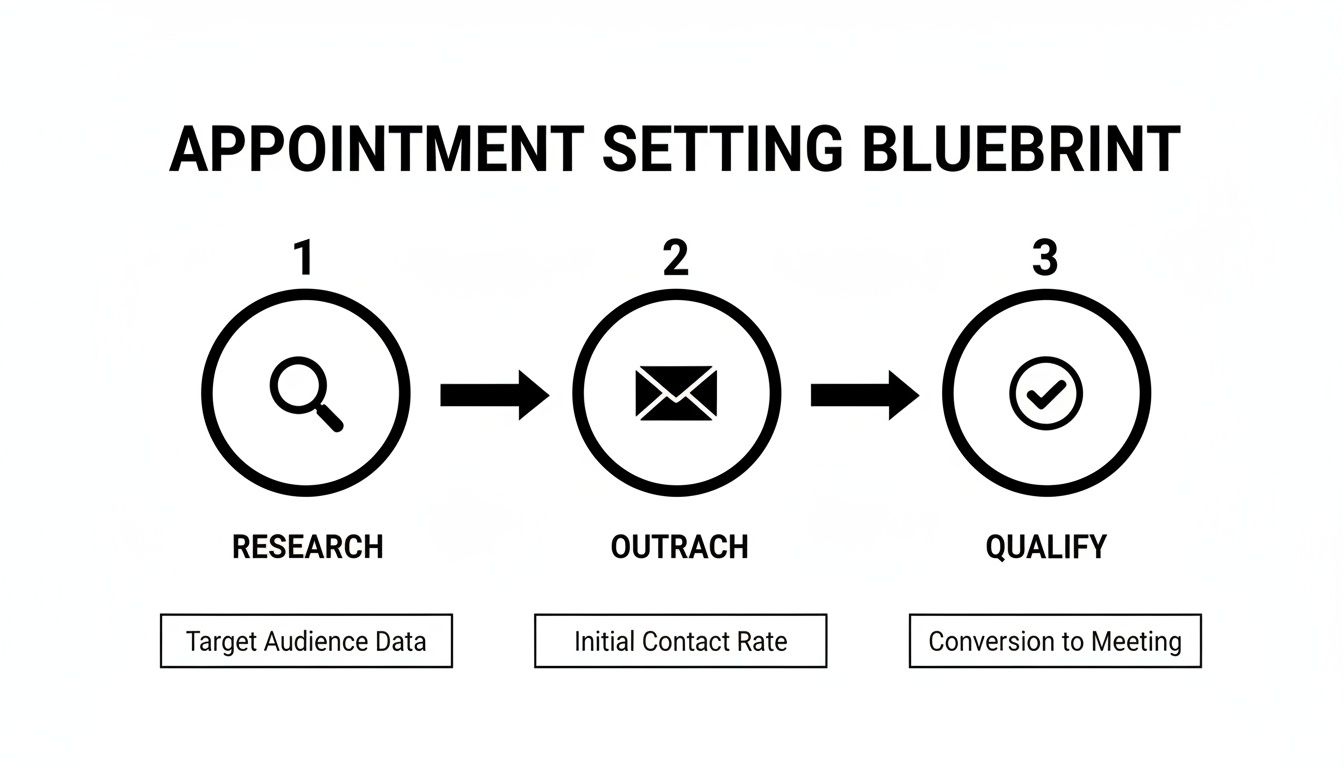
This blueprint shows how it all works, moving from broad research to laser-focused outreach and, finally, strict qualification. Every step is designed to make the next one more effective.
Ultimately, each of these benefits circles back to ROI. Filling your pipeline with qualified opportunities is one of the most direct and efficient paths to hitting your core business goals. To learn more, check out our guide on the specific lead generation KPIs to track for success.
Best Practices for High-Performing Campaigns in 2026

Let’s be real - just sending a blast of emails and hoping for the best doesn’t cut it anymore. If you want to book meetings today, you need a smarter approach. The days of relying on a single channel are long gone. Modern campaigns that actually get replies demand a thoughtful, multi-touch operation that surrounds your prospects with genuine value.
One of the biggest shifts we’re seeing is the move away from single-channel outreach. B2B teams using three or more channels - think cold email, LinkedIn, and targeted calls - are reporting engagement rates up to 287% higher than those just sticking to email. This integrated approach helps your message break through the noise by meeting people where they’re already active.
Adopt a Multi-Channel Mindset
A high-performing campaign isn’t about bombarding contacts; it’s about coordinating several touchpoints to build familiarity and trust over time. Before you ever ask for a meeting, your prospect should already know who you are.
Here’s how the pieces fit together:
-
Email: This is still the backbone. It’s perfect for the initial outreach and for delivering valuable follow-ups that keep the conversation going.
-
LinkedIn: Use it to engage with a prospect’s content, send a thoughtful connection request, or drop a quick, contextual InMail message. It adds a human face to your outreach.
-
Phone Calls: After a few digital interactions, a well-timed call can be the most direct way to qualify interest and lock in a meeting.
When you finally make the ask, you’re not a stranger - you’re a familiar name who’s been consistently helpful.
Focus on Value-Driven Copywriting
Your outreach copy is your first impression. It needs to spark curiosity, not scream “sales pitch.” The golden rule is simple: never ask for the meeting in your first email. Your only goal at the start is to earn a reply by offering something genuinely useful.
A great opening message might share a surprising insight about their industry or ask a smart question about their role. This instantly positions you as a helpful expert, not just another salesperson trying to fill a quota.
If you need some inspiration, we put together 8 proven cold email templates that book meetings that you can steal and adapt.
Finally, don’t forget the behind-the-scenes work. Using the right appointment scheduling software makes the booking process seamless for everyone. On the technical side, proper domain setup is non-negotiable to make sure your emails actually land in the inbox. And always, always be A/B testing your subject lines and calls-to-action to see what really works.
Choosing Your Model: Outsourcing vs. In-House Teams

Sooner or later, every growing business hits this crossroads: should we build our own appointment setting team or just hire an agency to do it for us? There’s no single right answer. The best path for you boils down to your resources, how fast you need to move, and your appetite for risk.
Each route has its perks, but they also come with some serious trade-offs you need to understand before you commit.
Building an in-house team gives you maximum control. Your setters live and breathe your company culture, and over time, they’ll know your product inside and out. But that control doesn’t come cheap. You have to factor in the real costs of recruiting, hiring, training, and managing a whole new team. It’s a significant investment of both time and money.
The Case for Outsourcing
For many, outsourcing is the smarter play. It gives you instant access to a team of specialists, battle-tested processes, and the flexibility to ramp up or scale back whenever you need. A good partner comes with all the infrastructure already built, letting you launch campaigns in a fraction of the time it would take to start from scratch.
The real magic of outsourcing is that you’re hiring a team that does nothing but appointment setting, all day, every day. They’ve already made the mistakes, figured out what works, and can start delivering results from day one.
Today’s economic climate is also pushing businesses to run leaner. Efficiency is king, and more B2B companies are looking for sales-as-a-service models that tie costs directly to results. This has fueled a major trend toward outsourcing tasks like list building and outreach, which helps build a scalable pipeline without bloating your payroll.
This shift has also given rise to a new, risk-free partnership model: pay-per-meeting. Instead of shelling out big retainers and hoping for the best, you only pay for qualified meetings that show up. This approach guarantees a clear and immediate return on your investment, making it an incredibly attractive option.
If you’re leaning this way, our practical guide to appointment setting outsourcing is a great resource to help you figure out the next steps.
Common Questions About Appointment Setting
Even with a solid plan, it’s natural to have questions before you dive headfirst into an appointment setting program. Let’s tackle some of the most common ones we hear from business leaders, giving you the straight answers you need to move forward.
What Is the Difference Between Appointment Setting and Lead Generation?
This is a frequent point of confusion, but the distinction is actually pretty simple.
Think of lead generation as the wide, open top of your funnel. It’s the whole process of capturing interest from potential customers - anyone who fills out a website form, downloads an ebook, or attends a webinar. It’s all about casting a wide net.
Appointment setting, on the other hand, is a specific job that happens later in the process. It takes that list of potential leads and actively turns them into scheduled, sales-qualified meetings. It’s the bridge that turns a name on a list into a real conversation on your sales team’s calendar.
Is Cold Email Still Effective for Appointment Setting?
Absolutely. But there’s a huge catch: the old spray-and-pray method is dead. To understand what appointment setting is today, you have to recognize that good cold email is hyper-personalized and focused on providing value. It’s also just one piece of a broader outreach strategy.
Your goal isn’t just to ask for a meeting anymore. It’s to start a conversation that genuinely piques their curiosity. When done right - with technical precision and great copy - it’s still one of the highest ROI channels for B2B.
How Long Does It Take to See Results?
While every campaign has its own rhythm, you should start seeing the first positive replies roll in within 2-4 weeks. A steady flow of qualified meetings usually builds up over the first 60-90 days as the outreach sequences run their course and we tweak the campaign based on what the data is telling us.
Performance-based models can often speed this up. Since the infrastructure and proven processes are already in place, you can get results much faster than if you were building everything from scratch.
Ready to fill your pipeline with qualified meetings without the risk of retainers? Fypion Marketing operates on a pure pay-per-meeting model, so you only invest in results. Book a free consultation today and see how we can build your predictable revenue engine.