
B2B Marketing SaaS: A Guide to Scalable Growth in 2026
Some quarters feel clean. Demos land, pipeline builds, sales has momentum, and the team starts talking about expansion. Then the next stretch goes flat. Traffic looks decent, a few campaigns get clicks, but revenue doesn’t follow. That feast-or-famine pattern is where many SaaS companies get stuck.
The problem usually isn’t effort. It’s that the company is running tactics without a connected growth system. Content lives in one lane. Paid campaigns chase another. Sales works a list that marketing didn’t help shape. Outbound happens only when inbound slows down. Nothing compounds because nothing connects.
That’s a dangerous place to sit in a market this large. The global B2B SaaS market is projected to reach $344 billion by 2027, with 85% of business applications expected to be SaaS-based by 2025 and an anticipated annual growth rate of 18.7% through 2030 according to Hubifi’s B2B SaaS growth analysis. Growth is available. Predictability is a key advantage.
Good b2b marketing saas work doesn’t start with more channels. It starts with a tighter foundation, a clear growth model, disciplined channel selection, and a clean handoff into sales. Once that’s in place, outbound becomes far more useful because it stops being random activity and starts behaving like a system.
If you’re trying to turn marketing into a repeatable growth engine instead of a monthly debate about what to try next, this is the operating model. For teams still tightening go-to-market fundamentals, this playbook for SaaS founders is also a useful companion resource.
Introduction The Path to Predictable SaaS Growth
Predictable growth in SaaS comes from sequence. Positioning first. Channel strategy second. Execution third. Measurement throughout.
Organizations often reverse that order. They launch paid search before they can explain why they’re different. They publish content before they know which buying pains matter. They hire SDRs before sales and marketing agree on what a qualified opportunity looks like. Then they wonder why cost rises faster than pipeline.
Practical rule: If your message is fuzzy, every channel gets more expensive.
There’s also a structural reason this matters in SaaS. You’re not marketing toward a one-time transaction. You’re acquiring recurring revenue that has to renew, expand, and justify its acquisition cost over time. A lead that closes but churns quickly was never a strong win. A campaign that produces meetings with the wrong accounts creates activity, not progress.
A working growth system looks more like a factory line than a bag of tricks. Positioning shapes demand capture. Demand capture feeds lead qualification. Lead qualification supports sales conversations. Sales conversations produce customers that are worth keeping.
That’s the difference between “doing marketing” and building b2b marketing saas infrastructure.
Nailing Your Foundation Positioning and Messaging
Positioning is the slab under the house. If it cracks, everything above it starts shifting. You can patch ads, rewrite emails, and redesign landing pages, but weak positioning keeps bleeding performance into every downstream tactic.

The simplest test is this. Can someone on your team answer four questions in under a minute?
-
Who is the product for
-
What painful job does it solve
-
Why is your approach different
-
Why should the buyer care right now
If those answers vary by person, your market hears static.
Define the ICP before writing copy
Teams often jump straight into personas and messaging. That’s backward. Start with the ideal customer profile, meaning the type of company most likely to buy, succeed, renew, and expand.
Build the ICP using operating characteristics, not vague labels. “B2B companies” is useless. “Multi-location field service software with a sales-led motion and a fragmented CRM process” is much more actionable.
Use these lenses:
-
Firmographic fit: Industry, company maturity, team structure, and buying environment
-
Operational triggers: Hiring patterns, new product launches, system migrations, compliance pressure, or expansion into new markets
-
Pain intensity: Problems that are urgent, expensive, and visible to a budget owner
-
Adoption readiness: Signs the company can implement and benefit from your product
One practical way to stress-test your thinking is to compare your statement against strong value proposition examples for B2B teams. Weak messaging usually tries to sound broad. Strong messaging makes the right buyer feel seen.
Build a messaging matrix your team can actually use
A messaging matrix keeps sales, marketing, and outbound aligned. It should live in a shared doc, not inside one strategist’s head.
A simple version looks like this:
| Audience | Core pain | Desired outcome | Proof angle | Objection | Message hook |
|---|---|---|---|---|---|
| Operations leader | Manual workflows | Faster execution | Ease of rollout | “Switching is painful” | Replace scattered processes without slowing the team |
| Revenue leader | Low pipeline quality | More qualified opportunities | Better targeting | “We already have leads” | Improve fit, not just volume |
| Founder | Unpredictable growth | Repeatable acquisition | Channel discipline | “We’ve tried agencies” | Build a system, not random campaigns |
That matrix gives you raw material for landing pages, ad angles, sales talk tracks, LinkedIn content, and cold outreach. It also exposes where your message is too generic. If the same line applies to every buyer, it won’t land with any of them.
Write messages that sound like buying decisions
Good SaaS messaging isn’t clever. It’s useful. Buyers respond to clarity that reduces risk.
That usually means writing closer to the decision than the product. Instead of “AI-powered workflow orchestration,” say what changes operationally. Instead of “streamline collaboration,” say who stops wasting time, where, and why it matters.
A practical message stack often follows this order:
-
Problem framing: Name the operational pain in plain language
-
Business impact: Show what the pain disrupts
-
Solution angle: Explain your mechanism, not just your category
-
Why now: Tie the message to urgency
-
Risk reduction: Address friction, implementation fear, or team resistance
Buyers rarely reject a product because the wording wasn’t creative enough. They reject it because the value wasn’t concrete enough.
When the foundation is solid, every later decision gets easier. SEO topics become clearer. Paid campaigns have sharper angles. Outbound sounds researched rather than generic. Sales calls start from relevance instead of re-education.
Choosing Your Growth Engine Demand Gen vs ABM
Many teams blend demand gen and ABM without understanding the trade-off. That usually creates mediocre execution in both directions. You need to know which engine is carrying the load.
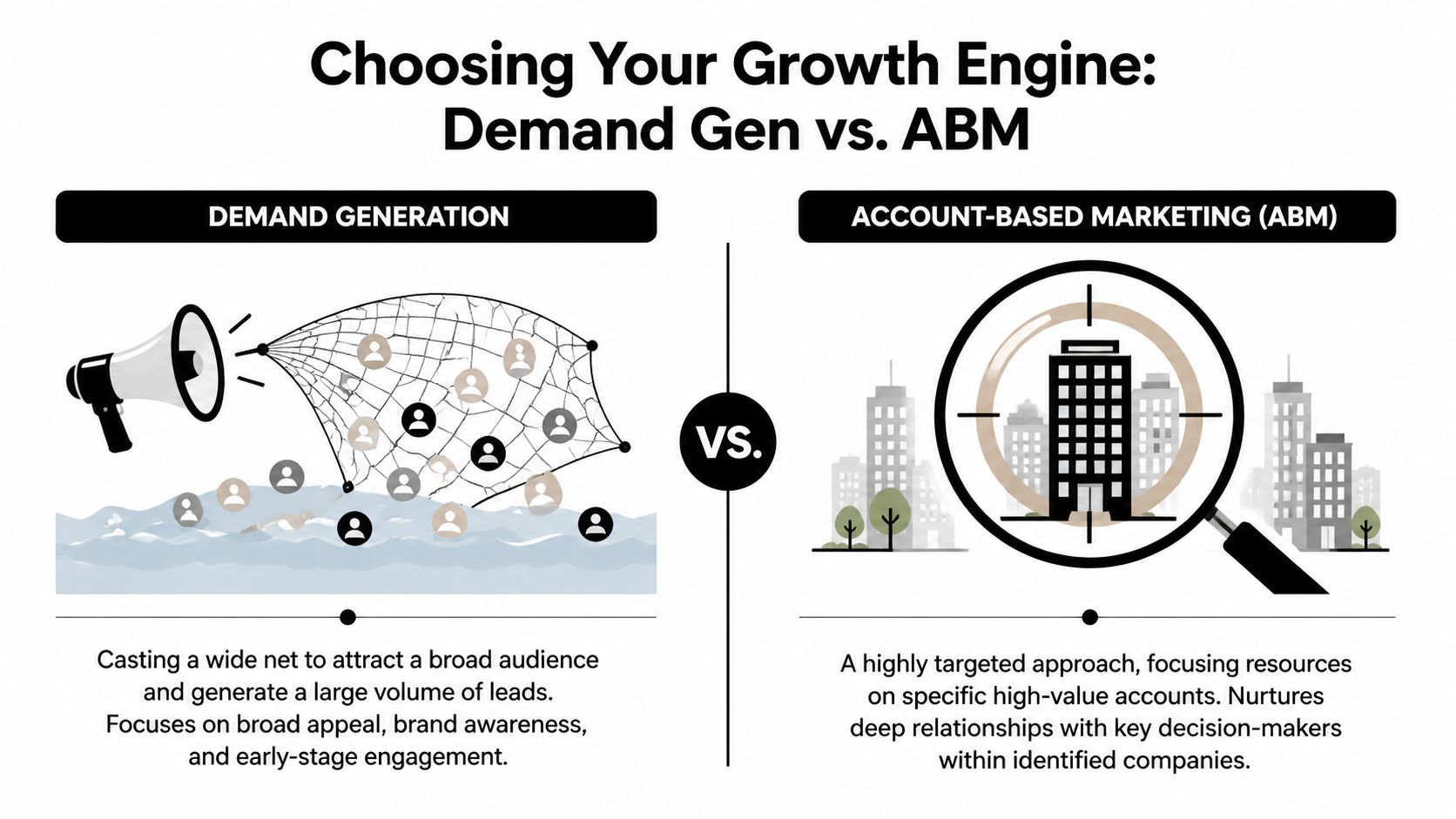
Demand gen is like casting a wide net. You’re trying to attract many relevant buyers through content, search, paid media, social, webinars, and category education. Account-based marketing is spearfishing. You pick specific companies, specific stakeholders, and specific problems, then coordinate outreach around them.
Neither is better in the abstract. One is better for your situation.
When demand gen carries the business
Demand gen works best when your market is broad enough to support scaled awareness and intent capture. It fits products with larger addressable audiences, repeatable use cases, and buying behavior that starts with research.
The upside is compounding. A strong article, comparison page, webinar, or landing page can keep pulling demand long after the campaign launches. The downside is patience. It usually takes time to build authority, content coverage, and conversion pathways.
Use demand gen as the primary engine when:
-
Your category has existing search behavior: Buyers already look for the problem and possible solutions
-
Your market is wide: Many accounts could plausibly buy
-
Your sales motion benefits from education: The buyer needs to understand the problem before evaluating vendors
-
Your team can publish consistently: Sporadic content rarely compounds
A lot of teams call demand gen “content marketing” and stop there. That’s too narrow. Real demand gen includes content, search intent mapping, conversion architecture, retargeting, lifecycle email, and revenue reporting. If you want a grounded primer on how these pieces connect, this overview of demand generation marketing in B2B growth is worth reviewing.
A short visual helps clarify the distinction.
When ABM is the right move
ABM becomes powerful when the target list is knowable and the upside per account justifies focused effort. This is common in enterprise SaaS, niche infrastructure products, and solutions where buying committees shape the sale.
The upside is relevance. You don’t wait for the right account to find you. You go after it directly with coordinated messaging across email, LinkedIn, ads, direct mail, events, and sales outreach. The risk is over-concentration. If the list is too narrow or the message is weak, the pipeline dries up fast.
ABM fits when:
| Signal | Demand gen fit | ABM fit |
|---|---|---|
| Market size | Broad | Narrow or highly defined |
| Buying committee | Light to moderate | Complex and multi-stakeholder |
| Sales cycle | Simpler discovery path | High-touch and consultative |
| Deal profile | Repeatable volume | Fewer, higher-value accounts |
| Messaging | Broad category language works | Deep account relevance required |
The hybrid model most SaaS teams actually need
In practice, many SaaS companies need a hybrid. But “hybrid” shouldn’t mean undisciplined. It should mean one engine creates the base and the other sharpens the focus.
A healthy pattern looks like this:
-
Demand gen builds category visibility and captures active demand
-
ABM targets strategic accounts that won’t convert from inbound alone
-
Sales uses account insight from both motions to prioritize outreach
-
Marketing measures contribution by pipeline quality, not just lead volume
If your team can’t name the primary growth engine, it’s usually because channels are competing instead of reinforcing each other.
One warning. Teams often choose ABM because it sounds more advanced. But if you haven’t nailed ICP, message hierarchy, and handoff rules, ABM just gives you a more expensive way to be unclear.
Selecting and Mastering Your Marketing Channels
Once the growth engine is clear, channel selection gets simpler. You’re no longer asking, “What should we try?” You’re asking, “Which channels match our buyer, our sales motion, and our operating capacity?”
That’s how mature b2b marketing saas teams allocate effort. They don’t chase every playbook. They pick a few channels they can run well, then connect them tightly to pipeline.
The four channel groups that matter most
Content and SEO build assets you own. Paid acquisition buys attention quickly. Partnerships let you borrow trust and distribution. Cold outreach starts conversations before the buyer raises a hand.
Each serves a different purpose.
Content and SEO are long-range channels. They’re strongest when your buyer researches problems, compares solutions, and needs education before speaking to sales. Good SaaS SEO isn’t just blog production. It’s commercial pages, use-case pages, comparison content, integration content, and conversion paths that match intent.
If your team is trying to justify search investment at a more strategic level, this breakdown on how to evaluate enterprise SEO software ROI is a useful reference point.
Paid acquisition is best when you already know which audiences and offers convert. Paid search can capture active intent. Paid social can create awareness and retarget engaged accounts. The mistake is treating paid as a substitute for positioning. It only scales what already works.
Partnerships are underused because they require relationship building, not dashboard tweaking. Integration partners, consultants, agencies, associations, communities, and marketplaces can all drive qualified attention. The right partnership compresses trust in a way ads can’t.
Cold outreach is the proactive channel. It’s useful when the product solves a clear pain, the ICP is identifiable, and the team can personalize enough to earn a response. It gets stronger when paired with account research, segmented messaging, and a sharp offer.
The overlooked opportunity in vertical outreach
One of the biggest misses in SaaS marketing is treating every industry like a software-native buyer. That’s a mistake. Vertical SaaS companies focused on non-tech industries like manufacturing or construction are growing 2-3x faster than their horizontal counterparts according to Saasiest’s analysis of underused SaaS marketing tactics.
Many teams still write outreach as if they’re selling to another startup. That falls apart fast with operators in logistics, field services, industrial distribution, construction, healthcare admin, or multi-location businesses. These buyers care about workflow friction, compliance pressure, handoff errors, reporting bottlenecks, and system sprawl. They don’t care that your platform is “cutting-edge.”
Vertical outreach works when the message reflects the buyer’s actual environment. That means using industry signals in list building, not just job titles. It also means writing copy that references the operating context the buyer recognizes immediately.
Examples of better vertical filters:
-
Manufacturing: ERP environment, quality processes, distributed plants, compliance layers
-
Construction: Bid workflows, subcontractor coordination, field-to-office reporting, documentation burden
-
Logistics: Carrier management, routing visibility, dispatch coordination, fragmented communication
-
Restaurants or hospitality tech: Multi-location ops, staff turnover, franchise complexity, location performance consistency
It is targeted SaaS lead generation strategies for B2B teams that outperform generic campaigns. The list, the pain point, and the call-to-action all need to fit the vertical.
A practical comparison for channel selection
Use this table as a planning tool, not a rigid rulebook.
| Channel | Typical Cost | Time to Results | Best For |
|---|---|---|---|
| Content and SEO | Front-loaded team or agency effort, then ongoing production | Slower build, stronger compounding | Capturing demand, education, trust building |
| Paid acquisition | Ongoing media spend plus creative and landing page work | Faster feedback loop | Validated offers, active demand capture, retargeting |
| Partnerships | Moderate relationship and coordination cost | Medium timeline | Trust transfer, niche reach, co-selling opportunities |
| Cold outreach | Moderate list, copy, tooling, and operations effort | Fast to moderate | Proactive pipeline creation, defined ICPs, account targeting |
No channel wins in isolation. The practical stack is usually one compounding channel, one fast-feedback channel, and one proactive channel. That mix gives you learning speed and pipeline resilience.
Good channel strategy isn’t diversification for its own sake. It’s making sure one weak month in a single channel doesn’t starve the sales team.
Optimizing the Marketing to Sales Handoff
The handoff from marketing to sales is a relay exchange. If one runner reaches out too early, the baton gets dropped. If the second runner starts too late, momentum dies. That’s what happens when marketing throws over names and sales says the leads aren’t real.

The fix isn’t more meetings between departments. It’s clearer qualification logic.
Define MQL and SQL in operational terms
A marketing qualified lead should be someone who has shown enough fit and intent that continued nurture alone is no longer the best next step. A sales qualified lead is someone sales accepts as worth direct follow-up based on agreed criteria.
Those definitions must be behavioral and contextual. “Downloaded an ebook” is rarely enough on its own. “Requested a demo from a target account after viewing pricing and product pages” is much stronger.
The benchmark matters here. The MQL-to-SQL conversion rate is considered strongest in the 20-50% range according to Pipelineroad’s SaaS marketing metrics guide. Below 20% usually means marketing is passing weak leads. Above 50% can mean the bar is too strict and marketing is withholding pipeline that sales could develop.
Build a handoff rule set sales will trust
Most handoff problems come from ambiguity. Marketing thinks it generated interest. Sales thinks it received noise.
Use a simple service level agreement with shared ownership:
-
Qualification criteria: Define firmographic fit, pain relevance, and behavioral triggers
-
Routing rules: Specify which leads go to which rep and under what conditions
-
Response timing: Set expectations for first follow-up and escalation
-
Feedback loop: Require sales to disposition leads in a way marketing can learn from
-
Recycling logic: Decide when a lead returns to nurture instead of dying in the CRM
A good supporting exercise is mapping this process visually. Teams that document their stages usually spot friction much faster. This sales process flowchart guide is a practical model for turning a messy handoff into a visible operating system.
Score for buying intent, not content consumption alone
Lead scoring gets abused when teams assign points to shallow activity and call it qualification. That’s how you get MQL inflation.
A better model weights three categories:
| Scoring layer | What to look for | Why it matters |
|---|---|---|
| Account fit | Industry, use case, role alignment | Prevents unqualified volume |
| Engagement depth | Pricing, demo, comparison, high-intent page views | Separates curiosity from buying motion |
| Trigger context | Timing, team change, expansion, process pain | Adds urgency and relevance |
Sales should be able to look at a routed lead and immediately understand why it was passed over.
The handoff becomes smoother when both teams can answer the same question the same way: “Why is this account ready for a conversation now?”
Tracking the B2B SaaS Metrics That Drive Growth
Vanity metrics are comforting because they move often. Traffic rises. Followers creep up. Open rates bounce around. Teams put them on slides because they look like momentum.
Revenue teams need a harsher scorecard.
In SaaS, the useful metrics are the ones that tell you whether acquisition is efficient, whether pipeline quality is holding, and whether growth is sustainable after the deal closes. That’s why you need to watch CAC, payback logic, sales cycle movement, churn, customer lifetime value, and pipeline conversion rates by channel.
Spend discipline matters more than channel excitement
A lot of SaaS teams don’t have a lead problem. They have an efficiency problem.
Median marketing spend for B2B SaaS companies is around 8% of ARR, total sales and marketing budgets can range from 27% to 45%, and the median New CAC Ratio recently rose to $1.76 according to Orb’s B2B SaaS benchmark review. That means waste gets expensive fast. If your channel mix is misaligned, you won’t feel it only in ad efficiency. You’ll feel it in hiring pressure, forecast misses, and margin compression.
The scorecard that actually changes decisions
These are the metrics I’d keep in front of leadership every month:
-
Customer acquisition cost: How much the company spends to win a customer or new ARR
-
Lifetime value: Whether acquired customers are worth the effort and spend
-
LTV to CAC relationship: Whether growth is healthy or artificially purchased
-
Sales cycle length: Whether friction is rising in the market or in your process
-
Churn rate: Whether the business keeps the revenue it fought to win
-
Pipeline by source: Which channels create serious opportunities, not just leads
The key is to use these metrics diagnostically.
If CAC rises while conversion quality falls, the issue could be targeting, channel-message mismatch, or poor handoff. If sales cycle length grows while win rates decline, positioning may be off or reps may be spending too much time educating low-fit accounts. If churn climbs after a certain acquisition source, the problem may be promise-to-product fit.
A dashboard should help you cut something, double down on something, or fix something. If it can’t do one of those, it’s probably reporting noise.
Metrics aren’t there to make marketing look accountable. They’re there to help the company make better bets.
How to Scale with Performance-Based Outreach
When CAC rises and internal teams are stretched, outbound usually comes back into the conversation. The problem is that many companies approach it the wrong way. They hire for activity, buy a list, send generic messaging, and hope volume will rescue weak strategy.
Performance-based outreach is a smarter model when the fundamentals are already in place. It works best for companies with clear product-market fit, a defined ICP, and a sales team that can close qualified conversations.
The appeal is alignment. Performance-based pricing models like pay-per-qualified-meeting remain underexplored, and they matter more in a skeptical buying environment where 92% of B2B buyers already have a vendor in mind before evaluation according to Omnibound’s B2B SaaS marketing perspective. If buyers are already leaning toward known options, outbound has to be precise, and the delivery model should reward outcomes instead of effort alone.
What good performance-based outreach actually looks like
This model only works when the operator handles more than copywriting.
A serious outbound program usually includes:
-
Market research: Tight ICP selection, segmentation, and angle testing
-
List building: Relevant accounts and contacts matched to the pain being addressed
-
Offer design: A call-to-action that feels worth taking
-
Personalized messaging: Enough specificity to show relevance without becoming unscalable
-
Campaign management: Ongoing testing, response analysis, and inbox quality monitoring
-
Qualification rules: Pre-agreed standards for what counts as a valid meeting
That’s why a strong partner matters more than cheap execution. You’re not buying emails. You’re buying a managed pipeline creation system. If you want to understand how this model is structured in practice, this guide to performance-based lead generation lays out the mechanics clearly.
When this model fits and when it doesn’t
Performance-based outreach is a strong fit when the company already knows who it sells to and what pain converts. It’s weaker when the product is still searching for a market, the offer is vague, or the sales process can’t convert booked conversations consistently.
The biggest advantage is operational focus. Marketing can keep building long-term demand. Sales can focus on selling. Outbound becomes a measured acquisition layer instead of a desperate reaction when inbound softens.
If your team wants a lower-risk way to build pipeline, Fypion Marketing is built for that model. They run performance-driven B2B cold email outreach with no upfront fees, no retainer, and no setup costs, so you pay only for qualified meetings that meet agreed criteria. Their process covers market research, list building, messaging, campaign management, and ongoing optimization, which makes them a practical fit for SaaS companies with proven product-market fit that want more predictable sales conversations.