
How to Improve Conversion Rates: B2B SaaS Playbook
Most advice on how to improve conversion rates starts too low in the funnel. It jumps straight to button copy, page layouts, and A/B tests as if the main problem is a weak CTA.
For B2B SaaS, that’s often the wrong starting point.
A landing page can convert well and still damage pipeline. If it pulls in low-fit leads, creates calendar noise for sales, or rewards curiosity over buying intent, the conversion rate looks healthy while revenue quality slips. That’s why serious conversion work starts by deciding which action deserves optimization in the first place.
Stop Chasing Conversions and Start Chasing Pipeline
The common goal is “increase conversions.” The better goal is increase qualified pipeline.
That sounds subtle, but it changes almost everything. A team optimizing for ebook downloads will make different decisions than a team optimizing for booked meetings with accounts that match its ICP. One will remove friction to maximize volume. The other will control friction so the right buyers move forward and the wrong ones self-select out.
The biggest gap in most CRO advice is that it over-focuses on page tactics and under-focuses on which conversions are worth improving. That gap matters in B2B because qualification, lead scoring, and routing shape revenue outcomes just as much as the page itself, as noted in Calendly’s guidance on sales conversion strategy and qualification.
A higher conversion rate can be the wrong win
A lot of teams celebrate more demo requests, then find out sales is spending time on students, job seekers, tiny accounts, or companies outside the target market. The site did its job. The business did not get the result it needed.
That’s why the first question isn’t “How do we get more people to convert?”
It’s this: Which conversion creates the strongest path to revenue?
For many B2B SaaS companies, that answer isn’t a generic form fill. It’s one of the following:
-
Qualified meeting booked: The prospect matches ICP, shows real intent, and enters a real sales process.
-
High-intent hand-raise: The buyer requests pricing, implementation details, security review, or a personalized walkthrough.
-
Sales-accepted lead: Marketing passes only leads that meet defined fit and intent standards.
Practical rule: If sales wouldn’t want more of a conversion event, marketing shouldn’t optimize for it.
Work backward from revenue, not page activity
A useful way to frame conversion optimization is to map the whole chain: traffic source, message, landing page, form, qualification, routing, meeting, opportunity. Weakness at any point can make a “good” conversion rate meaningless.
That’s why funnel planning matters more than isolated page tweaks. Fypion’s guide to B2B leads and conversions is useful here because it frames conversion work around funnel stages and business outcomes instead of just page activity.
In practice, the strongest conversion programs in B2B SaaS do three things early:
-
Define the revenue event first. Usually that’s a qualified meeting or another downstream action that sales values.
-
Separate fit from intent. Someone can want a demo and still be a bad prospect.
-
Accept that more friction isn’t always bad. If a short qualification step filters out poor leads, total conversion rate may drop while pipeline quality improves.
That’s the mindset shift. Once that’s in place, the rest of the work gets sharper.
Your B2B Funnel Diagnostic Playbook
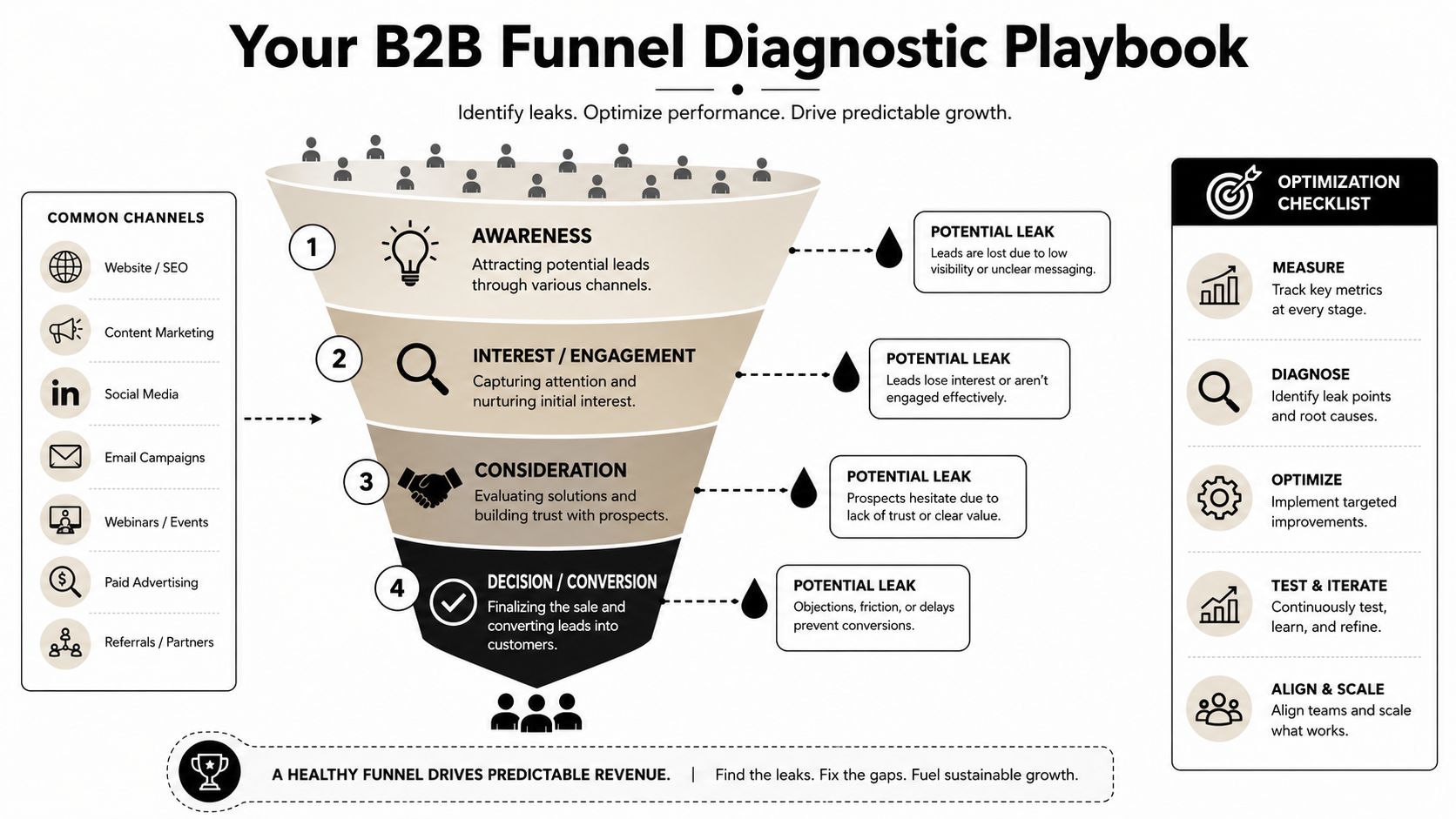
Before changing copy or design, build a clear funnel map. Most conversion problems are measurement problems first. Teams blend channels, devices, and audiences into one average, then optimize the wrong thing.
For an effective workflow, define one conversion event, use a fixed analysis window, keep the numerator and denominator clean, then segment by source, device, and audience cohort. That analytics-led approach helps teams compare like-for-like performance instead of reacting to blended averages, as explained in Trainual’s guide to the conversion rate formula and workflow.
Start with one conversion definition
If one dashboard counts demo form fills, another counts meetings booked, and paid media reports on MQLs, your CRO work will drift into politics. Pick a primary conversion event and align reporting around it.
For B2B SaaS, I usually recommend a hierarchy like this:
-
Primary conversion: Qualified meeting booked
-
Secondary conversion: Sales-accepted lead
-
Diagnostic micro-conversions: Pricing page visit, form start, calendar submit, reply to outbound, or product tour completion
The point isn’t to ignore micro-conversions. It’s to stop treating them as the main outcome.
Segment before you judge performance
Averages hide where the actual leak sits. Branded search traffic, outbound email traffic, partner referrals, and paid social clicks behave differently. So do desktop and mobile visitors. So do enterprise buyers and lower-intent researchers.
Use a simple audit structure:
| Funnel Stage | What to Check | What Usually Goes Wrong |
|---|---|---|
| First click | Channel, audience, promise | Weak targeting or low-intent traffic |
| Landing page visit | Message match, page speed, device experience | Ad promise and page content don’t align |
| Form start | CTA clarity, perceived effort | Offer sounds vague or too early |
| Form completion | Fields, qualification logic, trust | Friction is too high or asks feel intrusive |
| Meeting booked | Routing, calendar flow, rep assignment | Qualified leads stall after submitting |
A detailed B2B lead generation funnel should make each of these transitions visible. If it doesn’t, the reporting setup needs work before the page needs redesign.
Optimize the step with the highest business impact, not the step with the loudest drop-off.
Diagnose with both numbers and behavior
Analytics tell you where the leak is. Behavioral signals tell you why.
Once you identify the highest-value drop-off, review the page and workflow with a sales lens:
-
Check message continuity: Does the page continue the exact promise from the ad, email, or outbound message?
-
Review qualification logic: Are you letting obvious non-buyers flow into sales follow-up?
-
Inspect handoff speed: Does someone who converts get routed cleanly to the right rep or meeting path?
-
Look for friction patterns: Review heatmaps, session recordings, and drop-off paths around key steps.
A major pitfall in conversion work is optimizing from incomplete or misattributed data. Teams often improve the wrong page because attribution is messy or campaign data is split across systems. Clean attribution and unified reporting matter more than another CTA rewrite.
Prioritize leaks by pipeline value
Not every leak deserves equal attention. A page losing high-fit demo traffic from paid search usually matters more than a lightly visited blog CTA underperforming.
A simple prioritization filter works well:
-
Revenue proximity: How close is this step to qualified pipeline?
-
Audience quality: Are high-fit accounts involved?
-
Repairability: Can marketing or RevOps fix it quickly?
-
Learning value: Will the fix produce insight you can reuse elsewhere?
That turns diagnostics into a working backlog instead of a pile of observations.
Optimizing Top-of-Funnel B2B Channels
A high top-of-funnel conversion rate can hide a weak pipeline.
I see this in B2B SaaS accounts all the time. Paid social drives cheap form fills. Cold outbound gets polite replies. Branded search converts well. Then sales reviews the month and finds very few meetings with accounts that can buy. The problem is not the landing page first. It is the traffic source, the promise, and the filtering logic upstream.
Top-of-funnel work should answer one question before any other. Does this channel produce qualified buying conversations?

Cold email that attracts buyers, not just replies
Outbound underperforms when teams write for response rate instead of sales relevance. That creates inbox activity without pipeline. Sales gets curiosity replies, student requests, vendor pitches, and soft interest from companies that will never make it through qualification.
The fix is tighter positioning in the first touch.
Weak version
-
Subject line built for curiosity instead of a specific business issue
-
Opening line with surface-level personalization
-
CTA pushing for a meeting before the buyer sees a reason
-
Copy that could apply to any SaaS company
Stronger version
-
Subject line tied to an operating problem the prospect already feels
-
Opening line based on real context, such as hiring plans, PLG to sales-assisted transition, pricing complexity, or territory changes
-
Body copy focused on one bottleneck with one believable outcome
-
CTA that helps qualify intent, such as interest in fixing demo quality or inbound routing
In practice, this means writing to the role and the motion. A VP of Sales may care about reps burning time on low-fit demos. A demand gen leader may care that lead volume looks healthy while sales-accepted pipeline stays flat. A founder may care about creating qualified meetings without hiring a full SDR team. Fypion’s guide to SaaS lead generation strategies is useful here if you need a clearer channel mix between outbound, paid, and inbound.
Paid ads work when the click promise survives the landing
Paid media often fails before the visitor reads the form. The ad earns the click with a specific claim, then the landing page falls back to broad company copy. That gap kills qualified intent.
Analysts at WordStream found that across more than 17,000 Google Ads campaigns, average conversion rates were 7.04%, and personalized CTAs outperformed generic ones by 202% in its roundup of conversion rate optimization statistics. The useful takeaway for B2B SaaS is not to chase a benchmark. It is to keep relevance intact from keyword or ad through to the page and CTA.
A simple comparison makes the trade-off clear:
| Channel Setup | What Happens |
|---|---|
| Generic ad to generic page | More clicks from mixed intent, weaker qualification, lower meeting quality |
| Specific ad to matched page | Fewer wasted visits, clearer self-selection, stronger hand-raises from in-market buyers |
If the ad offers help booking qualified enterprise demos, the page should continue that exact thread. It should not switch to generic messaging about growth, efficiency, or full-service marketing.
Top-of-funnel changes that improve pipeline quality
-
Tighten targeting before scaling spend: Smaller audiences often produce better meetings if the segment matches your sales motion.
-
Match CTA to channel intent: High-intent search can support a direct demo ask. Cold outbound often performs better with a lower-pressure qualification step.
-
Use disqualifying language on purpose: Naming company size, use case, or GTM model filters out poor-fit traffic before it hits sales.
-
Protect speed and clarity on entry pages: Slow pages and cluttered first screens waste expensive intent, especially on paid traffic.
-
Judge channels by meeting quality: If a campaign drives conversions but few sales-accepted opportunities, it needs a different message, offer, or audience.
Good top-of-funnel optimization filters early. That usually lowers raw conversion volume and improves the part that matters, qualified meetings that can turn into pipeline.
Fixing the Leaky Mid-Funnel Experience
Mid-funnel is where good traffic gets wasted.
A prospect clicks because the message resonates. Then they hit a landing page crowded with navigation, multiple offers, soft copy, and a form that asks for more than the buyer is ready to give. Teams usually respond by adding more proof, more sections, more CTA buttons, and more explanation. That often makes the page worse.
The better move is usually subtraction.
Why fewer choices often win
Mainstream CRO advice tends to stack elements. More social proof. More personalization. More content blocks. More buttons. But a stronger question is when fewer choices, fewer fields, and less clutter outperform a richer page.
That’s the crux of CXL’s guidance on increasing conversion rate through simplification. For B2B pages, especially demo and consultation flows, qualified buyers usually don’t need more stimulation. They need a cleaner path.
Three common mid-funnel problems show up repeatedly:
-
Competing actions: The page asks visitors to book a demo, download a guide, subscribe, and browse resources.
-
Buried value proposition: The first screen talks about the company instead of the buyer’s problem.
-
Overbuilt forms: Teams collect data for internal convenience, not conversion logic.
Remove friction before adding persuasion
A fast audit of a B2B landing page should answer these questions:
-
Is there one clear next step?
-
Does the headline match the promise that brought the visitor here?
-
Is the form asking only for information needed at this stage?
-
Are there distractions that let buyers escape the page?
-
Is trust placed near the decision point instead of scattered everywhere?
If a page needs six persuasion devices to get a buyer to act, the offer probably isn’t clear enough.
A good nurture path also matters here. If a buyer isn’t ready for a meeting, the fallback shouldn’t be a dead end. It should push them into a useful next step such as a relevant guide, comparison page, or segmented follow-up sequence. That’s where a structured approach to nurturing B2B leads helps protect future pipeline without forcing premature sales actions.
B2B Call-to-Action Examples by Intent
| Intent Level | CTA Example | Best For |
|---|---|---|
| Low intent | Download the Buyer’s Guide | Early-stage education traffic |
| Low to mid intent | See How Teams Use This | Solution-aware visitors evaluating fit |
| Mid intent | Get Pricing Details | Buyers comparing options |
| Mid to high intent | Request a Tailored Walkthrough | Accounts with a defined use case |
| High intent | Book a Qualified Meeting | ICP-fit prospects ready for sales engagement |
The CTA should match buyer readiness. A high-friction CTA shown too early depresses conversion. A low-commitment CTA shown too late can water down intent and slow pipeline.
What usually hurts more than weak copy
In many B2B SaaS funnels, the conversion problem isn’t that buyers are unconvinced. It’s that the path feels busy, repetitive, or premature.
The practical fixes are usually plain:
-
Cut navigation on campaign pages
-
Remove secondary CTAs near the main action
-
Shorten forms to the fields sales uses
-
State the offer in direct language
-
Place proof close to the form or booking action
Many teams finally understand how to improve conversion rates. Not by adding another trust badge or changing a button color, but by making the next step feel obvious and proportionate.
How to Design and Prioritize Experiments
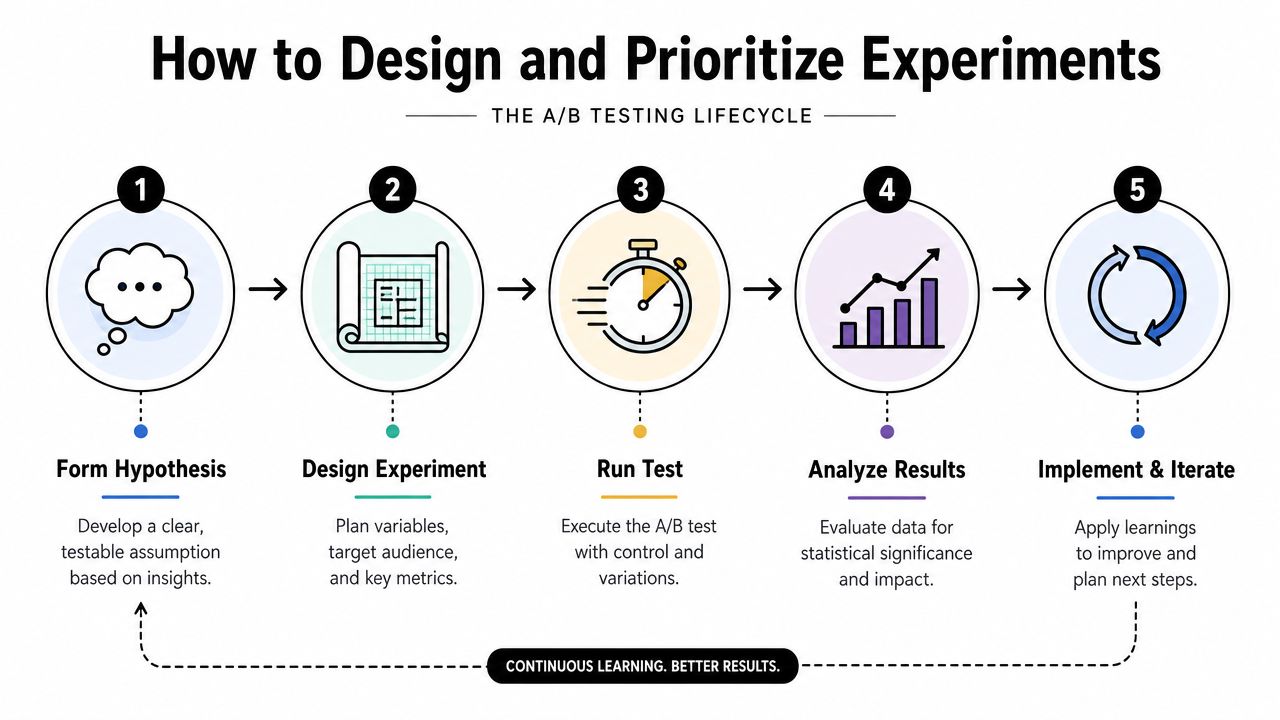
Good experimentation does not start with an A/B testing tool. It starts with a revenue question.
If the team cannot say which conversion should create more qualified pipeline, testing turns into local optimization. The page may convert better while sales quality gets worse. That is common in B2B SaaS. A demo page gets more submissions after fields are removed, but booked meetings fall because students, consultants, and small accounts now flood the form.
A stronger starting point is simple: define the commercial outcome first, then design the test around that outcome. For many teams, that means improving the rate from visit to qualified meeting, or from meeting to opportunity, not just lifting raw form completion. If sales is already struggling with low-fit volume, use B2B sales conversion rate benchmarks and funnel context to sanity-check whether the issue is page friction, weak targeting, or poor qualification.
Build hypotheses from observed friction
Useful hypotheses come from observed behavior and sales feedback, not preference.
Weak hypothesis:“We should test a stronger CTA color.”
Stronger hypothesis:“Paid search visitors reach the demo form, but they stall at company size and phone number. Reordering the form and making one field optional may increase qualified meeting requests because first-touch visitors have interest, but not enough trust for a heavy ask.”
That version gives the team something to evaluate. It names the segment, the point of friction, the proposed change, and the business reason it may work.
Use a small set of inputs before you prioritize anything:
-
Funnel drop-off analysis: Identify where ICP traffic stops progressing
-
Session recordings: Watch where buyers hesitate, re-read, or abandon
-
Heatmaps and click maps: Confirm whether attention is landing on the intended action
-
Sales call notes: Check whether leads are low-fit, poorly educated, or blocked by the page
-
Traffic source review: Compare paid, organic, partner, and outbound behavior separately
Poor aggregation frequently underlies flawed experiment design. A homepage test can look neutral overall and still be a strong win for one segment and a loss for another. Teams working through addressing distribution fitting pitfalls will recognize the same issue. Averages hide meaningful variation.
Prioritize experiments with commercial logic
Prioritization should reward pipeline impact, not novelty.
I usually rank tests on four questions: How close is this page or step to revenue? How painful is the current friction? How confident are we that the diagnosis is right? How hard is the change to launch cleanly?
A simple model works well:
| Test Idea | Potential Impact | Confidence | Effort | Priority |
|---|---|---|---|---|
| Reduce friction on demo request flow | High | High | Low | First |
| Improve message match from paid ad to landing page | High | Medium | Medium | Second |
| Rewrite homepage hero for broad positioning clarity | Medium | Medium | Medium | Later |
| Change CTA button color | Low | Low | Low | Last |
The trade-off is real. High-intent pages usually have lower traffic, so tests take longer to read. Low-intent pages reach significance faster, but a lift there may never show up in pipeline. In B2B SaaS, I would rather wait longer for a clean read on a meeting page than chase a fast win on a blog CTA that generates weak leads.
Fypion Marketing is one agency model some teams use during this phase for outbound and qualified meeting generation. In practice, that can help isolate the problem. If outbound messaging books meetings with the same ICP but the website does not, the issue is often on-site positioning, offer structure, or form flow rather than market demand.
A short explainer is worth reviewing before teams start testing at scale:
Testing rules that prevent bad decisions
Sloppy mechanics create false winners.
Keep the rules tight:
-
Split traffic evenly: Use a true 50/50 split so one version is not helped by traffic imbalance
-
Test one core change at a time: If headline, proof, and form length all change, attribution gets muddy
-
Wait for a stable read: Early peaks often disappear once more qualified traffic passes through
-
Judge the right conversion: Click-through rate is secondary if qualified meetings are the goal
-
Review downstream impact: A variant that lifts submissions but lowers show rate is not a win
-
Promote winners carefully: Make the winner the new control, then test the next highest-friction issue
The goal is not to win arguments. The goal is to improve the path from interest to pipeline with less guesswork.
Experiments that tend to matter in B2B SaaS
The tests that move revenue usually sit in a few repeatable areas:
-
Offer framing on demo, consultation, or pricing pages
-
Form structure including field order, required fields, and qualification logic
-
Message match between ads, outbound emails, and landing pages
-
CTA specificity based on buying stage and account intent
-
Routing after conversion such as calendar handoff, SDR qualification, or thank-you page next steps
These are not cosmetic tests. They shape who converts, what sales receives, and how quickly pipeline forms. That is the standard worth optimizing for.
Measuring What Actually Matters for B2B Growth
Most CRO reporting is too shallow for executive use. It shows traffic, page conversion rate, and maybe cost per lead. That’s not enough to judge whether optimization is helping the business.
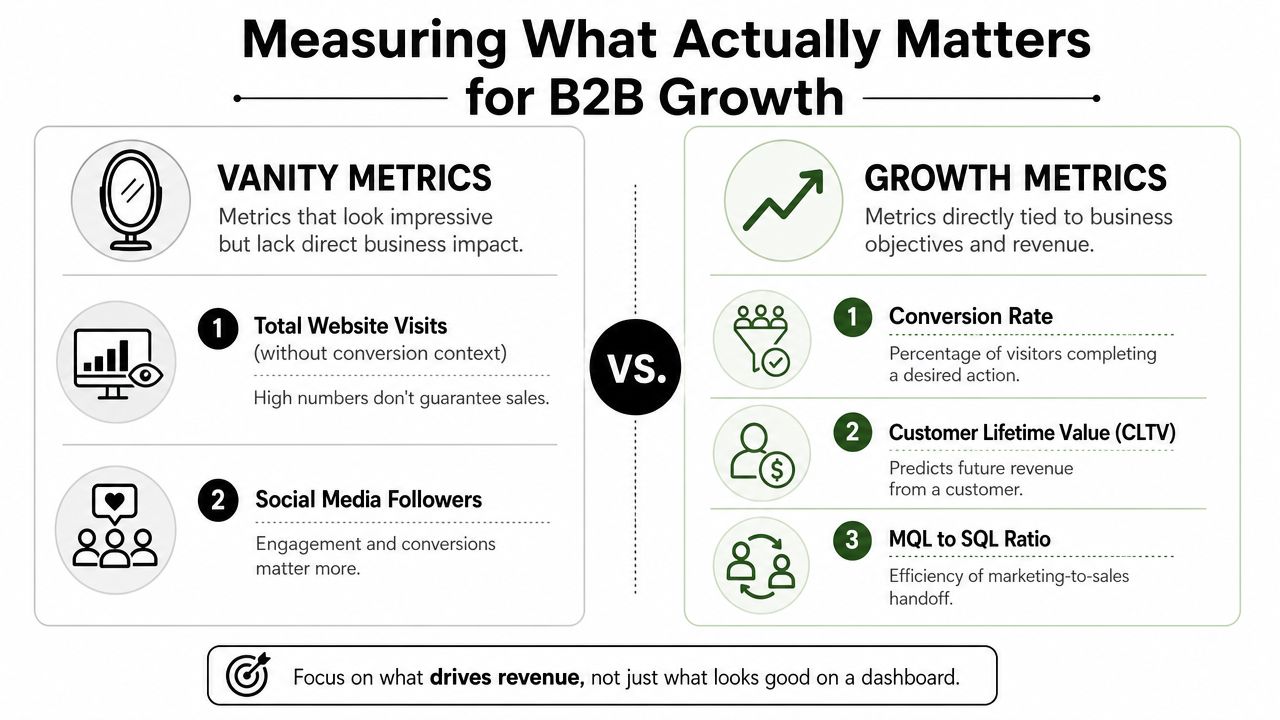
A stronger reporting model separates vanity metrics from growth metrics. Vanity metrics describe activity. Growth metrics describe commercial progress.
Know what a benchmark can and cannot tell you
A useful industry benchmark is that the average landing page conversion rate across industries is 2.35%, while top-performing websites can reach 11% or higher. Industry guidance also places a generally solid conversion rate in the 2% to 5% range, according to Invesp’s roundup of conversion rate optimization statistics.
That benchmark is helpful, but only in context.
A B2B SaaS company with a lower raw conversion rate may have a stronger business if the leads are highly qualified and move cleanly into pipeline. Another company may sit inside a “good” benchmark range while sending low-fit volume to sales. The number alone doesn’t settle the question.
Build a dashboard around revenue quality
A practical B2B growth dashboard should include both efficiency and quality signals.
Vanity metrics to demote
-
Total website visits: Useful for context, weak as a success measure by itself
-
Raw form fills: Volume without qualification can mislead
-
CTR on isolated assets: Helpful diagnostically, not as a business outcome
Growth metrics to improve
-
Qualified meeting rate: Which channels and pages create real sales conversations
-
Lead-to-opportunity progression: Whether conversions turn into pipeline
-
Sales acceptance quality: Whether marketing is sending leads worth working
-
Pipeline by source and path: Which funnel route produces revenue potential
For teams refining the reporting layer, Fypion’s overview of sales conversion rates is a useful reference because it ties conversion thinking to downstream sales performance instead of stopping at lead capture.
Bad models create false confidence
Measurement problems don’t only show up in attribution. They also appear in forecasting and analysis choices.
If you’re modeling conversion behavior, lead quality, or funnel progression using the wrong assumptions, your decisions can look rigorous while still being wrong. That’s similar to the analytical risk described in PlotStudio AI’s article on addressing distribution fitting pitfalls. The lesson applies to CRO too. If the underlying model is off, optimization effort drifts toward the wrong target.
A dashboard should help leadership answer one question quickly: are we creating more qualified pipeline from the traffic and spend we already have?
What to report to leadership
Executives rarely need another discussion about button tests. They need a compact view of commercial movement.
A clean monthly CRO readout usually answers:
| Question | Better Metric |
|---|---|
| Are more visitors converting? | Conversion rate on the primary revenue event |
| Are the right buyers converting? | Qualified meeting rate or sales-accepted lead rate |
| Is marketing efficiency improving? | Cost per qualified meeting |
| Is revenue quality improving? | Lead-to-opportunity movement by source |
That’s how to improve conversion rates without shrinking the conversation down to page cosmetics. In B2B SaaS, conversion work earns trust when it improves pipeline quality, sales efficiency, and the share of traffic that turns into real opportunities.
If your team wants help improving conversion rates at the pipeline level, not just the page level, Fypion Marketing is worth a look. They focus on B2B lead generation and qualified meetings, which makes them relevant for SaaS companies trying to tighten targeting, messaging, and conversion quality across the funnel.