
Outbound B2B Lead Generation: A Performance-Based Guide
A lot of B2B teams land in the same spot. The product is solid. Customers who do buy tend to stay. The website looks credible, the deck is polished, and the sales team is ready to talk.
But the calendar stays quiet.
Inbound brings some activity, just not enough to support real growth. Paid acquisition gets expensive fast. Referrals are welcome, but they don’t arrive on command. That’s when outbound B2B lead generation stops being a nice idea and becomes an operating requirement. You need a way to start conversations with the right companies instead of waiting for them to discover you.
The mistake is assuming outbound means blasting cold emails to a giant list and hoping someone bites. That approach burns domains, wastes sales time, and trains teams to confuse activity with pipeline. Modern outbound works when it’s built like a performance system. Every step has to earn its place. The market definition has to be tight. The data has to be clean. The message has to match the buyer. The cadence has to respect how people respond.
When you run outbound through a performance lens, the standard changes. You stop asking, “How many emails did we send?” and start asking, “Would I pay for the meetings this system creates?” That’s the right question. It forces discipline early, before bad targeting, weak copy, or poor execution get hidden under volume.
From Crickets to Conversations
A common starting point looks like this. A SaaS company has a product that retains well in one segment, but pipeline is inconsistent. Inbound volume rises and falls, account executives wait on marketing-sourced leads, and leadership starts asking for a repeatable way to create sales conversations.
The first attempt is usually operational, not strategic. The team buys contact data, loads a sequencing tool, writes a broad value proposition about efficiency or growth, and sends it to a large list. Replies show up, but they are thin on buying intent. Some are negative. Some come from people who were never plausible buyers.
That outcome comes from a weak outbound system.
Effective outbound B2B lead generation works best when every step is tied to meeting quality. The target account list has to be narrow enough to support relevant messaging. The outreach has to speak to a real business problem, not a slogan. The follow-up has to continue the conversation instead of repeating the same ask. If the process produces meetings your sales team would decline, the process is broken even if reply volume looks acceptable.
That is the performance model. It changes the standard from activity to yield. Instead of asking whether the team sent enough volume, ask whether the campaign generated qualified meetings worth paying for. That question sharpens every decision upstream, from list criteria to copy to sequencing.
I use that filter early because it exposes trade-offs fast. Broad targeting can increase surface area, but it usually lowers relevance and wastes SDR time. Heavy personalization can improve response quality, but only if the account selection is disciplined enough to justify the effort. Automation helps with speed, but only after the ICP, message angle, and handoff rules are clear. Teams evaluating tools and workflows can use this guide to AI lead generation for businesses to see where automation fits and where it creates noise.
Outbound gives you control that referral and inbound channels do not. You choose the accounts, define the trigger points, test message angles, and improve based on booked conversations, not just opens or clicks. For a practical walkthrough of first-touch execution, this guide on how to cold contact prospects without sounding robotic is a useful reference.
Good outbound earns meetings through precision, relevance, and follow-through. Those are the only outputs that matter in a performance-based program.
Your Modern Outbound Strategy Blueprint
Most outbound failures happen before the first email goes out. The team didn’t define the market tightly enough, chose channels based on habit, or built a sequence that depends on one message doing all the work.
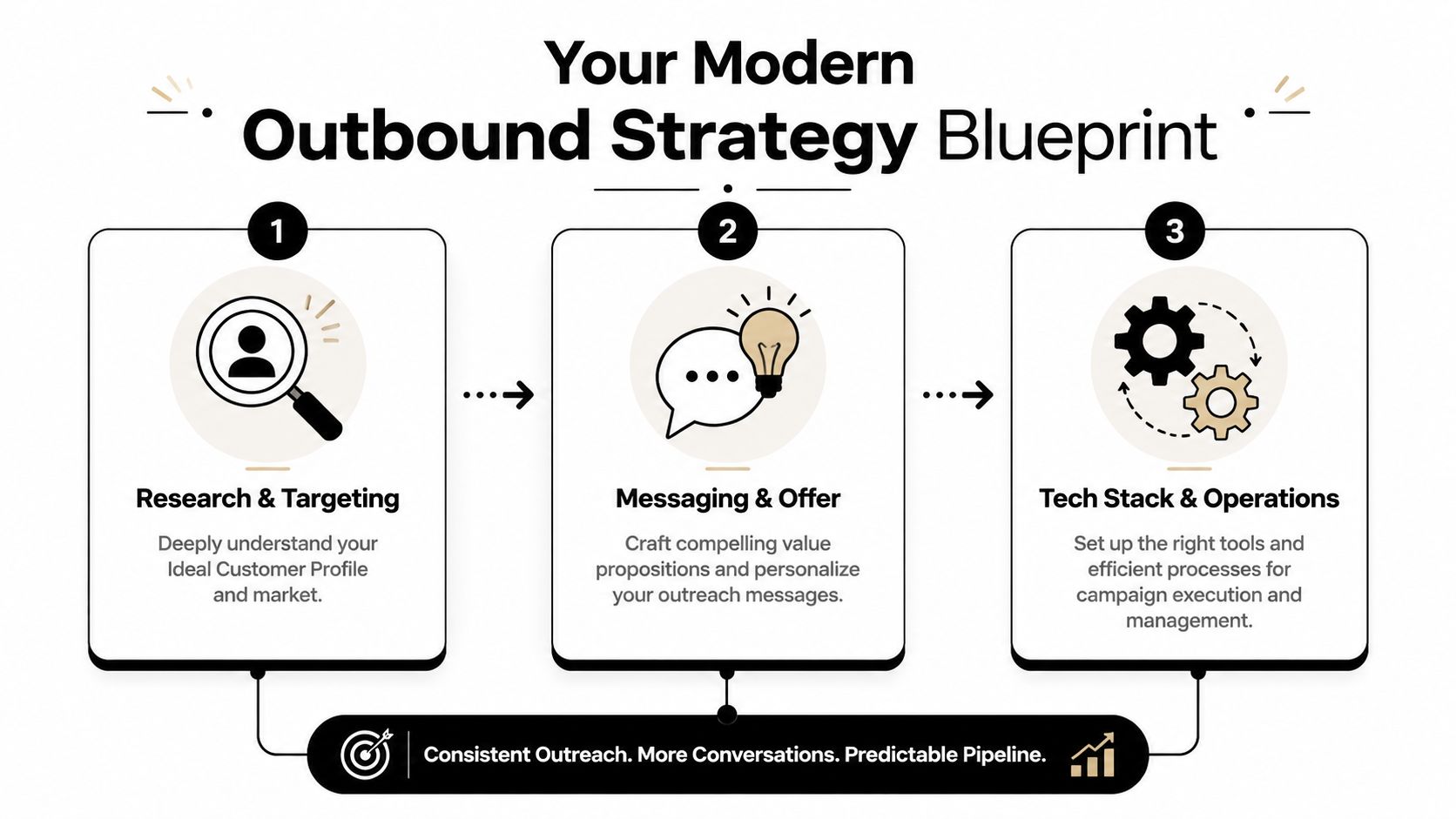
A usable strategy has three parts. The audience. The message. The operating model.
Start with ICP precision
An ideal customer profile, or ICP, needs more than industry and employee count. Those filters are too broad to support useful outreach on their own. Strong outbound programs define fit in operational terms.
That usually includes factors like:
-
Firmographic fit such as company size, geography, ownership structure, and business model
-
Technographic fit such as the tools a company already uses
-
Buying context such as hiring patterns, recent funding, or new initiatives
-
Pain visibility such as signs the problem is active enough to justify a conversation
The point isn’t to build a perfect theory. The point is to make sure sales and marketing are aiming at the same accounts for the same reasons.
Choose channels that support the conversation
Cold email is still the workhorse for most outbound B2B lead generation programs because it scales well and creates an easy path to a booked meeting. But email alone often leaves you invisible. Buyers miss messages, ignore unknown senders, or need more than one context cue before they respond.
That’s why strong teams build a simple multichannel pattern around email. LinkedIn usually plays a support role. It helps with familiarity, light validation, and follow-up context. In some cases, phone belongs in the mix too, especially when the offer is high-value and the account list is narrow.
If you’re thinking about where AI fits into this without turning your outreach into template sludge, this guide to AI lead generation for businesses gives a grounded look at where automation helps and where it still needs human judgment.
Build a sequence, not a one-shot campaign
A lot of teams still act like the first message should do everything. It won’t. One recent outbound guide notes that effective programs often require 8 to 12 touches across channels over 3 to 4 weeks in order to cut through inbox noise and inconsistent buyer attention, as outlined in Sopro’s outbound lead generation overview.
That doesn’t mean hammering the prospect. It means designing a sequence where each touch adds a little more context.
A basic blueprint looks like this:
-
First touch introduces relevance, not your full company story
-
Second touch sharpens the problem or timing angle
-
Third touch adds social or operational context
-
Later touches test a different angle, channel, or stakeholder
Teams that need a clearer model for the SDR-led side of this work can review this piece on outbound cold email and SDR-led demand generation.
Building Your High-Precision Target List
A campaign can have solid copy, clean infrastructure, and a disciplined sequence and still miss pipeline because the list was built on weak assumptions.
That failure usually starts early. The account set is too broad. Titles are pulled without checking whether those people own the problem. Contact data looks usable in a spreadsheet but falls apart once sending starts. In a performance model, that kind of list is expensive because you are not paying for activity. You are paying for qualified meetings. Every bad-fit record lowers the odds of producing one.

The standard is simple. Build a list around conversion potential, not record count.
A useful prospect record combines firmographic, technographic, and behavioral signals. The question is not whether you can collect enough names. It is whether you can identify the accounts and contacts that can realistically turn into sales conversations your team would want on the calendar.
That trade-off is clear in a Sales Echo guide on outbound lead generation. Their point is practical. A smaller, more accurate list outperforms a larger list full of guessing. Better data improves role match, personalization inputs, reply quality, and the sales team’s follow-up efficiency.
Practical rule: If you would hesitate to pay for a meeting from that account, it should not be on the list.
What a good target record actually includes
Strong list building starts at the account level and works inward to the buying group. That keeps the campaign tied to market reality instead of title scraping.
For each account, the record should usually include:
-
Company attributes such as size, geography, business model, and segment
-
Tooling clues that show likely fit, migration potential, or process maturity
-
Trigger events including hiring, expansion, funding, leadership changes, or new launches
-
Role validation so each contact is connected to the problem, budget, or implementation path
-
Contact verification so the campaign protects sender reputation instead of burning it
Weak outbound programs drift off course when teams rush to fill the top of funnel, only to discover the list is full of adjacent titles, outdated contacts, or accounts with no reason to act.
Segmentation belongs here, not after the list is already built. If you are dividing accounts by vertical, operational maturity, buying stage, or stakeholder role, this guide to email list segmentation for more relevant outreach is useful before launch.
Scraping fills spreadsheets. Enrichment builds pipeline
Raw scraping creates volume. It does not create precision.
The difference shows up fast:
| Approach | What happens |
|---|---|
| Raw scrape | More invalid contacts, weak role matching, lower relevance |
| Enriched list | Better fit, cleaner routing, stronger personalization inputs |
| Verified list with triggers | Fewer sends, more timely conversations |
The enriched and verified options take more work upfront. They also prevent a common outbound mistake. Teams spend two or three weeks testing copy against a list that was never good enough to produce qualified meetings in the first place.
That is the core list-building trade-off I make with clients. Broad data gives you more names. Narrow, verified data gives you a better shot at meetings worth paying for.
A short explainer below covers part of that data discipline in action.
The list should support multithreading
B2B deals rarely move through one contact, especially once the offer affects budget, process, or implementation.
A high-precision list should support outreach to multiple relevant stakeholders inside the same account. That usually means some mix of economic buyer, functional owner, day-to-day operator, and a second stakeholder who can confirm urgency or internal priority. Without that map, a campaign depends too heavily on one inbox and one person’s response habits.
This matters even more in a pay-per-meeting model. If one contact ignores the message, the account should still be workable through another valid path. You are building coverage inside target accounts, not collecting isolated records.
The same logic shows up outside email too. ReplyWisely’s growth reply strategy is useful here because it reflects the same operating principle. Relevance compounds when you engage the right people in the right context, instead of pushing more volume at the wrong audience.
Crafting Outreach That Earns a Reply
A rep spends hours building a solid account list, sends the first batch, and gets silence.
The problem is rarely effort alone. It is usually message fit. The email asks the prospect to understand your company before they have a reason to care. In a performance model, that mistake is expensive because meetings are the output that matters. Copy has to earn replies from accounts that match your ICP, not just fill a sequence with words.
Good outreach starts with message economics. High-value accounts deserve deeper research and a sharper point of view. Broader segments still need relevance, but the work should come from strong segmentation and role-specific messaging rather than fake personalization at scale. If every email is custom, throughput breaks. If every email sounds templated, reply rates drop and meeting quality follows.
Match the message to account value
I build outreach in tiers because the expected return is different by account.
-
Top-tier accounts get a custom angle based on a real trigger, priority, or constraint
-
Mid-tier accounts get a proven structure with a few fields adjusted for the role, company situation, or use case
-
Broader segments get clean segmentation by function, industry, or problem pattern
That trade-off matters in pay-per-meeting outbound. Time spent on copy should increase the odds of a qualified conversation you would actually accept, not just make the email sound busy.
Write from the buyer’s situation, not your offer
Cold outreach works when the prospect can quickly answer three questions: why me, why now, and why this conversation.
That means the first message needs a few specific parts:
-
A concrete opening based on something observable
-
A problem frame the buyer will recognize in their day-to-day work
-
A credible reason for reaching out that connects your offer to that problem
-
A small CTA that makes replying easy
Brevity still matters, but short copy is not the goal by itself. Clarity is. A 90-word email with a weak point still fails. A 140-word email with a sharp observation can produce meetings.
One test helps here. Remove your company name from the signature and read the email again. If it still sounds grounded in the buyer’s situation, the message is probably pointed in the right direction.
For teams refining structure and tone, this guide on how to write a cold mail that sounds specific and human is a useful reference.
Example 4-Step B2B Email Sequence
| Step | Focus | Example Snippet |
|---|---|---|
| 1 | Relevance | Noticed your team is hiring in customer success. That usually points to rising onboarding volume and more handoff pressure. |
| 2 | Problem clarity | Reaching out because teams at that stage often struggle with response consistency across expansion accounts. |
| 3 | Different angle | One thing that stood out from your setup. If account ownership is split across regions, reporting may be masking where pipeline slows down. |
| 4 | Simple close | If this is on the radar this quarter, open to a brief conversation to compare notes? |
The follow-ups should do real work too. Each one needs a new angle, a sharper observation, a stakeholder-specific point, or a clearer reason to talk. Repeating the first email with “just bumping this” trains prospects to ignore the sequence.
The same principle shows up in other channels. ReplyWisely’s growth reply strategy is a useful example because it relies on the same discipline. Short outreach gets results when it is relevant, timely, and tied to the right person.
Campaign Execution and The Art of the Follow-Up
A campaign can look solid on paper and still fail in production.
The target account list is usable. The message is relevant. The offer is clear enough to test. Then sending starts from a poorly configured domain, reply handling is inconsistent, and the sequence runs on fixed timing with no adjustment for account behavior. The result is predictable. Low inbox placement, weak response quality, and a sales team that concludes outbound is broken when the real problem sits in execution.
What happened is that the operational layer failed.
Protect deliverability before you scale
Deliverability sets the ceiling for everything that follows. If the message never lands in the primary inbox, copy quality and targeting precision stop mattering. In a performance model, that matters even more because meetings are the output you pay for. Weak setup turns every later metric into noise.
That means treating infrastructure as part of campaign strategy, not as admin work delegated after launch. Use properly configured sending domains, align authentication records, warm mailboxes in a controlled way, and monitor inbox placement during the campaign, not only after results drop. Teams that skip this step usually try to compensate with more volume. That raises risk and lowers meeting quality at the same time.
Apollo’s discussion of inbound and outbound lead generation highlights a common gap in outbound advice. Messaging gets attention. Deliverability, sender reputation, and sequencing limits get far less. In practice, those factors decide whether a campaign can produce qualified conversations consistently.
Run cadence like an operator, not a scheduler
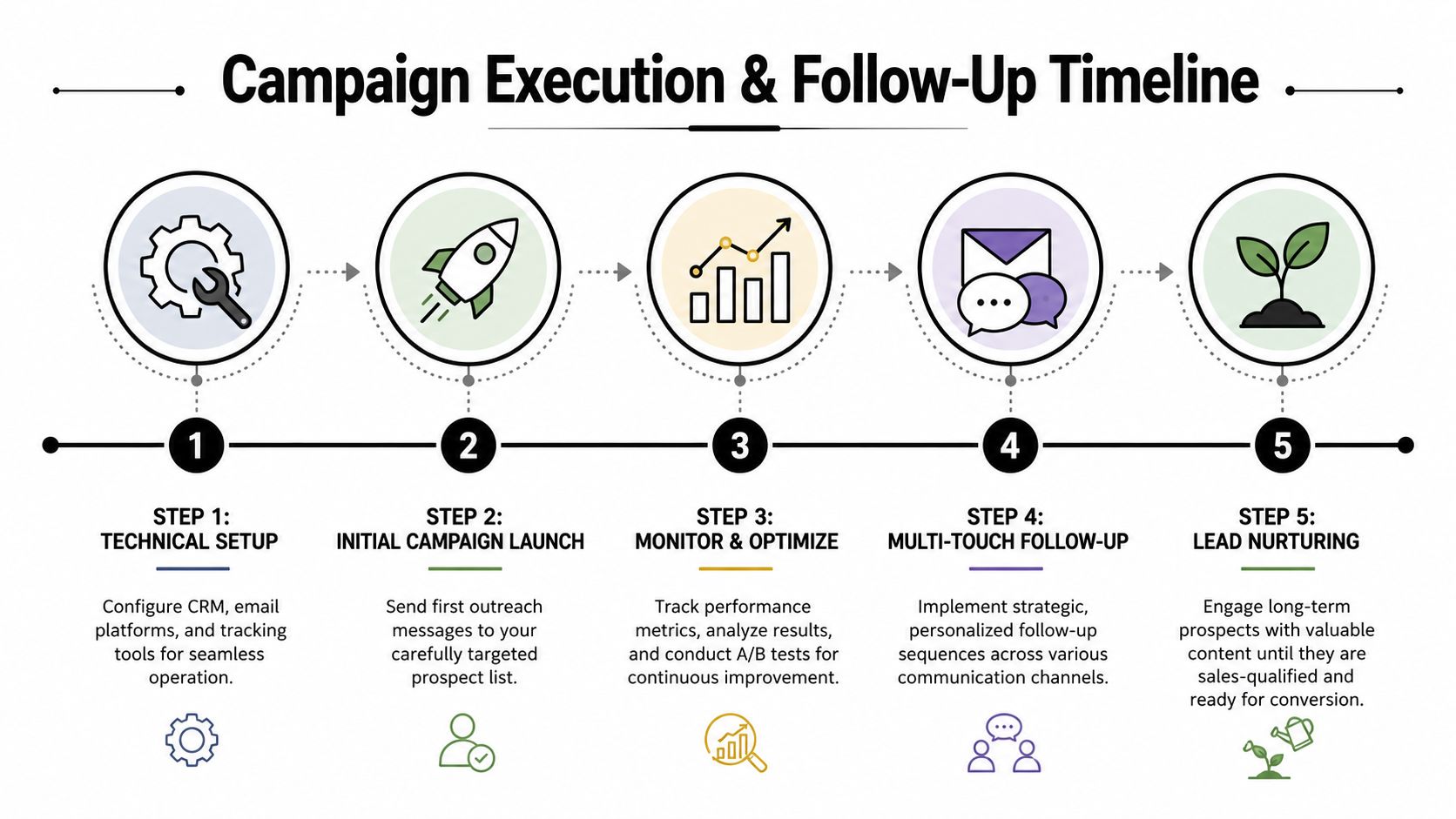
Good follow-up is structured, but it should not feel automated. A fixed sequence sent to every prospect on the same timeline usually creates one of two problems. It either pushes too hard on cold accounts or gives up too early on accounts showing quiet buying signals.
A better approach is to run cadence at the account level. Start with a clear contact plan, then adjust based on behavior, role, and signal quality. Some accounts need tighter spacing because timing is active. Others need longer gaps and a different message angle. The goal is not to maximize touches. The goal is to earn a reply or rule the account out without wasting domain health or rep time.
A practical cadence usually includes:
-
Email touches that add a new reason to respond
-
LinkedIn interactions that support recognition without forcing the ask
-
Stakeholder expansion when the first contact is not the only person involved
-
Pause and exit rules so unresponsive accounts do not absorb endless volume
Multithreading matters here because B2B buying rarely sits with one person. Reaching one contact per account creates fragile campaigns. Reaching the right small group gives you a better read on interest, internal ownership, and urgency. It also improves performance economics. If the objective is qualified meetings, the campaign should be built to create buying conversations inside the account, not just replies from a single inbox.
Keep the follow-up legally clean
Compliance affects campaign design from the start. It shapes who can be contacted, what can be said, what identification is required, and how opt-outs are handled. Teams running outreach across regions need process rules that match the markets they are entering. Fixing this after launch usually means pausing campaigns, rewriting sequences, and cleaning up preventable mistakes.
Use a simple standard before any sequence goes live. The team should be able to explain why this person is on the list, why the message fits their role, and how they can opt out. If those answers are weak, the campaign is not ready.
That discipline improves more than compliance. It improves meeting quality too. In a pay-per-meeting model, clean execution protects sender reputation, follow-up discipline protects conversion, and compliance protects the whole system from avoidable failure.
Measuring What Matters for True Performance
A campaign can look busy for weeks and still fail. Replies come in, dashboards fill up, the team feels productive, and sales still says the meetings are thin or missing. That gap is why outbound measurement has to start with one question. Are these campaigns producing qualified conversations your team would pay for?
The numbers that tell you something
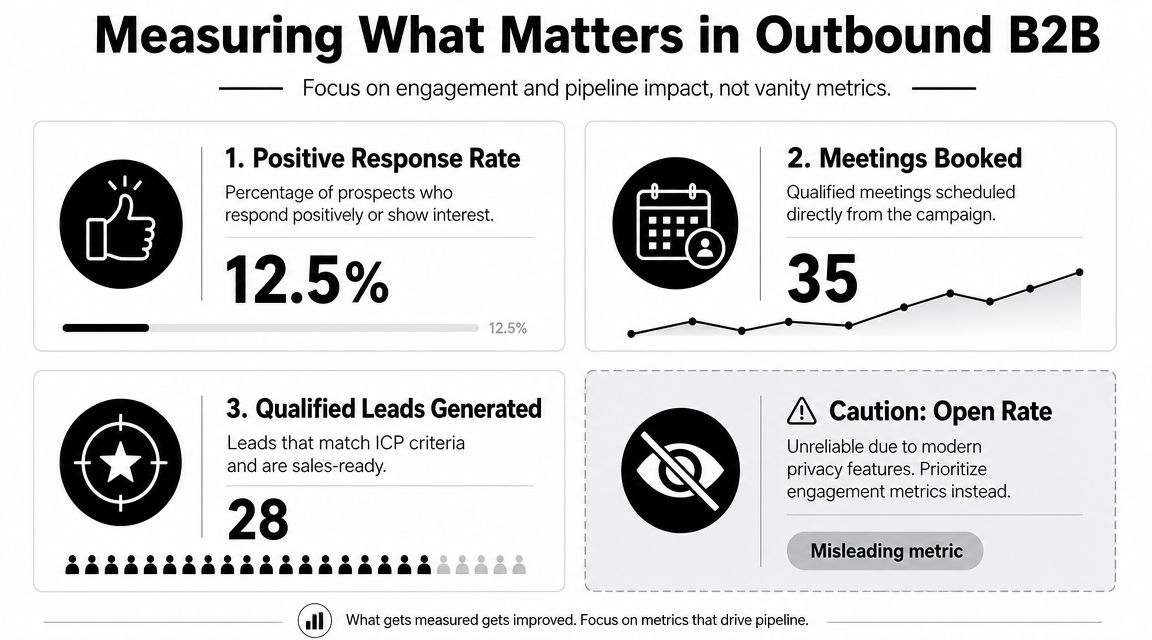
The best outbound metrics follow the path from first response to usable sales opportunity. They show whether the list is right, whether the message connects, and whether the handoff is worth the cost.
Track these first:
-
Reply rate because it shows whether the market sees enough relevance to respond
-
Positive reply rate because raw responses include pass-offs, objections, and dead ends
-
Meeting booked rate because this is the first commercial outcome, not just engagement
-
Meeting quality because booked time with poor-fit accounts does not create pipeline
-
Show rate because missed calls usually point to weak qualification, weak confirmation, or both
Benchmarks can help with context, but they should not run the program. What matters more is how each metric converts into the next one. A campaign with modest reply volume and strong meeting quality usually outperforms one with high reply volume and weak fit. That is the logic behind a pay-for-performance marketing model tied to revenue outcomes.
Open rate belongs in the background. Privacy controls and email client behavior have made it too noisy to guide decisions.
Use metrics to find the failure point
Good reporting is diagnostic. If a campaign misses target, the numbers should show where it broke.
Low reply rate usually points to one of three problems:
-
Targeting is off, so the offer is reaching people with no reason to care
-
Deliverability is weak, so the message is not landing where it should
-
Message relevance is thin, so the problem, timing, or angle does not match the buyer
If replies are healthy but meetings stay low, the issue is lower in the process.
| Signal | Likely problem |
|---|---|
| Replies with no meeting interest | Message created curiosity but did not tie clearly to a business problem |
| Positive replies but low booking | CTA asks for too much, or the scheduling step creates friction |
| Meetings booked but poor attendance | Qualification is loose, or confirmation and reminder process is weak |
Often, teams misread performance. They see response volume and assume progress. In practice, outbound works like a conversion chain. A small drop in list fit, copy relevance, or qualification standards can cut booked meetings hard, even when top-line activity looks stable.
Measure outbound by the quality of conversations it creates and the percentage that hold up once sales gets involved. That standard keeps optimization honest.
How a Pay-Per-Meeting Model Changes the Game
The cleanest way to judge outbound is simple. Would you pay for the meetings it generates?
That question changes behavior fast. It forces everyone involved to care about qualification, not just output. It also exposes the difference between activity-based outsourcing and performance-based delivery.
Why incentives matter
In a retainer model, an agency can complete tasks without producing outcomes. They can send campaigns, build lists, write copy, and report on replies. None of that guarantees a sales conversation your team wants.
A pay-per-meeting model resets the incentive. The operator only wins when a qualified prospect agrees to meet and that meeting fits pre-agreed criteria. That makes list quality, messaging, and operational discipline essential.
The practical advantages are straightforward:
-
Risk stays lower because you aren’t paying upfront for motion alone
-
Qualification gets sharper because both sides define what counts
-
Sales gets cleaner handoffs because meetings have to meet a usable standard
-
Optimization gets faster because poor-fit volume doesn’t get rewarded
It turns outbound into a managed production system
This model works best when the provider owns the messy middle. That includes market research, target list development, mailbox infrastructure, copywriting, sequencing, inbox management, and optimization. Your internal sales team doesn’t need to become an expert in deliverability and cold email operations. It needs qualified conversations on the calendar.
One agency operating on that model is Fypion Marketing’s pay-for-performance approach, which focuses on booked B2B meetings rather than setup fees or retainers. That structure is appealing for teams that already know they can close the right prospects and don’t want to fund outbound effort that never turns into pipeline.
The strongest use case is a company with proven product-market fit, a clear sales motion, and a need for more predictable top-of-funnel creation. In that setting, outbound stops feeling like a speculative marketing project and starts functioning like a controlled pipeline engine.
The standard stays the same throughout the process. Not “Did we launch?” Not “Did people open?” Not “Did the sequence run?” Just this: did the system produce meetings worth taking?
If your team has product-market fit and needs a steadier flow of qualified B2B sales conversations, Fypion Marketing is built for that model. They run cold email outbound on a pay-for-booked-meeting basis, which means you pay for qualified meetings that match agreed criteria rather than upfront setup or retainer fees.